
Tanks Parades And Tell All Displays
It’s a good thing the United States doesn’t have politically motivated military displays.
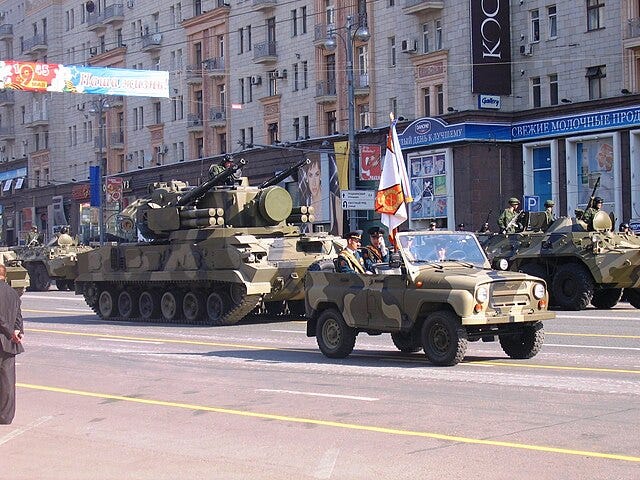
When North Korea debuts a new missile or Russia rolls out its latest hypersonic weapon in a parade, U.S. intelligence analysts swing into action. What may appear to the public as mere pageantry is, to the trained eye, a strategic data source. Open-source analysts and intelligence professionals review high-resolution imagery, track the movement of equipment before and after the event, and dissect public video feeds frame by frame. They identify unit patches, rank insignia, missile dimensions, chassis modifications, and support vehicle patterns to determine everything from range estimates to command structure. Even the sequence in which platforms appear can suggest doctrinal priorities or internal factional influence.
Serial numbers on rocket canisters, antenna placements on vehicles, or inconsistencies in paint or markings may indicate production batch information, foreign components, or retrofits to compensate for battlefield shortcomings. Equally telling are the faces and formations, who stands next to whom, which foreign dignitaries are present, and whether certain branches are underrepresented. All of it is cataloged, cross-referenced with satellite archives, and analyzed.
From just a few choreographed minutes of patriotic theater, analysts can extract volumes of insight into an adversary’s force structure, technical maturity, logistical capacity, and command dynamics, often learning as much from what is omitted as from what is revealed.
It’s a good thing the United States doesn’t have politically motivated military displays.
That’s what we will tell ourselves, at least, while tanks roll down Constitution Avenue, a reviewing stand is built for one, and elite paratroopers descend to present a flag to the president on his birthday.
To be clear: the U.S. Army’s 250th birthday deserves celebration. The men and women who wear the uniform serve with honor and sacrifice. They deserve public gratitude. But celebration should not come at the expense of strategic advantage, or become a vehicle for the personal glorification of a single leader.
On June 14, when the U.S. Army hosts its 250th birthday parade in Washington, D.C., it will be America on display, and our adversaries will be the ones taking notes.
The parade will feature troops, tanks, helicopters, dozens of vintage and modern warplanes, and combat vehicles. President Donald Trump will preside alone from a reviewing stand, coinciding neatly with his 79th birthday. Troops will bivouac in federal office buildings, horses and cannons will cross the Potomac, and fireworks will close out the day.
This scale, theatricality, and personalization around Trump blur the lines between commemoration and campaign. And while the audience on the Mall may see inspiration, adversaries in Moscow, Beijing, and Pyongyang will see opportunity.
Just as the U.S. studies adversary parades to understand emerging systems, this event offers foreign analysts a rare high-resolution look at U.S. capabilities in the open. Displayed equipment, especially tanks, drones, or aircraft, can reveal sensor configurations, armor retrofits, data link placements, and assessments of key leaders. Parade formations, spacing, and route logistics offer clues about unit structure and readiness levels. These are data points adversaries will cross-reference with satellite imagery and cyber intelligence.
This spectacle tells a story not just of national pride, but of centralized command, executive aggrandizement, and military compliance. For adversaries accustomed to using state-run media to reinforce control, the sight of a single leader receiving the flag, alone on a dais, while tanks roll past, validates their own propaganda narratives about President Trump’s “de-mocratization” efforts.
In a democracy, the politicization of the military is supposed to be a red line. Former Defense Secretary Jim Mattis once warned against precisely this kind of event, citing its corrosive effects on public trust and military neutrality. Now, those guardrails are gone, and so is any ambiguity about the optics.
“Any man who must say ‘I am the king’ is no true king.” A popular line from a television series that disturbingly applies here: true national strength doesn’t need a parade to prove itself and shouldn’t be put on display so a president can declare himself king.
America’s power lies in its values, its alliances, its innovation, and the professionalism of those who serve without needing a stage. What we risk displaying on June 14 is not resolve, but personal vanity that promotes U.S. national insecurity. Our adversaries will read it that way and be ready for the U.S. intel giveaway.
Sergio Fontanez is a U.S. Air Force veteran and deployed to Afghanistan in support of Operation Enduring Freedom. Also served as an Intelligence Analyst in the U.S. Department of State and most recently served as National Security Advisor to the U.S. Export-Import Bank. He is a member of The Steady State.
Initially founded in 2016, The Steady State is a nonpartisan, nonprofit 501(c)(4) organization of more than 270 former senior national security professionals. Our membership includes former officials from the CIA, FBI, Department of State, Department of Defense and Department of Homeland Security. Drawing on deep expertise across national security disciplines including intelligence, diplomacy, military affairs and law, we advocate for constitutional democracy, the rule of law and the preservation of America’s national security institutions.