
Doge Is Officially Dead What Did
Now that Trump and Musk’s “foreign aid replacement” has been shuttered, it’s time to tally the damage.
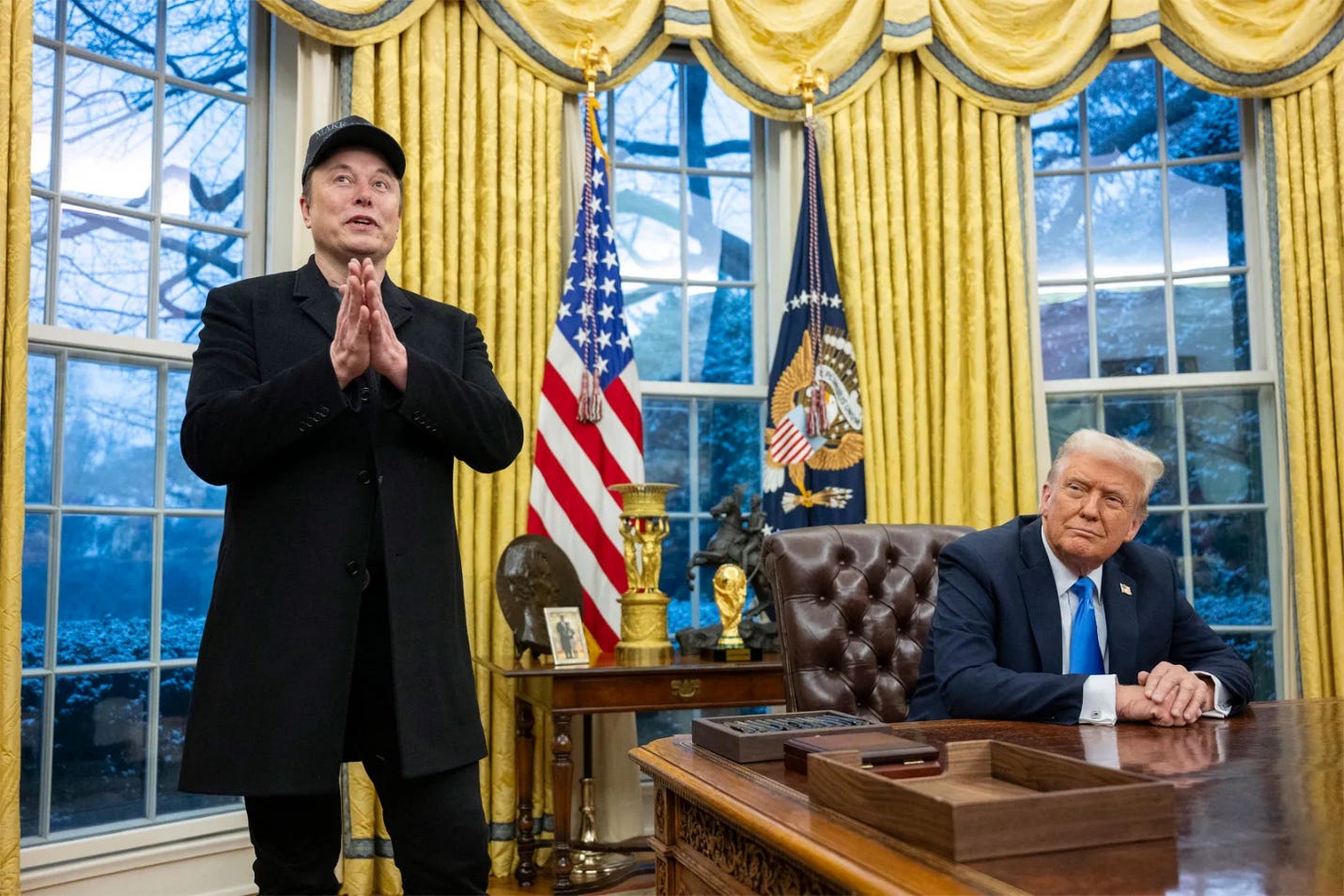
The official end of the Department of Government Efficiency (DOGE) was as abrupt as its creation. Born from a presidential signature, amplified by a Musk tweet and justified with vague claims about “saving billions,” the operation has been shut down after less than a year. Though some DOGE personnel and initiatives were absorbed into other agencies (equally terrifying if you ask me), it’s time to take stock. What did DOGE actually accomplish? The uncomfortable conclusion is that it achieved nothing beneficial. Instead it wasted money, hollowed out essential national security tools, mishandled sensitive data and contributed to preventable death on a large scale. It also failed to uncover a single instance of the “waste, fraud or abuse” that supposedly justified its existence.
The “Savings” Were Fiction—and Expensive Fiction at That
From the outset, DOGE promised astronomical budget savings by dismantling foreign assistance programs. The claim was always mathematically impossible since foreign aid is less than 1% of the federal budget, but the fiction served a political narrative. In reality, the costs of killing USAID were far higher than the cost of running it. USAID programs reduce long-term expenditures by preventing disasters, containing epidemics before they reach American shores, strengthening weak states before they collapse and supporting democracies before rival powers move in. When DOGE halted these activities, the downstream emergencies became more expensive and more frequent. Famine responses, refugee crises, disease outbreaks and conflict escalation all demanded emergency appropriations that exceeded what USAID had been spending to prevent them in the first place. To make matters worse, DOGE generated its own bureaucratic costs with consulting contracts, stalled or abandoned audits and duplicative IT systems, all without producing any usable output. By the time DOGE officially closed, no independent analysis could identify any net savings and several concluded the United States spent more because of DOGE’s intervention.
People Died Because USAID Was Dismantled
This is the most damning reality. The collapse of USAID operations cost human lives. Foreign assistance is not abstract policy, it is the lifeline for millions. When DOGE sidelined USAID, the consequences were immediate and severe. Cholera containment efforts in Haiti stalled. Malaria prevention programs across East Africa broke down. Food distribution networks in the Horn of Africa went dark just as famine conditions worsened. Civil society and humanitarian programs in Ukraine were abandoned in the middle of an active war. Disaster response operations in South Asia lost critical support as floods and earthquakes struck vulnerable populations. Humanitarian NGOs and U.S. officials warned repeatedly that these interruptions would be lethal. Their warnings were accurate. Though estimates vary, researchers and aid organizations have pointed to tens of thousands of preventable deaths caused by the abrupt withdrawal of U.S. development assistance. The moral weight of those deaths belongs squarely to DOGE’s political project.
A Blow to U.S. National Security
Echoing a point I made in a previous article, USAID is not a charity. It is a strategic asset. It stabilizes fragile regions before crises demand U.S. military intervention. It constrains the influence of autocratic rivals by strengthening democratic institutions, transparency and civil society. It reduces refugee flows, corruption, extremism and state collapse, each of which carries national security consequences. When DOGE targeted USAID, it effectively blinded and disarmed the U.S. in key regions. Stabilization missions in conflict zones lost momentum or collapsed entirely. Counter-disinformation initiatives in Eastern Europe vanished just as Russian influence operations intensified. Anti-corruption programs that protect partner governments from criminal capture went unfunded. Humanitarian corridors that keep mass displacement in check disappeared. The result was a geopolitical vacuum. China moved in with financing. Russia moved in with mercenaries. The United States meanwhile, appeared unreliable and unserious, undermining partnerships that take decades to build. No responsible official in the diplomatic or national security community believes America is safer because USAID was dismantled. Most agree the damage will take a decade or more to repair.
Waste, Fraud, and Abuse? DOGE Never Found Any.
One of DOGE’s central promises was to expose corruption in foreign aid. Yet no such findings ever materialized because the investigations never truly existed. Former DOGE staffers have described chaotic, unserious, politically motivated operations that bore no resemblance to real audits. So-called investigations consisted of downloading program descriptions from the USAID website. “Draft findings” were prepared before any fact-gathering occurred, then quietly discarded when they could not be substantiated. Political operatives with no development experience were tasked with reviewing complex, technical programs that they did not understand. The result was predictable. DOGE failed to uncover a single case of systemic waste, fraud or abuse. The only thing it exposed was its own ignorance.
In the End, DOGE Was About Ideology—and Musk’s Access
The motivations behind DOGE were not fiscal. They were ideological and personal. Trump has long viewed foreign aid as a scam, largely because he does not understand it and resents money flowing anywhere beyond U.S. borders. Musk, meanwhile, cast foreign assistance as “woke globalism,” dismissing the national security logic that has guided both Republican and Democratic administrations for decades. DOGE gave them a way to dismantle an agency they disliked on instinct.
And as a bonus, Musk gained access to a vast amount of sensitive information, including social security, IRS and federal employee data. Rumors abounded regarding the creation of a national database, the very antithesis of Privacy Act provisions. And while there has been no definitive proof presented publicly that Musk directly used U.S. private data for his own companies, the unprecedented and largely unfettered access to the data and the lack of transparency surrounding its handling are central to concerns raised by privacy advocates, legal experts and whistleblowers.
The Bottom Line
Now that DOGE is officially dead, its legacy is clear: no money saved, no corruption uncovered, tens of thousands of preventable deaths, a weakened U.S. security posture, abandoned allies and a private tech mogul who gained access to information no private citizen should ever hold. DOGE did not reform foreign aid. It dismantled it, quickly, destructively and pointlessly. And now the country must rebuild an agency that, before DOGE, quietly advanced U.S. interests, saved lives and strengthened democratic partners at remarkably low cost. The real question isn’t what DOGE achieved. It’s what America lost –and may be continuing to lose– in the process.
Bruce Berton served as a U.S. diplomat for over three decades, ultimately rising to the senior ranks of the Foreign Service, including two years as Ambassador and Head of Mission at the Organization for Security and Cooperation in Europe’s (OSCE) Mission to Bosnia and Herzegovina. He is a native of the Pacific Northwest and a graduate of Pacific Lutheran University. He is a member of The Steady State
Founded in 2016, The Steady State is a nonprofit 501(c)(4) organization of more than 360 former senior national security professionals. Our membership includes former officials from the CIA, FBI, Department of State, Department of Defense and Department of Homeland Security. Drawing on deep expertise across national security disciplines including intelligence, diplomacy, military affairs and law, we advocate for constitutional democracy, the rule of law and the preservation of America’s national security institutions.