Donald Trump And The Concept Of Power
In November, 2024, American voters elevated Donald Trump to be the most powerful man in the world. Not, however, with the majority he claims (which, he insists, gave him a mandate to pursue a radical agenda). He came close, but he prevailed with only a plurality: more voters chose somebody else. But he has brushed this fact aside, and his Presidency, as seen on many international and domestic policy fronts, has primarily consisted of claiming and wielding ever more legally doubtful power.
Yet this power-obsessed man has a narrow, one-dimensional understanding of the concept of power.
As a recent article in “Vanity Fair” described it (The Godfather Presidency: How Donald Trump’s Governing Style Mimics the Mob | Vanity Fair), he behaves like a “mob boss,” exacting revenge for a long list of grievances and dispensing and revoking favors to his toadying subordinates. At this activity, he is quite skilled: he has remade the Republican Party into his own cult, he has cowed the Republican majorities in both houses of Congress, he has bent law enforcement authorities into pursuing his personal political enemies, he has persuaded much of the judiciary to accept wobbly and far-fetched interpretations of law, and he has lied his way to the almost unshakable support of about a third of the American electorate.
More crucially for national security, however, he knows nothing about how to exercise American power for the benefit of the United States, in conformance with the Constitution, existing law, or the oath of office he swore. Even worse, he is not even aware that he does not understand this.
Having rapidly discarded traditional and proven sources of American power, Trump has three methods for dealing with other countries: immediate coercion, farther-reaching threats, or giving in. He is most comfortable swinging a two-by-four at weaker nations. This has some very limited, short-term effectiveness: since everyone would prefer to avoid the blows, affected foreign leaders will do a lot to ward off serious injury. (However, they are not likely to forget the insult, which will redound to our detriment sooner or later.) To those he cannot immediately intimidate, he is fond of making threats, most of which are poorly thought through and often subject to revision, extension, or even revocation if they don’t achieve their ends. When facing the really tough problems (e.g. Gaza or Ukraine), or tough opponents (e.g. Putin or Xi), Trump, having run out of options, either begs, issues meaningless deadlines, or caves in and turns away to something else. Very little has been heard from him, for example, or seen in international diplomatic activity, about ending the war in Ukraine since he spent several hours in Alaska bowing and scraping to an intransigent Putin.
Trump came to office thundering that his predecessors had made so many mistakes that the world did not take America seriously anymore. But a current piece in the “Atlantic” magazine (The World No Longer Takes Trump Seriously – The Atlantic) exposes this nonsense. The article begins: “The leaders of Russia, China, and North Korea are not good men. They preside over brutal autocracies replete with secret police and prison camps. But they are, nevertheless, serious men, and they know an unserious man when they see one. For nearly a decade, they have taken Donald Trump’s measure, and they have clearly reached a conclusion: The president of the United States is not worthy of their respect.” Only the other day, in an unmistakably glaring example, Xi, accompanied by Putin and Kim, did not even think it necessary to invite the American President to a very public commemoration of World War II victory in the Pacific.
All this is bad enough and heightens, not diminishes, the international risks to the United States. But there is something else about power completely foreign to Trump. Sometimes, restraining one’s power is the most intelligent thing to do. It’s hard to be certain, but Trump’s Cabinet and other advisers behave as if they do not understand this, either.
Deploying U.S. military force to destroy an alleged drug-running vessel in international waters, for instance, far from the United States and posing no direct threat, might seem like a logical show of strength, but there is little in either practical or legal terms to separate it from an act of piracy, a practice long and universally condemned. While this “feel good” act might conceivably make an impression on those orchestrating international drug flows, it is more likely to be either a “one off” lashing-out or possibly a first step in a spray-gun, clumsy use of the U.S. military. (Certainly, Trump’s boasts, directed so far primarily at Venezuela, suggest such a direction.) Given the sophistication and geographic reach of Mexican and South American drug cartels, however, we are more likely to see – absent a major, far-reaching, complicated, and thus risky commitment by the U.S. — what amounts to technically skillful but haphazard action than anything reflecting well-designed counter-narcotics strategy.
Trump has wildly insisted that parts of the world belonging to others – Greenland, Canada, the Panama Canal – must be his instead, because he wants them. But we can juxtapose to this infantile greed a time and a place where, in the cockpit of the Cold War, the U.S. did possess ultimate sovereignty. From 1945 until 1990, Greater Berlin (divided into four sectors) legally remained under military occupation by the World War II allies Britain, France, the Soviet Union, and the United States. Neither East nor West Berlin belonged legally to any independent state. Consisting of American, French, and British sectors, West Berlin, despite being surrounded by hostile military fortifications (the Wall was only a part of these barriers), 400,000 Soviet and 200,000 East German troops, remained a thriving showcase of Western freedoms. Presumed to be at the time, and then confirmed after the 1991 fall of the Soviet Union, those troops were part of an envisioned invasion force that would sweep into Western Europe after quickly overrunning West Berlin.
The question for the U.S. and its two partners was how to keep the city and its several million residents free in the face of decades of Soviet threats and pressure. While firmly resisting those efforts, we chose, wisely, to exercise our power over Berlin’s inhabitants sparingly and judiciously. For most purposes, the city was functionally its own boss. But there were certain things it was not allowed to do, or certain things it could do only with our permission, or certain things it could do but only after notifying us. During my years in the city in the 1980’s as a U.S. official, West Berlin’s government was required to report weekly to me and my British and French colleagues on its work. We possessed with this arrangement enormous authority, but as the nation which after victory in 1945 brought democracy to Germany, it would have been nonsensical (as well as foolishly counterproductive) for us to use anything but a very light touch in wielding it. The Soviets chose the opposite strategy in “their” sector – East Berlin — never letting the local German authorities forget who was really in charge — an international mark of shame, the main reason that ordinary East Germans led a quite different and much more unhappy existence, and a direct factor leading to the collapse of the Soviet Union’s front-line buffer state, East Germany.
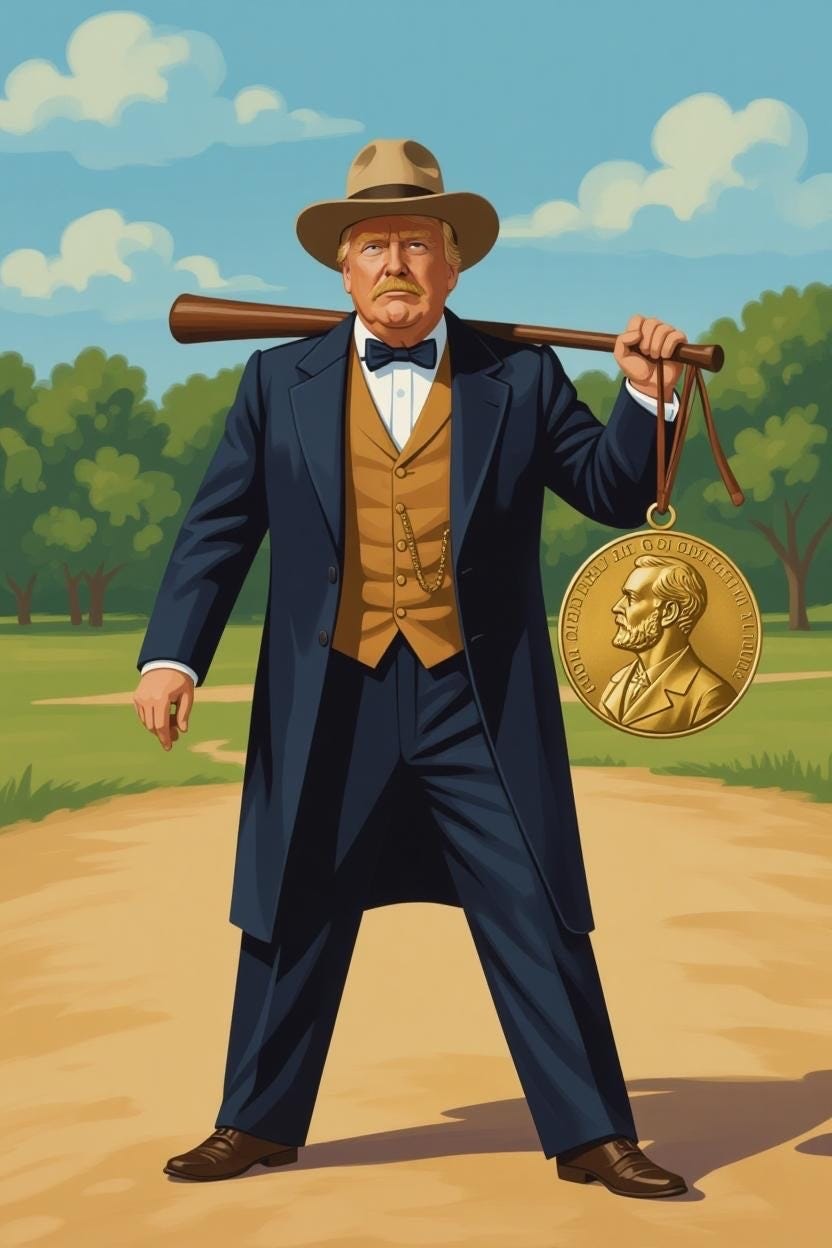
Trump’s misunderstanding of power, and his failure to use it wisely, can even be reduced to a cartoon: he is shamelessly campaigning for a Nobel Peace Prize, while at the same time trumpeting that renaming the Department of Defense the Department of War demonstrates that America is top dog. Yet American power is declining almost in inverse proportion to Trump’s insisting it is supreme. Most American high-schoolers understand what Teddy Roosevelt’s advice to “speak softly and carry a big stick” meant. While Roosevelt’s maxim is not necessarily the best guide to action in all cases, it is sadly beyond Donald Trump’s ability to grasp. The U.S. and the world suffer accordingly.
Tom Wolfson is a former senior U.S. diplomat who has lived and worked in six foreign countries, occasionally multiple times. His work representing the U.S. has included assignments at the United Nations, in the U.S. Congress, and with an international democracy-building organization. He is a member of The Steady State.
Founded in 2016, The Steady State is a nonpartisan, nonprofit 501(c)(4) organization of more than 300 former senior national security professionals. Our membership includes former officials from the CIA, FBI, Department of State, Department of Defense and Department of Homeland Security. Drawing on deep expertise across national security disciplines including intelligence, diplomacy, military affairs and law, we advocate for constitutional democracy, the rule of law and the preservation of America’s national security institutions.