
He Thinks Hes The King One Year After
HELOISE KROB / FRANCEINFO / GETTY IMAGES)
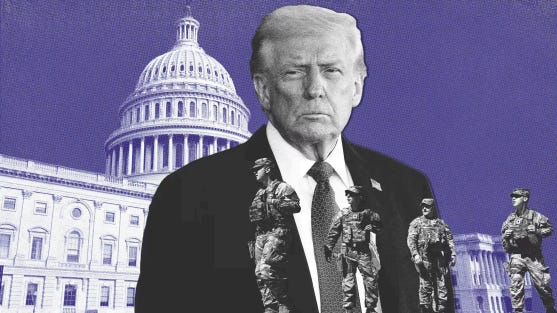
Since his inauguration in late January 2025, Donald Trump has made numerous actions that, according to experts, are blows to American democracy.
Since returning to the White House, the American president has relentlessly sought to increase his powers and extinguish all opposition to the government, to the point of permanently weakening American democracy.
“We are in the midst of an authoritarian moment.” The warning was issued by Oregon Democratic Senator Jeff Merkley during a speech lasting more than 22 hours before the Senate on October 22. The senator sought to prove that Donald Trump is “tearing the Constitution to shreds” and “thinks he’s the king” of the United States, according to The New York Times.
Concern is also growing among many experts, as the Republican billionaire celebrates the first anniversary of his re-election to the White House on Wednesday, November 5. .
The Steady State, a nonpartisan organization of former US intelligence officers, published a report in mid-October. asserting that the United States is sliding “ toward competitive authoritarianism: a system in which elections, courts, and other democratic institutions still exist, but are manipulated to strengthen executive control .” To reach this conclusion, the authors “applied the same methodology used by intelligence agencies for authoritarian foreign countries ,” explains Steven Cash, executive director of The Steady State.
The conclusion, according to him, is inescapable. “When dictators seize power, they almost always do the same thing: attack the media, force universities and institutions to adopt the executive branch’s viewpoint, and put pressure on the judicial system,” lists this former prosecutor and ex-CIA member. Under Donald Trump, the United States “checks all these boxes,” he asserts.
“Eliminate” all internal dissent
Since his inauguration at the end of January, the 79-year-old politician has issued numerous decrees. “ Attacking democratic institutions and norms ,” adds Brian Klaas, a political scientist at University College London (UK). “He seems to be violating all sorts of laws, for example with his attempt to unilaterally reallocate federal funds—which Congress normally controls—or by bombing ships in the Caribbean and the Pacific Ocean, which amounts to executions,” as part of his declared war on drug traffickers. Donald Trump also tried to abolish birthright citizenship . or even imposed customs tariffs on dozens of countries – prerogatives which, according to the American Constitution, do not belong to the head of state.
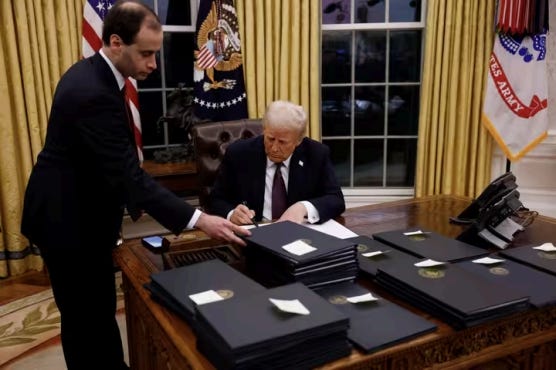
Donald Trump signs dozens of executive orders on the first day of his second term, January 20, 2025, at the White House in Washington, D.C.
(ANNA MONEYMAKER / GETTY IMAGES NORTH AMERICA / AFP)
To gain a free hand, the president made sure to “eliminate” all opposition within the administration by orchestrating a massive purge of government agencies, notes Ludivine Gilli, director of the North American Observatory at the Jean-Jaurès Foundation. “In the first week of his presidency, some fifteen inspectors general” and other officials “responsible for ensuring ethics within the government” were dismissed, the historian recalls. Their positions, supposed to be independent of political power, are now filled by civil servants loyal to the president. During his first term, he had faced “internal resistance.” who had notably leaked information to the press.
One year after Donald Trump’s re-election, the United States faces the risk of an authoritarian drift. This purge also serves to better control the image of the head of state. Ludivine Gilli cites a “symbolic” example : the dismissal of the commissioner in charge of the employment statistics office. She was ousted after disappointing unemployment figures. “The president is preventing the release of neutral data because it contradicts his rhetoric,” explains the historian. “Suppressing or manipulating statistics that don’t suit the government is a characteristic of authoritarian regimes.”
This situation is all the more worrying given that the external checks and balances on the administration are also largely weakened . Congress has “abandoned its purpose,” the New York Times denounced . late October. The reason: the Republican majority, in both the Senate and the House of Representatives, refuses to oppose the president’s abuses of power. Unlike during his first term, few conservative elected officials still dare to criticize Donald Trump, for fear of seeing him support other candidates in the next election. .
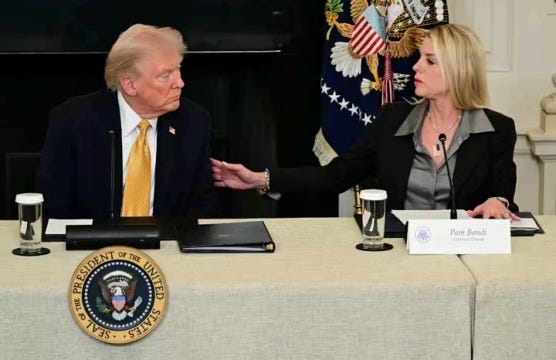
Freedom of expression has been “redefined by Donald Trump ,” observes Ludivine Gilli. “It’s no longer the freedom to express one’s opinion, whatever it may be, but the freedom to say that one agrees with him.” In September, the Attorney General stated that the administration would “target” any critic of Charlie Kirk, a far-right, pro-Trump influencer who was murdered at a rally. At the same time, the head of the Federal Communications Commission (FCC) threatened to revoke the licenses of the networks broadcasting comedian Jimmy Kimmel’s talk show, after Kimmel made a pointed remark about Trump supporters’ reactions to the murder. As a result, ABC suspended the show for several days. .
This is just one example of the administration’s repeated attacks on the media. “The Associated Press was denied access to the Oval Office. “ for refusing to use the name ‘Gulf of America’ to refer to the Gulf of Mexico ,” as decided in a presidential decree, Ludivine Gilli points out. Furthermore, the New York Times and the Wall Street Journal “were targeted by lawsuits from Donald Trump.” , which accuses them of having partisan coverage . “
“Using financial and political means, the administration puts pressure on media owners to muzzle, suspend, or steer their media coverage in a direction favorable to the administration.” According to the expert, Donald Trump is in the process giving “carte blanche to ideologues like [his deputy chief of staff] Stephen Miller,” who comes from xenophobic nationalist circles . These advisors “are behind measures such as rewriting the history of slavery in museums and attacks on the federal government,” she continues. And the pressure exerted on universities, notes The New York Times. In recent months, the Trump administration has offered “preferential funding” or, more often, subjected universities to administrative or judicial investigations to force them to abandon their diversity policies, notes the American public radio station NPR.
A risk of “election manipulation”?
For Steven Cash, the increased use of police and military forces is one of the most striking signs of this drift. Immigration and Customs Enforcement (ICE), tasked with the mass arrest of migrants for deportation, “operates largely outside the law and without any oversight, “ functioning “like a paramilitary group ,” the expert believes. Since the beginning of the summer, the president has also deployed National Guard reservists in five Democratic cities. Los Angeles, Washington, Memphis, Chicago, and Portland. He justifies this mobilization “by invoking riots and a risk of civil war, which, in reality, does not exist ,” notes Ludivine Gilli. “I am not a dictator, I am a man of common sense, an intelligent person ,” Donald Trump asserted at the end of August, responding to criticism on the subject.
The White House seems ready to go even further. At the end of October, The Guardian… An internal Pentagon memo has been revealed, ordering the National Guard to create “rapid response forces” in each state. According to the president of a veterans’ association
“He thinks he’s the king”: One year after Donald Trump’s re-election, the United States faces the risk of an authoritarian drift quoted by the British newspaper, this is “an attempt by the president to normalize a militarized police force ,” which could be used as a means of exerting pressure. to influence the results of the next elections.
The “best chance to slow” this drift is a Democratic victory “in one of the chambers of Congress during the 2026 midterm elections ,” says Brian Klaas. “But there are clear signs that the Trump administration and Republicans in several states are preparing to manipulate these elections ,” he argues. At the White House’s request, authorities in Texas, North Carolina, and Missouri have approved redistricting aimed at ensuring that conservatives retain a majority in Congress. Democrats have since undertaken to do the same in some states, to compensate for potential losses.
“These redistricting decisions are ethically questionable, but legal ,” notes Ludivine Gilli. However, “we cannot rule out other illegal and anti-democratic acts during the elections ,” the historian believes. “This could take the form of uncounted votes, a postponement of the election, the invocation of a state of emergency, or simply threats against voters ,” lists Steven Cash. The former prosecutor is also concerned about the announced deployment of “federal observers” to monitor the elections in certain Democratic-majority states, such as California and New Jersey. “If these observers are military personnel or ICE agents, Hispanic voters might not go to the polls for fear of being arrested.”
“I believe there is a fifty-fifty chance that the United States will not have another free election in my lifetime. (…) The Midterms will be the key moment to determine which direction the country is going in, and at what pace.”
Faced with these attempts by the president to further increase his power, the decisions of the Supreme Court will be particularly scrutinized. It must rule on several major measures of the Trump administration by the summer of 2026. The conservative-majority court, guarantor of the rule of law, has already given signs “that it might not oppose Donald Trump very firmly ,” according to Ludivine Gilli. “But how far will it let him go?”
Civil society represents another safeguard. On October 18, 7 million people demonstrated. at the call of the “No Kings” movement, during one of the largest mobilizations in the country’s history. But optimism remains limited. “The future looks particularly bleak because all these deteriorations of democracy have occurred in less than a year,” laments Brian Klaas . “There are still more than three years to go.”
Founded in 2016, The Steady State is a nonprofit 501(c)(4) organization of more than 360 former senior national security professionals. Our membership includes former officials from the CIA, FBI, Department of State, Department of Defense and Department of Homeland Security. Drawing on deep expertise across national security disciplines including intelligence, diplomacy, military affairs and law, we advocate for constitutional democracy, the rule of law and the preservation of America’s national security institutions.