
In Another Turbulent Time A President
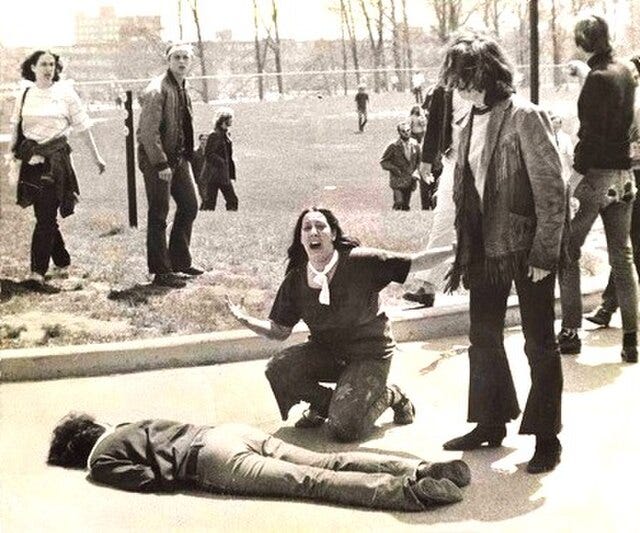
Mary Ann Vecchio, Kent State, May 4, 1970
At this moment, the citizens of Washington D.C., and Los Angeles, California are facing National Guard troops, as well as FBI agents and other military and law enforcement officers in their streets. These officers and agents are not trained to police the streets, and they are listening, hourly, to Trump, his cronies, and his Fox News mouthpieces spew venom and nonsense about the area they are policing; the residents of D.C. and LA know that the Trump comments about each of their cities are exaggerations at best, and flat out lies at worst.
We are moving toward a situation that, in many ways, mirrors the afternoon of 4 May 55 years ago in Kent, Ohio.
In the Spring of 1970, life was moving along as I was thinking of where I would apply to college. It was a time to consider questions that would affect most of the next stages of my life. And, all of a sudden, the atmosphere in which I was living and thinking blew up, changing the data I was considering. On May 4th, 4 students at Kent State University in Kent, Ohio were killed, and 9 students were injured by Ohio National Guard troops. And the mindset of the American people – both pro and anti-Vietnam War, pro and anti-President Richard Nixon, and pro and anti the anti-establishment movement in the country, was altered and hardened forever.
The Vietnam War was increasingly unpopular, in part because the media coverage ensured that what was happening on the battlefield was on television screens all over the country every night. And, there were photographs of horrific battle scenes in every issue of every daily or weekly newspaper and magazine around the country.
Richard M. Nixon, elected president in 1968, was growing more unpopular and embattled. He had won the presidency by promising to end the Vietnam War. The preceding five years had witnessed a significant troop buildup in Vietnam, fueled by a draft that meant that every young man in the country had to fear being dragged into the quagmire the Vietnam War had become. In the spring of 1970, the US troop presence in Vietnam was some 540,000 people.
The protests, which had begun in earnest in 1965, were growing in size and included students, mothers, and anti-establishment figures, later joined by veterans, clergy, lawyers, academics, and others. Across the country, more and more people were demonstrating, with more and more rage, more and more frustration, and more and more fury at the state of the country, at the president and his actions. From March through April of 1970, student protests on college campuses were also increasing in numbers and frequency, and Kent State University in the town of Kent, Ohio, about 30 miles south of Cleveland, was no exception. That spring, Nixon announced that he was planning to end deferments for fathers and would end student deferments as soon as Congress authorized him to do so.
On April 30, President Nixon announced that he had approved and directed the US military to move into Cambodia, which fanned the flames of protest. Kent University was one of many sites of demonstrations, at which protestors were getting angrier and angrier, and on May 1, LeRoy Satrom, the Mayor of Kent, asked the governor of Ohio, James Rhodes, to mobilize the Ohio National Guard. On May 3, 1200 Guard troops, having just taken part in a police action against striking truckers, arrived in Kent. On that night, students, frustrated at the lack of university response to their protests, blocked an intersection at the edge of the university’s campus. There was a confrontation: the National Guard troops dispersed the students, using bayonets and tear gas. The next day, May 4, at about 3:00 pm, at Kent State University, the Guard troops and the students faced off. Four unarmed students were killed, and nine were wounded; of the nine wounded, one was permanently paralyzed from the waist down.
How could this have happened? Despite numerous “studies” there has never been a complete or satisfying answer to why the Guard opened fire. Tension was high; the National Guard had scant training and even less experience policing civil demonstrations. They had travelled to Kent State after having taken part in a police action against striking workers, and walked into a tense situation opposite students who were venting their anger about the war, and about Nixon’s promise to end deferments. The country was deeply divided, politically, culturally, and by the continuing failure to end the Vietnam War. The two sides were unable to communicate, unwilling to compromise, and each had and believed wildly different views of the country and each other. Each side vilified the other, and each side mocked the other. Tensions were so high that it is, in some ways, stunning that more people on each side hadn’t been hurt before May 1970.
As a nation, we are, in 2025, in a similar place, looking at similar events and situations, and potentially similar outcomes as we saw in 1970. The National Guard, military, and law enforcement have been dispatched, for not always justified reasons, and in LA’s case, on tenuous legal grounds, to serve a purpose for which they have not been trained. The citizens in LA and DC are frustrated and angered by the actions, words, and policies of the Trump administration. Should the worst outcome of the Federal takeover of security in Washington, D.C., and Los Angeles come to be, and there is a repeat of shooting unarmed civilians, it will come as no surprise. And responsibility must sit squarely on the shoulders of the President of the United States, on every member of the Trump Administration, and on every member of the Republican Senate and House, each of whom refuses to lift even one finger to respond to or limit Trump’s reckless actions.
Margaret Henoch served in the Clandestine Service of the CIA for 25 years, at Headquarters and in the field, focusing on operations and counterintelligence and retiring as a Senior Intelligence Officer. She is a member of The Steady State.
Founded in 2016, The Steady State is a nonpartisan, nonprofit 501(c)(4) organization of more than 300 former senior national security professionals. Our membership includes former officials from the CIA, FBI, Department of State, Department of Defense and Department of Homeland Security. Drawing on deep expertise across national security disciplines including intelligence, diplomacy, military affairs and law, we advocate for constitutional democracy, the rule of law and the preservation of America’s national security institutions.