
Rethinking The Military Law Enforcement
For generations, American law and public discourse have treated the use of the military in domestic law enforcement as a red line not to be crossed. This concern—rooted in the Posse Comitatus Act of 1878 and in the Founders’ deep mistrust of standing armies—has shaped our legal frameworks and guided political norms. The fear is clear: soldiers patrolling American streets, answering not to local communities but to federal authority, threatens democratic self-governance and invites authoritarian overreach.
But while legal scholars and civil libertarians have long focused on this version of the danger—the Army deployed as police—there is another, quieter, and perhaps more insidious threat that demands attention: the transformation of police into an army.
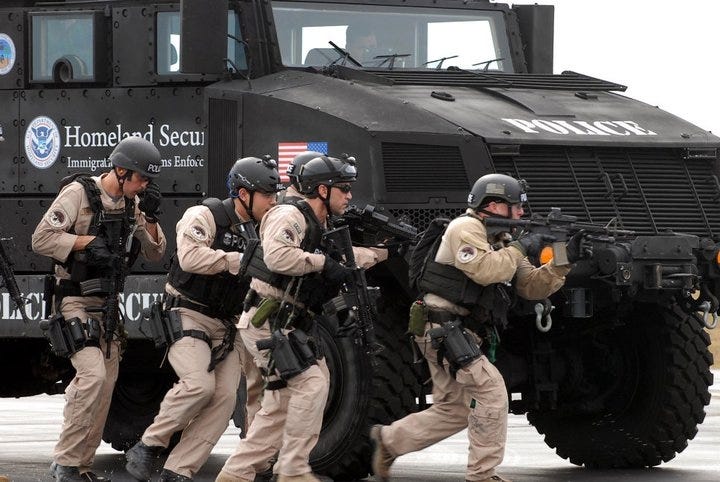
Over the past several decades, American law enforcement agencies have steadily adopted the tools, tactics, and culture of the military. Through federal programs like the Department of Defense’s 1033 Program, surplus military equipment—including armored vehicles, assault rifles, and tactical gear—has been transferred in bulk to local police departments, often with little training or oversight. At the same time, the proliferation of SWAT teams, originally intended for rare high-risk situations, has normalized the use of military-style raids for routine policing operations, including the execution of search warrants or the arrest of nonviolent suspects. Police departments have recruited many new officers from soldiers returning from two decades of warfare in the Middle East and elsewhere. The Department of Homeland Security has pioneered the use of federal intelligence to support policing, drawing on practices developed to support armies in the field, not police officers enforcing laws. More and more we see our police officers dressed like soldiers, armed like soldiers, patrolling like soldiers, and trained like soldiers.
But the problem goes deeper than hardware. Increasingly, law enforcement agencies mirror military organizations in their hierarchical command structures, warrior ethos, and “us vs. them” mentalities. Officers are increasingly trained to view their work as a form of combat — their training and deployment terminology echoes common parlance —fighting a “war on drugs,” and “war on crime”. This shift fundamentally alters the relationship between police and the communities they serve. In a democratic society, law enforcement is meant to be a guardian—not a warrior.
When police adopt the mindset of soldiers, they begin to see the public not as citizens with rights, but as potential threats to be neutralized. This inversion of the traditional civil-military divide changes the very nature of public safety. The problem is no longer only that the Army might be used to police citizens, but also that police have come to see themselves as an army, an occupying force.
This reality demands a reframing of the national conversation. The risk is not just that the military will overstep its constitutional limits; it is that the lines between civil and military power will dissolve altogether—not necessarily from above, but from within. In a time when trust in public institutions is fragile and when democratic norms are under stress, we must reaffirm the principle that the role of the police is not to conquer, but to protect.
The events of the past weeks, with images of camo-clad, helmeted “soldiers” in the streets of Los Angeles drive home the image. Masked, without badges, and with the only indicator of traditional policing a vestigial patch saying “POLICE” on their chest, these federal and state law enforcement are, in every meaningful respect, soldiers, not police officers.
Reversing the militarization of law enforcement will not be easy. It requires not only policy change but cultural change: ending the transfer of military equipment, rethinking training and tactics, restoring community policing models, and investing in accountability and transparency. But above all, it requires remembering a basic truth: in a democracy, the state serves the people—not the other way around.
Steven A. Cash served as a former prosecutor in the Manhattan District Attorney’s office before joining the CIA in 1994 as Assistant General counsel and subsequently serving as an intelligence officer in the Directorate of Operations. In 2001 he joined the Senate Select committee on Intelligence as Counsel and designee-staffer to Senator Diane Feinstein). He later served as a Minority Staff Director of the House Select Committee on Homeland Security, Chief of Staff to the Department of Energy’s Office of Intelligence, and Minority Chief Counsel. In the private sector he has advised on national security, counterintelligence, and technology policy and served on the Biological Sciences Experts Group under the Director of National Intelligence. Most recently, Mr. Cash served as Senior Advisor to the Under Secretary, Intelligence & Analysis, at the Department of Homeland Security. Mr. Cash is currently the Executive Director of The Steady State.
Founded in 2016, The Steady State is a nonpartisan, nonprofit 501(c)(4) organization of more than 300 former senior national security professionals. Our membership includes former officials from the CIA, FBI, Department of State, Department of Defense and Department of Homeland Security. Drawing on deep expertise across national security disciplines including intelligence, diplomacy, military affairs and law, we advocate for constitutional democracy, the rule of law and the preservation of America’s national security institutions.