
The Alts Civil Society Digital Dissent
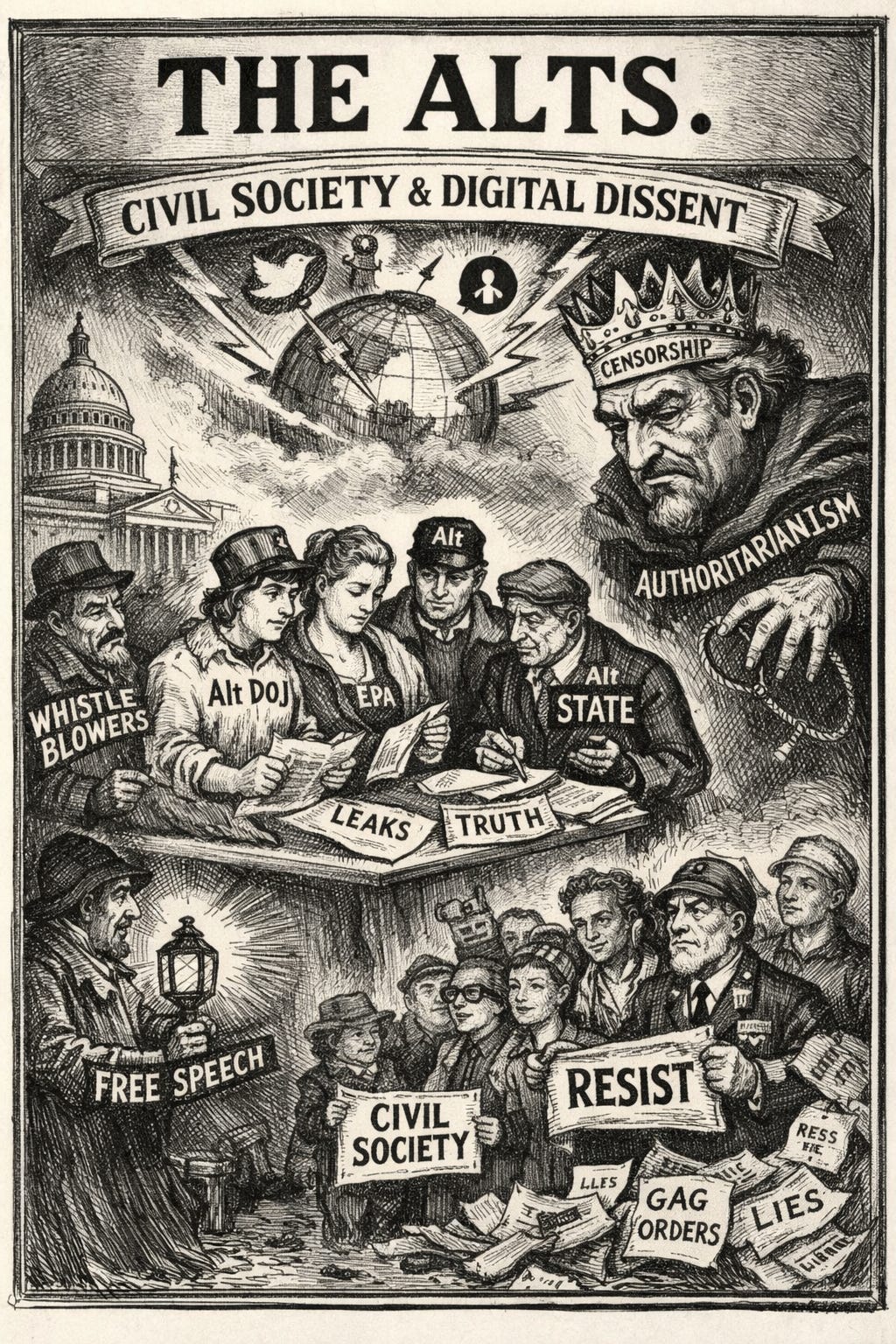
Over the past year, a quiet but notable development has taken shape across social-media platforms, particularly on X (formerly Twitter) and Bluesky: the growing visibility of accounts styled as “Alt” versions of government agencies — Alt DOJ, Alt State, Alt EPA, and dozens of variations beyond. These accounts are often operated by former federal officials or closely aligned professionals, many of whom once worked inside the very institutions whose names they now echo. What might initially appear as a niche online phenomenon is, in fact, something more consequential: an emerging civil-society movement that reflects democratic resilience in the face of authoritarian pressure.
This trend received early journalistic attention in a February 2025 article (#AltGov: the secret network of federal workers resisting Doge from the inside”) by Timothy Pratt in The Guardian, which examined the rise of “AltGov” networks and their role in pushing back against political intimidation, censorship, and institutional capture. Since that article appeared, the activity and visibility of these “Alts” have only increased — suggesting not a passing fad, but the early stages of a durable civic response.
To understand why this matters, it helps to step back from the platforms themselves and consider the broader historical context. Authoritarian movements do not rely solely on coercion. They work just as effectively through silence, fear, and the slow erosion of professional norms. Institutions are hollowed out not only by purges, but by self-censorship: when career officials, experts, and professionals conclude that speaking publicly — even truthfully — is simply not worth the personal or professional risk.
The “Alts” represent a refusal to accept that silence.
Crucially, these accounts are not official government communications. They do not claim authority, issue directives, or pretend to speak for agencies. Instead, they occupy a space that democratic systems have always relied upon but rarely formalized: the realm of civil society, where informed individuals organize, speak, and warn — not because they are ordered to, but because they feel a civic obligation to do so.
That distinction matters. Authoritarian systems attempt to collapse the distance between state and society, insisting that loyalty to power is the measure of legitimacy. Democratic systems, by contrast, depend on pluralism — including the ability of former officials, professionals, and experts to criticize, contextualize, and resist abuses without being accused of treason or disloyalty. The “Alt” movement sits squarely within that democratic tradition.
Seen in this light, the “Alts” function much like earlier forms of professional resistance. In other eras, this role was played by open letters, leaked memoranda, academic journals, bar associations, or retired officers speaking publicly about unlawful orders. What has changed is the medium, not the impulse. Social media allows for speed, reach, and coordination that older forms of dissent lacked — but the underlying motivation is familiar: to preserve truth, institutional memory, and professional ethics when those values are under threat.
This is particularly important in moments of democratic stress. Authoritarian movements frequently target institutions that rely on expertise and continuity — intelligence agencies, law enforcement, regulatory bodies, the diplomatic corps — precisely because those institutions are obstacles to arbitrary power. By branding professionals as enemies, traitors, or members of a “deep state,” authoritarians seek to delegitimize both the institutions and the people who once staffed them.
The “Alts” push back by doing something deceptively simple: reminding the public that these institutions are made up of human beings with experience, values, and a lived understanding of how government is supposed to function. They explain, often in plain language, what norms are being violated, what procedures are being bypassed, and why it matters. In doing so, they help close the gap between insider knowledge and public understanding — a gap that authoritarian movements depend upon.
There is also an important psychological dimension to this phenomenon. Resistance to authoritarianism is not sustained by outrage alone; it requires community. Individuals are far more likely to speak, write, and act when they know they are not alone. The visibility of “Alt” accounts signals to others — former officials, civil servants, journalists, and citizens alike — that dissent is possible, shared, and legitimate. That signal has value well beyond any single post or thread.
Critics sometimes dismiss these accounts as performative or partisan. That critique misses the point. Civil-society resistance is not about neutrality; it is about norms. Defending the rule of law, constitutional governance, and professional ethics is not a partisan act, even if it angers those who benefit from their erosion. Indeed, authoritarian systems rely heavily on the cynical claim that “everyone is political,” because that claim erodes the moral standing of principled opposition.
The “Alts” reject that cynicism. They do not argue that institutions are perfect, or that government is above criticism. On the contrary, many of these voices are sharply critical — precisely because they care about institutional integrity. That posture is not anti-government; it is pro-democracy.
History suggests that successful resistance to authoritarianism rarely comes from a single source. Courts matter. Elections matter. Journalism matters. But so do less formal networks: professional associations, retired officials, educators, veterans, and citizens who organize horizontally rather than hierarchically. The “Alt” movement should be understood as part of that ecosystem — a modern, digital expression of civil society adapting to new conditions.
Whether these accounts persist, evolve, or are eventually supplanted by other forms of organization is less important than what they represent right now: a refusal to retreat into silence, and a reminder that democratic systems are defended not only by laws and institutions, but by people willing to speak when speaking becomes risky.
In that sense, the “Alts” are not a curiosity of social media. They are a signal — that even under pressure, civil society can reconstitute itself, find new forms, and push back. That is not just encouraging. It is essential.
Steven A. Cash served as a prosecutor in the Manhattan District Attorney’s office before joining the CIA in 1994 as Assistant General counsel and subsequently serving as an intelligence officer in the Directorate of Operations. In 2001 he joined the Senate Select committee on Intelligence as Counsel and designee-staffer to Senator Diane Feinstein). He later served as a senior staffer in the House Select Committee on Homeland Security, the Department of Energy, the Senate Judiciary Subcommittee on Terrorism, Technology and Homeland Security and the Department of Energy. In the private sector he has advised on national security, counterintelligence, and technology policy and served on the Biological Sciences Experts Group under the Director of National Intelligence. Mr. Cash is currently the Executive Director of The Steady State.
Founded in 2016, The Steady State is a nonprofit 501(c)(4) organization of more than 370 former senior national security professionals. Our membership includes former officials from the CIA, FBI, Department of State, Department of Defense and Department of Homeland Security. Drawing on deep expertise across national security disciplines including intelligence, diplomacy, military affairs and law, we advocate for constitutional democracy, the rule of law and the preservation of America’s national security institutions.