
The Day After Yesterday Is Now
The Authoritarianism we Fear is Already Here
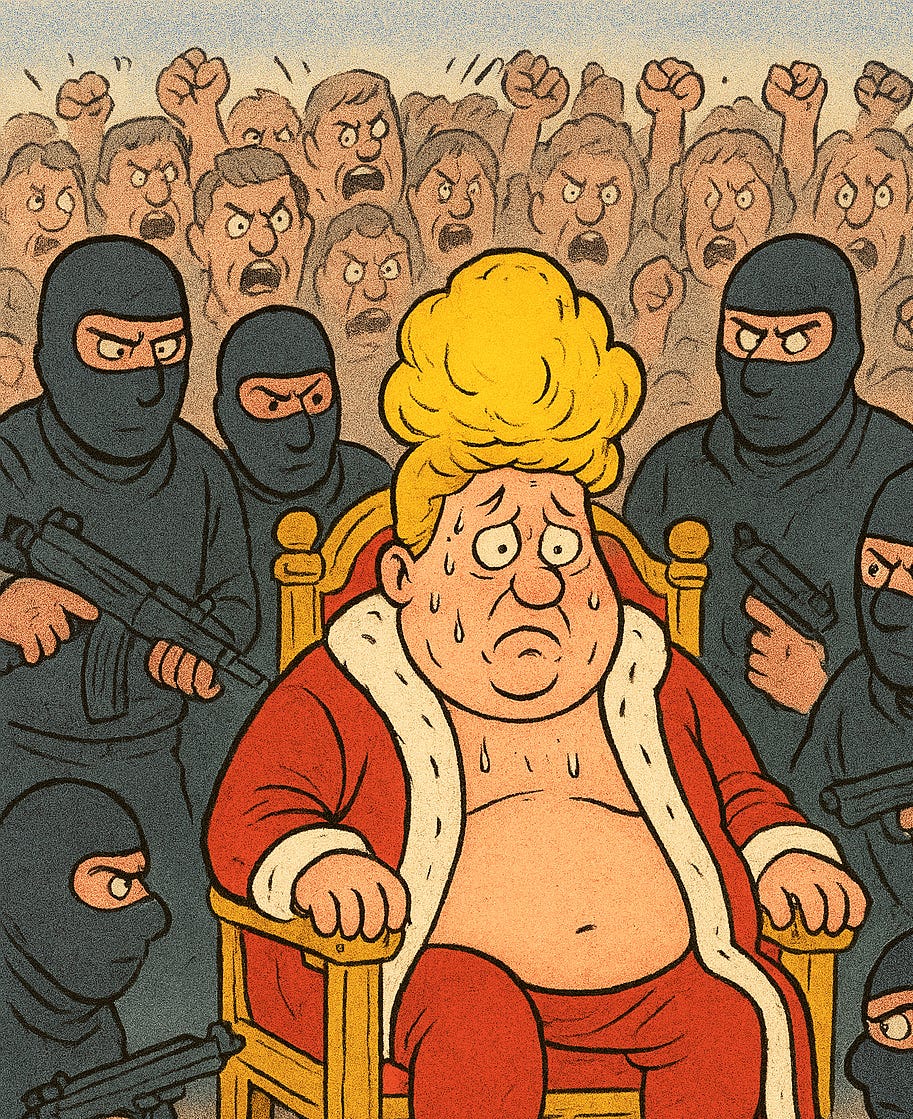
Since January 2025, there has been much written about the United States’ inexorable slide toward authoritarianism. A lot of it has been in relatively muted tones, akin to whispering as we walk past the graveyard, fearful that if we speak too loudly, we’ll make the things we fear come true. I must confess that I have been guilty of this, even though I should know better, because in a 30-year career as a diplomat, I’ve seen it happen in other countries, so I should know better than anyone that no country is immune.
As I look at what’s happening around me, I am now forced to admit that we’re no longer on the precipice of a slide into an elected autocracy. We are at the bottom of the slide and in the early stages of an authoritarian government, and with each passing day, it becomes more entrenched, making it all the more difficult to root it out in the future.
As I reflect on it, though, I realize I’d been looking at the wrong models to assess where we were on the slide to authoritarianism and the odds of reaching that tipping point. While situations in foreign lands are worthy of study, such as the rise and subsequent fall of the democratic movement in Morocco, we can find an example of living under authoritarianism much closer to home.
Few reading this are old enough to recall the Jim Crow era in the United States, and most of those who are old enough were mercifully spared the effects that it had on the day-to-day existence of a significant percentage of the American population. As someone who came of age during the 1950s in rural East Texas, though, I can vividly recall what it was like living under the thumb of old Jim Crow, and, trust me, it’s eerily similar to what it might be like for all of us if we move much farther into authoritarianism.
To ensure everyone fully understands the issue, I’ll start with some basic background. The Jim Crow laws, or Black Codes, were state and local laws enacted, primarily in the South, from the period after the end of Reconstruction in the 19th century until the 1960s. In the South, they legally enforced racial segregation and marginalized African Americans by denying them access to voting, education, housing, and employment opportunities. The Supreme Court decreed them valid under the principle of ‘separate but equal,’ but in practice, they led to inferior treatment and facilities, from housing to schools. Outside the South, while there were no official statutes, Jim Crow was the de facto social code in many places in the United States.
How does this compare to living under an authoritarian government? For starters, the freedoms we take for granted, such as speech or assembly, are curtailed for the targeted population. In my East Texas hometown, with a population of 715, for example, parking in the tiny downtown area was strictly segregated until well into the 1960s, and the schools were separated by race, with the African American schools forced to take the hand-me-down books and desks from the white school. Efforts by the targeted community to change the social status quo were often met with violence, and whites who sided with the African American community became victims as well.
I could go on, but I hope the point is made. The only difference between today’s authoritarian proclivity and the Jim Crow of the past is that the population targeted for government control is based on political ideology rather than race. The outcome is the same, though. Fundamental liberties that we now take for granted disappear, and the individual is considered a servant of the state, to be used and discarded at will. Political, Religious, and other rights are dispensed by the ruler, or dispensed with, as the case might be.
Just as Jim Crow did, though, the new authoritarianism is not likely to be uniform countrywide. Different strokes for different folks, and in this case, there are likely to be large pockets of resistance that could fuel violence. It’s unlikely, for instance, that states like California, Illinois, and New York will meekly bow before a tyrant. Some of the red states, like Texas and Florida, will want to go their own way, much as some states did with Jim Crow, leading to a patchwork of polities and a lot of sniping and backbiting—in other words, chaos. So, even the wannabe dictator is likely to be disappointed with the outcome.
Think about that for a while and get back to me.
Charles A. Ray spent 20 years in the U.S. Army with two tours in Vietnam. He retired as a senior US diplomat, serving 30 years in the U.S. Foreign Service, with assignments as ambassador to the Kingdom of Cambodia and the Republic of Zimbabwe, and was the first American consul general in Ho Chi Minh City, Vietnam. He also served in senior positions with the Department of Defense and is a member of The Steady State.
Founded in 2016, The Steady State is a nonprofit 501(c)(4) organization of more than 340 former senior national security professionals. Our membership includes former officials from the CIA, FBI, Department of State, Department of Defense, and Department of Homeland Security. Drawing on deep expertise across national security disciplines, including intelligence, diplomacy, military affairs, and law, we advocate for constitutional democracy, the rule of law, and the preservation of America’s national security institutions.