
The Evil Kings Evil Ministers
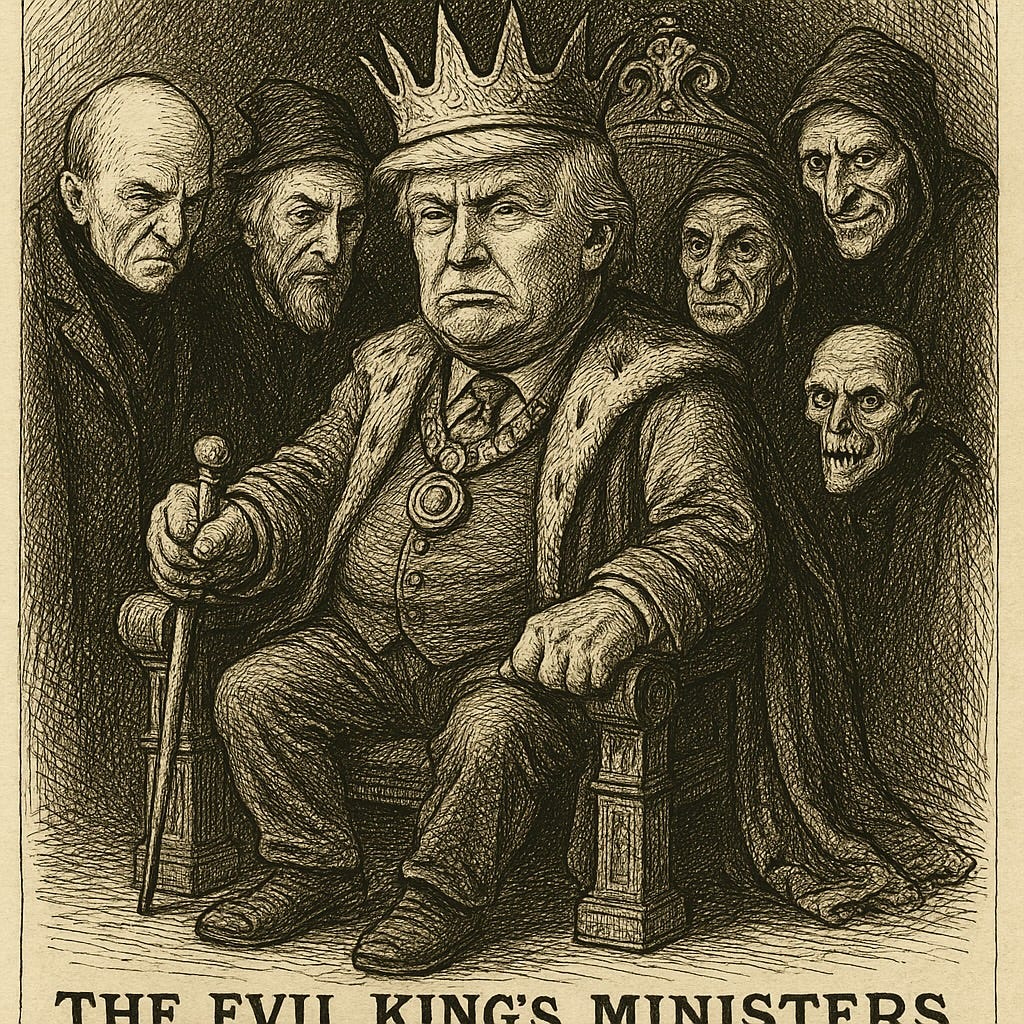
The phrase “the King’s evil Ministers” is older than many of the monarchies it once excused. It arose in times when the people, suffering under misrule, needed to preserve faith in the crown while explaining away tyranny. If the taxes were unjust, if wars were wasteful, if the prisons were full — it was not the King, they told themselves, but his evil Ministers.
It was a political fiction of enormous convenience. It allowed subjects to maintain the illusion of a wise and benevolent ruler misled by those around him. It allowed Parliament to condemn “corrupt counsel” while avoiding the dangerous charge of disloyalty to the sovereign himself. It allowed the King to sacrifice scapegoats to preserve his own legitimacy. And it allowed the public, even while angry or oppressed, to believe in the continued goodness of monarchy as an idea.
The usefulness of the fiction was so great that it became a recurring pattern. Across centuries and nations, “evil Ministers” have been summoned whenever citizens needed to reconcile loyalty to power with dismay at how that power was used. It was comforting because it preserved order. It reassured the faithful that the system itself was sound — only the people within it were wicked.
Applied to the Trump era, this trope feels strangely familiar. Around the modern American monarch, we see courtiers, flatterers, and opportunists eager to do his bidding and absorb his blame. Like the viziers and counselors of old, they act as both enablers and shields. We can name them easily: Stephen Miller, Russel Vought, Tulsi Gabbard, Pete Hegseth, Marco Rubio, and a long line of others who converted personal ambition into royal service. Each was willing to translate the leader’s impulse into action and his grievance into policy — while leaving room for loyalists to imagine that Trump himself was somehow misled, misinterpreted, or misunderstood.
But here the old story breaks down. Trump is no passive king led astray by evil Ministers. He is their source, their model, and their purpose. His Ministers are evil precisely because the King is evil — not in spite of it. The direction of corruption runs from the top down, not the other way around. The court behaves as it does because its ruler demands it.
And yet…
… as false as this ancient fiction may be, it may still have value. In an era when political devotion to Donald Trump has taken on cult-like dimensions, the idea of the King’s evil Ministers could provide something unexpectedly useful: a rhetorical bridge back to reality. It gives his adherents a narrative through which they can begin to separate the man from his myth.
Blaming the “bad advisers,” the supposed “deep state traitors,” or the “handlers who betrayed him” may be historically and morally wrong — but it may also be psychologically necessary for some to escape the totalizing grip of loyalty. The same old story that once excused tyranny could, paradoxically, become a way to loosen it.
If divine right has crept back into American politics in the form of blind faith that Trump was “chosen” or “anointed,” perhaps we can make use of a political tool from the same distant past. The King’s evil Ministers is a comforting fiction — but it may also be a therapeutic one. If it helps even a few begin to question the throne, to imagine that the King can err, then the story will have done its work.
In that sense, the fiction still serves democracy. For in any age of authoritarian temptation, even the wrong story can sometimes lead toward the right conclusion.
Founded in 2016, The Steady State is a nonprofit 501(c)(4) organization of more than 360 former senior national security professionals. Our membership includes former officials from the CIA, FBI, Department of State, Department of Defense and Department of Homeland Security. Drawing on deep expertise across national security disciplines including intelligence, diplomacy, military affairs and law, we advocate for constitutional democracy, the rule of law and the preservation of America’s national security institutions.
Steven A. Cash served as a former prosecutor in the Manhattan District Attorney’s office before joining the CIA in 1994 as Assistant General counsel and subsequently serving as an intelligence officer in the Directorate of Operations. In 2001 he joined the Senate Select committee on Intelligence as Counsel and designee-staffer to Senator Diane Feinstein). He later served as a senior staffer in the House Select Committee on Homeland Security, the Department of Energy, the Senate Judiciary Subcommittee on Terrorism, Technology and Homeland Security and the Department of Energy. In the private sector he has advised on national security, counterintelligence, and technology policy and served on the Biological Sciences Experts Group under the Director of National Intelligence. Mr. Cash is currently the Executive Director of The Steady State.