
The National Security Act Of 1947 17E
“Among the most enduring lessons of World War II was the necessity of coherent, integrated, and apolitical decision-making in matters of national security. … The architects of America’s postwar order…understood that winning the peace required no less. The National Security Act was their answer…When functioning as intended, the system created by the 1947 Act could give the President access to the best analysis, the clearest options, and the hardest truths, drawn from across the government.” Steven A. Cash
During the George H.W. Bush Administration, I was privileged to observe firsthand the importance of the National Security Act system and to witness how that system operated in practice.
National Security Accomplishments (January 1989-January 1993)
The years of that administration, from January 1989 to January 1993, brought the most dramatic international change since the Second World War. But that time the change occurred peacefully, with no shots fired – thanks in no small part to the heroism of Soviet General Secretary Mikhail Gorbachev, as well as to the leadership of President G.H.W. Bush and to the exemplary national security decision making system that he led. I had the great fortune to participate in that process, first as Assistant Director of the Arms Control and Disarmament Agency (ACDA) for Strategic and Nuclear Affairs and then, especially, as Director for Arms Control and Nonproliferation on the National Security Council (NSC) Staff.
The Bush Administration witnessed first the dissolution of the Warsaw Pact and then of the Soviet Union itself, followed by the creation of 15 independent states. The Administration immediately established embassies and diplomatic relations with 14 of the 15, a major increase in representation from the one embassy in Moscow and consulates only in Vladivostok, Russia and Kyiv under the Soviet Union.
We also reached out right away from Washington. I was part of a small interagency delegation to Moscow, Kiev, Minsk and Almaty in mid-January 1992, less than a month after they became national capitals. President Boris Yeltsin first met with President Bush in Washington and Camp David at the end of January 1992, and then again at the first formal U.S.-Russian Summit in June 1992.
The Administration had an unprecedented record on arms control. Bush and Gorbachev signed the Strategic Arms Reduction Treaty (START I) in July 1991. In May 1992, Russia, Ukraine, Belarus and Kazakhstan took on the Soviet Union’s START obligations; at the same time, Ukraine, Belarus and Kazakhstan agreed to eliminate all nuclear warheads on their territories, to join the Nuclear Nonproliferation Treaty (NPT) as non-nuclear-weapon states, and to eliminate their strategic bombers and missiles. All of those undertakings were completed successfully.
Another important arms control treaty was the Chemical Weapons Convention (CWC), signed in January 1993. Although some parties – especially Russia and Syria – have violated the CWC, and other states, like North Korea, have never been parties, it has been largely successful in ridding the world of chemical weapons.
Other ambitious arms control agreements reached by the Bush Administration were ultimately less successful, but were notable achievements at the time. The Open Skies Treaty, based on a 1955 proposal by President Eisenhower, was signed in March 1992 and now has 32 parties; unfortunately, those do not include the United States or Russia, which withdrew from the Treaty in 2020 and 2021, respectively.
NATO and the Warsaw Pact had been negotiating about conventional forces since 1973, when the members finally signed the Conventional Armed Forces in Europe (CFE) Treaty in November 1990. By the time, CFE entered into force in 1992, the Warsaw Pact and Soviet Union no longer existed. Efforts to update the treaty ultimately failed. Russia withdrew from, and NATO members suspended participation in, the Treaty in May and December 2023, respectively.
Except for START I, the ambitious nuclear reduction achievements of the Bush Administration met similar fates. In September 1991, President Bush announced dramatic unilateral reductions in U.S. shorter-range nuclear forces, followed by similar unilateral moves on strategic nuclear forces in January 1992. Gorbachev in 1991 and Yeltsin in 1992 immediately promised to take similar steps. The United States fully implemented those commitments, reducing U.S. nuclear warheads by about 50% in the four years of the Bush Administration. No other President has come close to that record, although George W. Bush presided over another 50% reductions in his eight-year Presidency. Unfortunately, Russia did not fully implement its commitments, resulting in a huge Russian advantage in shorter-range nuclear forces.
Finally, Presidents Bush and Yeltsin signed the START II Treaty in early January 1993. START II would have greatly reduced strategic nuclear forces below START I levels, and most importantly, banned all multiple-warhead intercontinental ballistic missiles (ICBMs). Regrettably, Russia never ratified the Treaty, so it never came into force.
Nevertheless, all of these agreements were major accomplishments in an exceptionally short period of time. In addition, the Bush Administration began implementations of an entirely new way of cooperating with former adversaries – the Cooperative Threat Reduction Program, which helped Russia, Ukraine, Belarus and Kazakhstan meet their START I, CWC and NPT commitments.
The Decision-Making Structure Responsible for Those Accomplishments
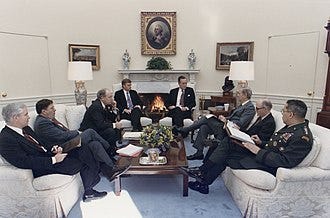
None of that would have been possible without the U.S. national security decision structure which was a model of that envisioned in the National Security Act of 1947. The President was clearly in charge, assisted by retired Air Force Lieutenant General Brent Scowcroft, who may have been the most accomplished National Security Advisor in U.S. history. Lieutenant General Scowcroft was a true leader, of the interagency process at the Cabinet level and of the NSC Staff that worked for him.
During the George H.W. Bush Administration, the formal structure of the 1947 Act was strengthened by an informal structure inspired by the same principles. The National Security Advisor held regular (in my memory, weekly) luncheon meetings in his office with the Secretaries of State and Defense and the Chair of the Joint Chiefs of Staff. The four were a real team.
Below that level, for arms control and nonproliferation work, was another informal group, “the Ungroup,” chaired by the NSC Staff Senior Director for Defense Policy and Arms Control. The members from the various agencies were at different levels– senior enough to be able to speak for his/her agency, junior enough to be a real expert in the field. Thus the Ungroup included the ACDA Director, a State Department Under Secretary, an Office of the Secretary of Defense Assistant Secretary, the Special Assistant for Arms Control to the CIA Director, and the three-star Assistant to the Chairman of the Joint Chiefs of Staff.
The Ungroup’s defining feature was that its members were dedicated to the pursuit of the national interest, not that of their separate agencies. In that crucial respect, they reflected the approach taken by their bosses in their informal lunches. They also reflected the aims of the National Security Act of 1947, to a degree that has not always been achieved in other eras.
Given its members and guiding principles, the Ungroup usually reached agreement even on difficult issues. In the few instances when issues went to the President for final decision, the options papers prepared by NSC Staff had to present the different agencies’ positions fully and fairly. We owed the President no less.
The dedication of the Administration to the national interest may never have been as clear as it was during the Presidential transition period of November 1992-January 1993. Beginning on the day after the election, the NSC Staff was instructed to cooperate fully with the Clinton transition team. While the future Administration had no veto over the Bush actions, we had to make certain that they were comfortable with the decisions we were taking that they would have to implement. For the Clinton’s team part, they fully supported President Bush signing the START II and CWC treaties, lest they be caught up in the chaos following even the smoothest possible transition. Once again, the national interest prevailed, greatly outweighing any narrower aim like who gets credit for a landmark treaty.
Observers today may be forgiven if they fear that “coherent, integrated, and apolitical decision-making in matters of national security” is an impossible dream. History shows that it is quite possible. We simply need to choose leaders and foster experienced career officials who share the essential principles that motivated those who were “present at the creation” in 1947 and those who taught me so much more than 30 years ago.
Dr. Susan Koch’s federal government service included work in the White House National Security Council Staff, State Department, Office of the Secretary of Defense and the Arms Control and Disarmament Agency, specializing in weapons of mass destruction arms control and nonproliferation. She is a member of The Steady State, an organization of former national security officials.
Founded in 2016, The Steady State is a nonpartisan, nonprofit 501(c)(4) organization of more than 300 former senior national security professionals. Our membership includes former officials from the CIA, FBI, Department of State, Department of Defense and Department of Homeland Security. Drawing on deep expertise across national security disciplines including intelligence, diplomacy, military affairs and law, we advocate for constitutional democracy, the rule of law and the preservation of America’s national security institutions.