
Trumps Ukraine Whiplash The Peril
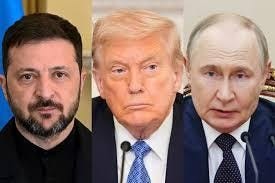
Since the moment Donald Trump returned to the White House, the world has been watching, bewilderedly, by his abrupt swings in policy toward the Ukraine war. Most recently, after voicing confidence that Ukraine could win the war against Vladimir Putin’s Russia, Trump now says he does not believe it will. The U.S. could offer Tomahawk missiles to Ukraine said Trump, but he has now backed off. This kind of flip-flop is not simply a matter of shifting rhetoric. It has become a danger to national security, not just for the United States, but for Ukraine, for Europe, and for the global order.
What Strategy?
A core element of U.S. national security is the ability of allies and adversaries alike to predict American policy. But when the U.S. President veers from “Ukraine must win” to “Ukraine probably won’t win,” (especially without long range missiles), the entire architecture of trust and planning collapses. Trump’s latest statement that parts of the Donbas and other regions of Ukraine might have to be left under Russian control is another vivid example.
For Ukraine’s leadership in Kyiv, this chaos means they cannot reliably plan or count on the U.S. for anything. Live-or-die military operations, domestic morale, reconstruction financing, all rely on clarity of the U.S. position. For European partners, many of whom have stepped up arms, intelligence, and diplomatic resources, the lack of a coherent U.S. anchor undercuts the allied front. A fragmented strategy invites adversaries, especially Moscow, to exploit the vacuum.
As for the U.S. itself, every time policy pivots, the credibility of American deterrence erodes. If the U.S. can’t hold a position, why should Russia fear escalation? Why should NATO allies trust U.S. commitments? A president who publicly says “we might abandon Ukraine” sends a shockwave through the system.
The Putin Factor
From the early days of his first term, Trump has displayed an undeniable personal affinity (some would say deference) for Putin. It’s no surprise that Russian state media is openly mocking the U.S. president as being essentially under Kremlin control. Now, we’re seeing policy follow character. Trump’s latest posture, urging Ukraine to cede territory or “be destroyed,” pressuring Kyiv to take Russian terms, mirrors Moscow’s messaging. Whether this is deliberate or incidental, the result is the same: the U.S. foreign-policy line begins to look like a Kremlin draft.
And here lies a dangerous pattern that has long characterized Trump’s governing style: his positions depend almost entirely on whoever spoke to him last. When that person happens to be Vladimir Putin, the results are both predictable and alarming. Advisors who brief the President in the morning can find their guidance undone by evening after a phone call from Moscow. This is not deliberation, it’s manipulation by proximity. In foreign policy, where consistency and credibility are the currency of power, being led by the last voice in the room is not leadership, it’s abdication.
Who Knows What’s Next?
The most dangerous feature of this moment is not just the wrong policy, it is the absence of any coherent policy. Allies, adversaries, even Trump’s own advisors cannot know what the next statement will be. Will the U.S. send Tomahawks to Ukraine one day, then say “no” the next? Will talks with Russia move forward then be canceled, as just happened with the planned meeting in Budapest?
If Ukraine can’t count on U.S. military or diplomatic backing in a consistent way…if Europe can’t plan coordinated defense or reconstruction with U.S. help…if Moscow can keep advancing or pausing when convenient as the U.S. continues to shift positions…then the U.S. itself risks being isolated and/or out-maneuvered because allies will stop trusting Washington and look elsewhere. In other words, strategy becomes impossible. When no one can trust the anchor, the ship drifts.
Trump Doesn’t Care
Perhaps the saddest dimension of all this is what it suggests about priorities. When a leader treats a major war at the heart of Europe’s security as a backdrop for his own spectacle as opposed to any principle or strategy, danger astronomically increases. It isn’t just that Ukraine may lose, it’s that Trump doesn’t care who wins or loses. For him it isn’t about Ukrainian freedom or the global order, it’s about optics and that ever-elusive Nobel Peace Prize. The implications for U.S. policy are staggering. Our commitment becomes contingent, transactional, and subject to the whims of ego. That is not reassuring to a country under invasion, nor to an alliance facing historic stakes.
Why This Matters
For Americans, the stakes are not remote. The erosion of credibility means the U.S. has fewer levers to deter aggression elsewhere, including the South China Sea or the Arctic. When the world sees the U.S. constantly shifting positions, the deterrent value of alliances and forward presence is weakened. For Europeans and Ukrainians, the crisis of U.S. reliability means they may have to invest more in their own defense (not necessarily a bad thing) and look toward other partners, reshuffling the global balance of power. For Russia (and anyone else watching), this sends a clear message: gamble, push, probe and wait for the U.S. to blink. When leadership is inconsistent, the aggressor dictates the terms.
When no one knows what Washington will do next, the world is less stable, and the margin for error shrinks. And when policy depends on the last person Trump speaks to, the world effectively becomes hostage to his next conversation. The war in Ukraine is not reality TV. It’s a war for sovereignty and for the rules of international order. If the U.S. treats it like a stage for spectacle, the consequences will be real, and potentially catastrophic.
Bruce Berton served as a U.S. diplomat for over three decades, ultimately rising to the senior ranks of the Foreign Service, including two years as Ambassador and Head of Mission at the Organization for Security and Cooperation in Europe’s (OSCE) Mission to Bosnia and Herzegovina. He is a native of the Pacific Northwest and a graduate of Pacific Lutheran University. He is a member of The Steady State.
Founded in 2016, The Steady State is a nonprofit 501(c)(4) organization of more than 300 former senior national security professionals. Our membership includes former officials from the CIA, FBI, Department of State, Department of Defense and Department of Homeland Security. Drawing on deep expertise across national security disciplines including intelligence, diplomacy, military affairs and law, we advocate for constitutional democracy, the rule of law and the preservation of America’s national security institutions.