Veterans Day Drama Why Trumps Oval
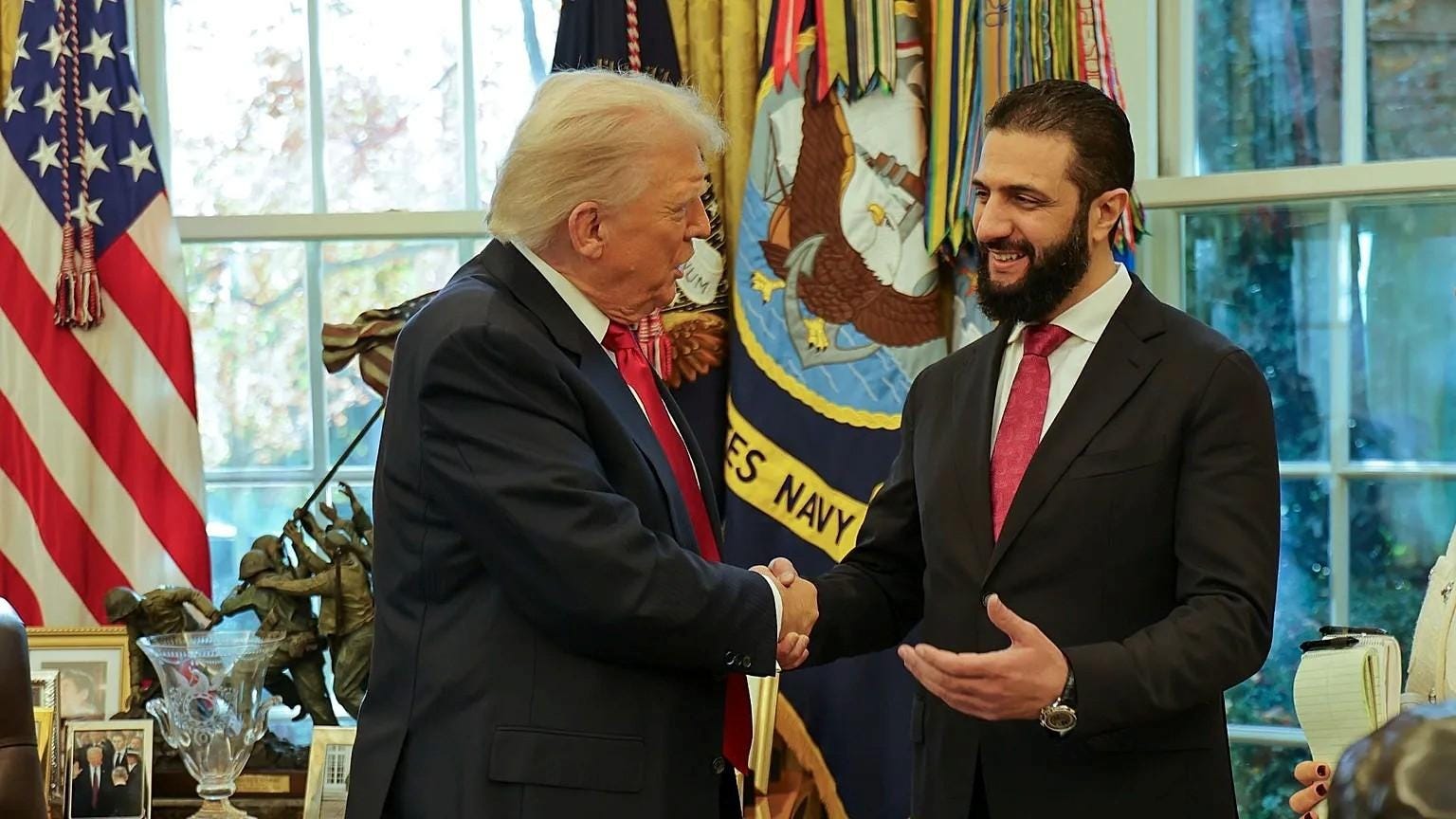
When Donald Trump welcomed Syrian leader Ahmed al-Sharaa to the Oval Office on Veterans Day, it wasn’t just an odd diplomatic gesture, it was a tone-deaf political spectacle with serious national-security implications. On the day America honors those who served and died in uniform, the optics of rolling out the red carpet for a man once branded a terrorist send a chilling signal about what, and whom, this administration values.
From $10 Million Bounty to the White House
Ahmed al-Sharaa’s résumé reads like a cautionary tale of the Syrian war. Under his nom-de-guerre Abu Mohammad al-Golani, he led the al-Nusra Front, al-Qaeda’s Syrian affiliate, and was designated a Specially Designated Global Terrorist by the U.S. in 2013. At one point, my former colleagues at the State Department offered a $10 million bounty for information leading to his capture. His fighters were responsible for bombings, executions, and deadly attacks on U.S.-backed forces.
Even after formally breaking from al-Qaeda in 2016 and rebranding as Hayat Tahrir al-Sham (HTS), al-Sharaa never renounced the violence that fueled his rise. Yet by late 2024, his forces had toppled former Syrian President Bashar al-Assad. Now, just a year later, al-Sharaa sat in the Oval Office as Syria’s new head of state. On Veterans Day, no less!
To be sure, there are rational arguments for engaging Damascus: Syria’s war is at a standstill, and a leader who can stabilize the country might be seen as a lesser evil. Administration officials have floated hopes that al-Sharaa can help contain ISIS remnants and curb Iranian influence. But the timing and symbolism are a disaster. On Veterans Day, a sacred day for those who fought against men like al-Sharaa, Trump’s meeting looked less like realpolitik and more like provocation.
Backlash came fast and furious. Senators from both parties blasted the meeting as “an insult to veterans” and “a betrayal of American principles.” The American Legion called it “a slap in the face to every service member who fought in Iraq and Syria.” Even some former Trump allies privately questioned the wisdom of the move. “You don’t invite a man with American blood on his hands to the Oval Office on Veterans Day,” one aide told Reuters.
Diplomacy Without Compass has Implications
Unfortunately, this isn’t an isolated misfire. It’s part of a broader Trumpian pattern of transactional diplomacy stripped of moral guardrails and institutional ballast. Under this administration, adversaries become partners and pariahs become props. Sanctions are relaxed without conditions. Old red lines blur into deal-making photo ops.
What makes this even more dangerous is how deliberately Trump has dismantled the institutions designed to restrain such impulses. The State Department, National Security Council and intelligence agencies, the very bodies that exist to vet, test, and refine policy, have been gutted through funding cuts, purges of career expertise and loyalty tests. Experienced diplomats, analysts, and military liaisons have been sidelined or driven out, replaced by political operatives and television surrogates.
In this vacuum, America’s foreign policy no longer reflects coherent interests, but only the president’s moods and instincts. “Diplomacy without compass” isn’t a metaphor; it’s the operating system. And when knowledge is stripped from government, the result is a president making foreign policy literally in the dark, guided neither by intelligence briefings nor by institutional memory. It is not diplomacy informed by facts and analysis. It’s improvisation masquerading as leadership.
Our enemies are the first to notice. They exploit our blindness, test our boundaries, and learn that the world’s most powerful nation can now be gamed by flattery and spectacle.
A Call for Clarity
The al-Sharaa meeting is a symptom of that decay, a photo op born of impulse, unmoored from both history and consequence. And many important questions remain unanswered. What guarantees exist that al-Sharaa no longer poses a threat to U.S. personnel or allies? What oversight ensures U.S. sanctions relief won’t fuel Syrian corruption or proxy conflicts?
Finally, what message does this send to veterans whose comrades died fighting the very forces al-Sharaa once led? Veterans Day should remind us of duty, sacrifice, and principle. By inviting a former jihadist commander to the Oval Office, the Administration blurred that principle beyond recognition. In more than three decades as a diplomat, one thing I learned is that part of America’s strength has always come from a simple idea: we don’t make deals with those who kill our people and call it “diplomacy.”
If Trump wants to re-engage Syria, he should start by demanding accountability, not by offering legitimacy. On a day meant to honor sacrifice, he chose instead to honor expedience. The world took notice.
Bruce Berton served as a U.S. diplomat for over three decades, ultimately rising to the senior ranks of the Foreign Service, including two years as Ambassador and Head of Mission at the Organization for Security and Cooperation in Europe’s (OSCE) Mission to Bosnia and Herzegovina. He is a native of the Pacific Northwest and a graduate of Pacific Lutheran University. He is a member of The Steady State.
Founded in 2016, The Steady State is a nonprofit 501(c)(4) organization of more than 300 former senior national security professionals. Our membership includes former officials from the CIA, FBI, Department of State, Department of Defense and Department of Homeland Security. Drawing on deep expertise across national security disciplines including intelligence, diplomacy, military affairs and law, we advocate for constitutional democracy, the rule of law and the preservation of America’s national security institutions.