
We Are Not Sending The A Team To
In seeking to negotiate a new nuclear deal with Iran, Trump’s team is hampered by inconsistent messaging and inexperience.
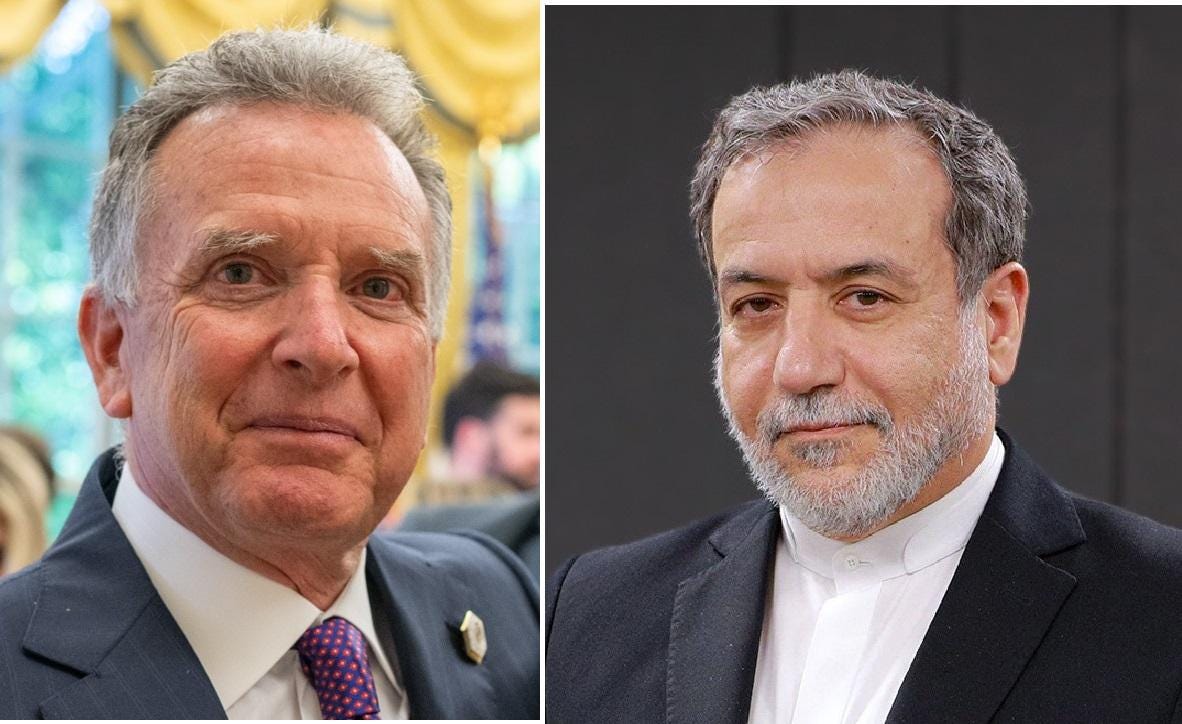
Special Envoy Steve Witkoff at swearing-in ceremony, May 6, 2025, White House; and Foreign Minister Seyyed Abbas Araghchi, 2024, by Khamenei.ir
We are not sending the A team to the Iran talks
By Mark Fitzpatrick
As talks with Iran on its nuclear program move toward a fifth round, peace-loving citizens will be wishing the negotiators fortune. The US team, in particular, will need it. Compared to their Iranian counterparts, they are at a significant disadvantage in terms both of goal consistency and expertise.
Inconsistency
When President Donald Trump announced on April 7 that the US and Iran would begin nuclear talks, he repeated the red line posed by his predecessors, that “Iran cannot have a nuclear weapon.” It was a reasonable way to start talks with a shared vision: Iran itself foreswears nuclear weapons, even if its development program suggests otherwise. Not until nearly a month later, after three rounds of talks, did Trump expand on this goal, to say, in a “Meet the Press” interview aired on May 4, that he would only accept “total dismantlement” of Tehran’s nuclear program. Yet in the same interview, he said “The only thing they can’t have is a nuclear weapon.” Well, which is it? “No nuclear program” and “no nuclear bomb” are two very different red lines. And only the latter will produce success.
As late as April 12, Special Envoy to the Middle East Steve Witkoff told Fox News that Iran could be allowed to enrich uranium at a low level for civilian use. Yet a day later he issued a statement saying Iran must eliminate its enrichment program. Witkoff had come under heavy fire from hawks inside and outside the administration for accepting the standard of the 2015 Iran nuclear deal called the Joint Comprehensive Plan of Action (JCPOA). Although Trump in May 2018 withdrew from what he called the “worst deal in history,” the negotiations he himself initiated this year were pointed toward a similar endgame – until the policy apparently changed.
Confusing the messaging even more, Trump on May 15 said a nuclear deal was “very close” because “Iran has sort of agreed to the terms.” His only basis for saying this though was that Ali Shamkhani, a senior adviser to Iranian Supreme Leader Ali Khamenei, had said the day before that Iran could accept a deal under if it were allowed to enrich uranium at low levels and all economic sanctions were lifted. This was not a new position; Iran had negotiated the same conditions in the JCPOA, except that not all sanctions were lifted then.
In other ways, Trump’s words have been inconsistent with his actions. In early spring he repeatedly threatened military strikes if negotiations fail. Yet on May 1, he ousted former National Security Advisor Mike Waltz for having coordinated such military options with Israeli Prime Minister Benjamin Netanyahu. Signaling an aversion to airstrikes surely pleased Americans who oppose entanglement in Middle East wars, but it undercut his strongest form of leverage.
Inexperience
Inconsistency in messaging reinforces Trump’s other disadvantage in personnel selection. In any normal administration, the Secretary of State or the National Security Advisor would lead negotiations over an issue so vital to US national interests. Trump, however, chose his real-estate pal and all-around senior envoy Witkoff, who was also tapped to lead the so-far failed talks over the Ukraine War and the conflict in Gaza. One wonders why. Witkoff has zero background in Iran, nuclear matters, and arms control.
Then there is the matter of homework. Unlike Trump, Witkoff probably reads his briefing material, but there is no public reporting of his having undertaken the intense review that is normal for any new administration embarking on a complicated quest. They saw no point in talking with the Kerry-led team that put together the JCPOA. It seems they did not even consult with the man who led Iran planning during Trump’s first term: Brian Hook, who in a petty move on January 21 was fired from a board position at the Wilson Center. Two days later Trump revoked his security detail without explanation.
Witkoff’s “technical team” is hardly led by experts such as the nuclear physics guru (Secretary of Energy Earnest Moniz) and the skillful “rogue-state” negotiator (Under Secretary of State Wendy Sherman) who helped Secretary of State John Kerry put together the JCPOA. Witkoff’s team is instead led by a politico who rose through the ranks in communications positions. State Department Policy Planning Director Michael Anton has an earned reputation as a gifted and principled strategist, but he has little background in Iran issues.
By contrast, Iran’s negotiators are highly experienced, most of them having been involved in hammering out the JCPOA, starting with their lead negotiator, Foreign Minister Abbas Araghchi. In addition to drawing on their own decades of expertise, the Iranian diplomats also have been consulting with leaders in Moscow and Beijing, whose diplomats were deeply involved in the JCPOA talks. By contrast, US consultations with its JCPOA European partners have been lower level and less evident.
In sum, as the musical Hamilton has King George III singsong after hearing John Adams would succeed George Washington, “Good Luck!”
Mark Fitzpatrick is a retired US diplomat who served as Deputy Assistant Secretary for Non-Proliferation. He is an Associate Fellow at the London-based International Institute for Strategic Studies and a member of Steady State, among other affiliations. His views expressed here are personal.
Initially founded in 2016, The Steady State is a nonpartisan, nonprofit 501(c)(4) organization of more than 270 former senior national security professionals. Our membership includes former officials from the CIA, FBI, Department of State, Department of Defense and Department of Homeland Security. Drawing on deep expertise across national security disciplines including intelligence, diplomacy, military affairs and law, we advocate for constitutional democracy, the rule of law and the preservation of America’s national security institutions.