
Whats So Bad About Immigrants
Millions of Americans have been persuaded that accepting people from other countries into American life is a bad thing. This view seems to be based mostly on emotional grounds, rather than evidentiary ones. Immigrants are thought to be – variously – criminals, under-educated, unwilling to become like “us.” They supposedly take “American” jobs, unfairly reap social benefits, do not pay taxes, haven’t “waited their turn” to immigrate legally. And, many people think, there are just too many of them — they don’t deserve to be here at all. However, to the extent that such attitudes claim to rest on evidence, it’s often lacking; the facts tell a mostly different story.
History Gives Us Some Context
St. Patrick’s Day celebrations, for instance – street parades, green beer, schoolchildren urged to wear something green regardless of their ancestry — are a beloved feature of American life. Yet when the Irish started arriving in numbers in the late 1840’s, escaping famine, they were regarded as an alien flood. People already here saw them as dirty, uncouth, prone to drinking and fighting, of an alien religion, and shiftless. “Help Wanted” signs in shop windows added “No Irish Need Apply.” It got worse for the nativists: large numbers of despised Italians, Poles, and Jews came to the U.S. in the following decades. Worse still were the numbers of Chinese, whom nobody wanted, except as cheap labor. From 1894, when a new, larger immigration facility opened on Ellis Island in New York harbor, until 1924, when a restrictive immigration law imposed a system of national-origins quotas, 22 million arrivals were recorded.
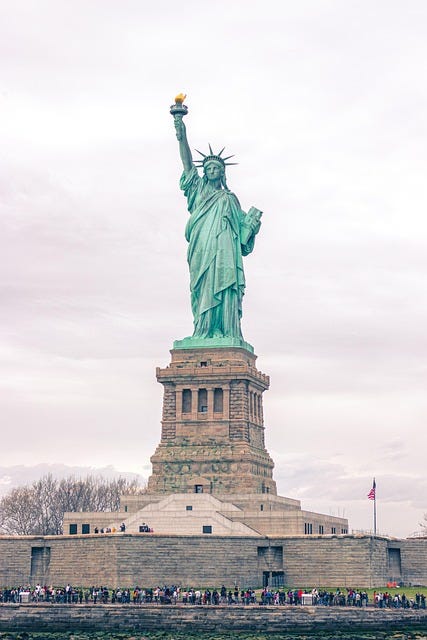
There were loud debates about how America was being “swamped” by people it could not accommodate. Of course these events changed the way society was organized – overcrowded housing was the norm in lower Manhattan, for instance — but few Americans today would suggest that somehow the country was damaged, particularly those large numbers of loyal, patriotic, well-educated, and productive Americans descended from, in the words of the poem on the Statue of Liberty, “the refuse” of “teeming shores.”
“Legal?” Well, It’s Complicated
Today, many law-abiding Americans, and more recent arrivals who have found their way through the thicket of U.S. immigration law, see no reason why those who “don’t wait their turn” should be allowed to stay. However, it’s understandable that foreigners would fall afoul of the current rules.
U.S. immigration law is a book-length mishmash of laws passed at different times and riddled with contradictory provisions and special exceptions. There is no limit to how many visitors’ visas can be issued worldwide, for instance, and every eligible applicant (i.e., those not barred by specific exclusion grounds) is supposed to be issued one. Yet the law also presumes everyone applying really to be intending to stay. If the applicant cannot establish to the American adjudicator’s satisfaction that ties to his or her homeland compel a return, there will be no visa.
Those emaciated 1840’s Irish arrivals were very lucky that that law did not exist when they left home, precisely because they had nothing to go back to. (A third of Ireland’s population starved to death, with people collapsing in the streets and often buried in mass graves.) More contemporary applicants, many fleeing war, persecution, or disastrous economic conditions, encounter, as a first step, American officials like me. Officials who, as I did on my first assignment to a U.S. Embassy abroad, sit behind plexiglass, listen briefly (there are too many people to grant longer interviews) and then rule “yes” or “no.” Moreover, in that country, which President Trump might well put on his “sh—hole ” list, it was obvious that a substantial part of the population would never qualify. The law seldom permits permanent refusals, but a refusal often negatively factors into any subsequent applications. Depending on fate, that group might have included your grandfather or mother.
The national-origins provisions in our law mean that the quotas for many countries are hopelessly oversubscribed. People will wait years before their numbers come up. This provides a huge incentive to overstay a visitor’s visa, and our law does permit even those who overstay to “adjust status” while in the U.S. That is, such a person is not required to leave the country again in order to apply for an immigrant visa. Not surprisingly, navigating this legal tangle is difficult and possible for many only with the help of specialized, often expensive attorneys.
Immigration Reform and Congressional Inaction
Our law desperately needs a rationalized overhaul, but Congress’ most recent bipartisan attempt in 2024, on course for passage in both chambers, was torpedoed by Donald Trump, then not-yet Republican candidate for president. Because he was more interested in having an issue with which to bash the Biden Administration, rather than seeing the country benefit from an improved law, he ordered the Republican co-authors of the bill to pull out. Too meek to defy him, they performed rhetorical gymnastics to repudiate their work.
We Are All Immigrants
The fact is that we are all immigrants or the descendants of immigrants. This Administration has decided to try to uproot millions. But it’s worth noting that the drivers of this crusade do not themselves have U.S.-origin names, including Secretary of Homeland Security Kristi Noem; White House Executive Associate Director of Enforcement and Removal Operations, and so-called “border czar” Tom Homan; FBI Director Kash Patel; Deputy FBI Director Peter Bongino; Defense Secretary Pete Hegseth; and Secretary of State Marco Rubio. That’s true of even President Trump and the First Lady, formerly Melania Knavs. Trump’s grandfather came from Germany. Mrs. Trump, after arriving from Slovenia, violated, as many other “illegals” have, the terms of her visitor visa by remaining in the U.S. and accepting paid employment. Her parents subsequently entered the country in a perfectly legal procedure (on the basis of her, by then, legal presence in America, although there is reason to doubt whether she actually qualified for the “exceptionally accomplished person” visa type she received). Republicans used to loudly denounce this part of the law, mocking it as “chain migration.”
The Administration’s vigorous attempts to round up “illegals” for deportation, which Trump insists will continue, make no effort to avoid legal residents or even citizens. (When asked what would happen to U.S. citizen children of parents marked for deportation, Homan glibly replied that they could leave with them.) Armed enforcement officers are allowed to conceal their faces and insignia. Also permitted are pursuits – now frequently documented — through the streets and use of wildly excessive force. The Administration is making no provision for legal due process or observance of basic rights to which everyone on American soil, whatever their immigration status, is legally entitled. When reprimanded or countermanded by courts, Administration officials have done their best to ignore those instructions. The scene this week of a California father of three U.S. Marines being pursued, tackled, and punched by masked agents is indistinguishable from what police dictatorships do to their citizens.
Is that what you want the government doing in your name? We call ourselves the land of the free and the home of the brave, but these actions are anything but brave, and they are the exception, rather than what has become customary here, in any land of the free.
Tom Wolfson is a former senior U.S. diplomat who has lived and worked in six foreign countries, occasionally multiple times. His work representing the U.S. has included assignments at the United Nations, in the U.S. Congress, and with an international democracy-building organization. He is a member of The Steady State.
Founded in 2016, The Steady State is a nonpartisan, nonprofit 501(c)(4) organization of more than 290 former senior national security professionals. Our membership includes former officials from the CIA, FBI, Department of State, Department of Defense and Department of Homeland Security. Drawing on deep expertise across national security disciplines including intelligence, diplomacy, military affairs and law, we advocate for constitutional democracy, the rule of law and the preservation of America’s national security institutions.