
While Rome Burns And What Nero Was
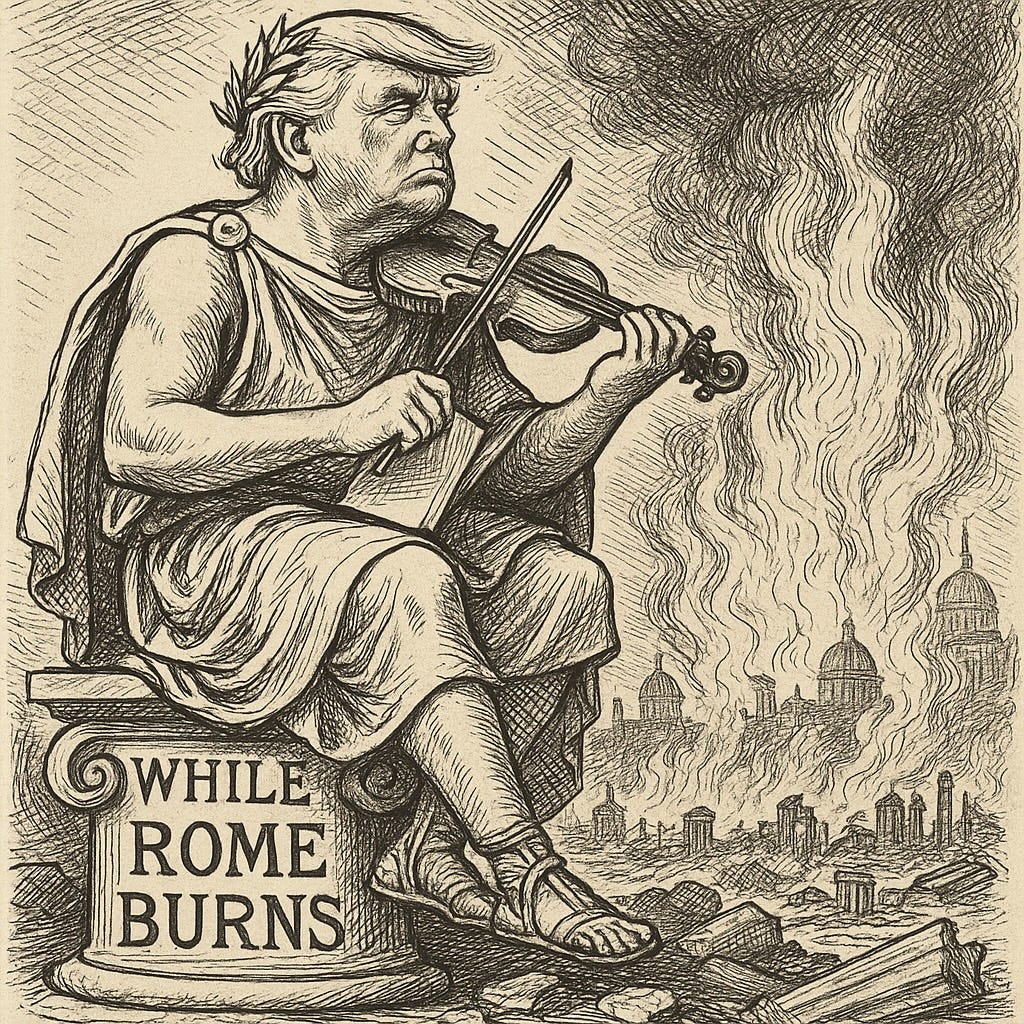
The phrase “Fiddling While Rome burns” has returned to the headlines, often used to describe the Trump Administration’s indifference—or worse, opportunism—in the face of national crisis. The expression conjures the image of Nero, the Roman emperor, blithely playing his violin while his capital city was consumed by fire. It has become a shorthand for vanity amid disaster, for a leader so self-absorbed that catastrophe becomes a kind of background music.
But like so many myths, the story says as much about how we remember power as about the events themselves. There was, of course, no fiddle in Nero’s Rome—string instruments of that kind did not exist in the first century A.D. What the Roman historian Tacitus actually reports is that Nero was in his palace singing an epic poem about the destruction of Troy while the flames spread through the city. The symbolism was unmistakable: even as real lives and homes burned, Nero cast himself as a tragic hero in his own performance.
Yet what happened next is even more revealing. Once the fire had done its work—destroying three-quarters of the city—Nero seized the opportunity to clear out the ruins and rebuild the center of Rome according to his own grand design. He claimed vast swaths of the devastated city as imperial property and began construction of his Domus Aurea—the Golden House—a sprawling palace complex of gardens, lakes, and marble halls, adorned with gold leaf and statues of himself.
In other words, Nero wasn’t just fiddling. He was speculating—turning disaster into a development project. He used the destruction as pretext to consolidate power and remake the capital in his image.
That, perhaps, is the real lesson of the metaphor. The danger is not merely that a ruler is indifferent while the city burns, but that he may see in the flames an opportunity: to expand his dominion, to enrich his circle, to rebuild the state as a monument to himself.
Today’s invocation of “Fiddling While Rome burns” should remind us that the problem isn’t only neglect—it’s exploitation. The true authoritarian impulse is not to prevent the fire, but to profit from its aftermath.
Steven A. Cash served as a former prosecutor in the Manhattan District Attorney’s office before joining the CIA in 1994 as Assistant General counsel and subsequently serving as an intelligence officer in the Directorate of Operations. In 2001 he joined the Senate Select committee on Intelligence as Counsel and designee-staffer to Senator Diane Feinstein). He later served as a senior staffer in the House Select Committee on Homeland Security, the Department of Energy, the Senate Judiciary Subcommittee on Terrorism, Technology and Homeland Security and the Department of Energy. In the private sector he has advised on national security, counterintelligence, and technology policy and served on the Biological Sciences Experts Group under the Director of National Intelligence. Mr. Cash is currently the Executive Director of The Steady State.
Founded in 2016, The Steady State is a nonprofit 501(c)(4) organization of more than 360 former senior national security professionals. Our membership includes former officials from the CIA, FBI, Department of State, Department of Defense and Department of Homeland Security. Drawing on deep expertise across national security disciplines including intelligence, diplomacy, military affairs and law, we advocate for constitutional democracy, the rule of law and the preservation of America’s national security institutions.