
Why President Trumps Embrace Of Crown
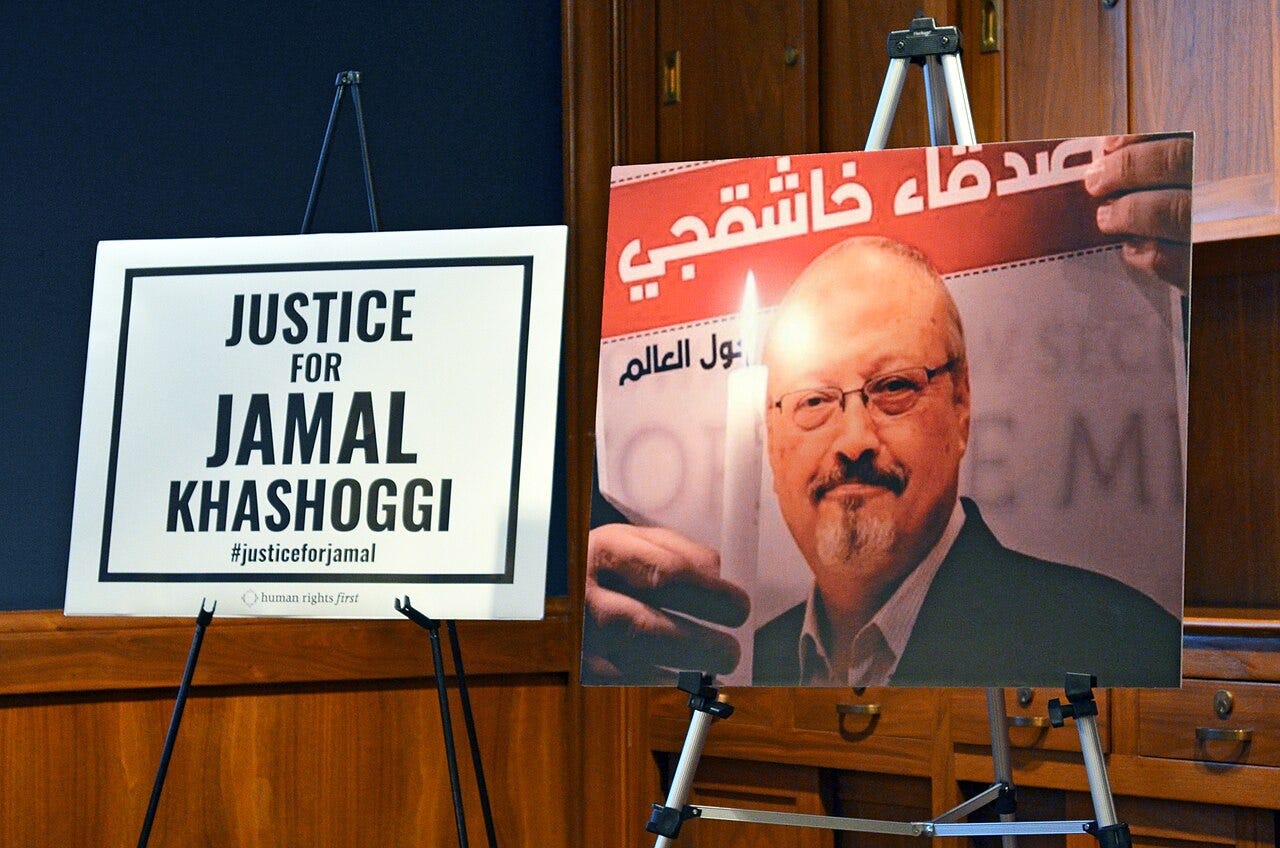
By POMED – https://www.flickr.com/photos/154085524@N02/48826783596/, CC BY 2.0, https://commons.wikimedia.org/w/index.php?curid=92884583
To mark the one-year anniversary of Jamal Khashoggi’s brutal murder, POMED and 12 other human rights and press freedom organizations held a public event on Capitol Hill to commemorate Jamal’s life, to call for accountability, and to cast a light on the Saudi government’s repression of those who are perceived to be critical of Crown Prince Mohammed bin Salman and his regime. Thursday, September 26, 2019
Today’s events were not subtle. They were not diplomatic nuances. They were a statement of power.
Standing alongside Crown Prince Mohammed bin Salman—the man our intelligence community has concluded ordered the murder of Jamal Khashoggi, a U.S. resident and Washington Post journalist—the President of the United States dismissed that killing as something that “upset some people” and shrugged that “things happen.” That is not the language of a democratic leader. It is the language of a mob boss.
At the same time, he waved away the unified assessment of the American intelligence community, which found that the Crown Prince was directly responsible for the murder. In its place, he substituted his personal relationship with a foreign autocrat—reinforced by ceremonial extravagance rarely afforded to even our closest allies, including today’s military flyover.
This matters for three reasons.
It signals that the President identifies with the world’s strongmen, not with America’s democratic institutions. By publicly siding with a foreign leader over his own intelligence agencies, the President sends a blunt message: loyalty to him matters more than fidelity to facts, law, or American values. It normalizes the idea that political murder is an inconvenience—not a crime.
Khashoggi was a U.S. resident. A journalist. A dissident. The Crown Prince arranged his killing, dismemberment, and disposal. The President’s reaction? “Things happen.” When a leader jokes about death, excuses murder and casually affiliates himself with those who use violence to maintain power, he is telling the public that brutality is acceptable—and perhaps inevitable. It reinforces a core authoritarian message: “I can do what I want.”
For months, we’ve seen the President adopt the posture of a man who relishes the idea that he—and his allies—can harm whomever they choose. The near-daily clips of him celebrating lethal force only underline the point. Fear is the currency of authoritarianism, and he is spending it aggressively.
The Heart of the Matter
Yes, this behavior is reprehensible. Yes, it demeans the presidency. But the deeper danger is this: The President is telling Americans that he rules through fear—that he can act without limits—and that those in his circle can do the same.
That is the opposite of constitutional democracy. That is the opposite of freedom. And the American public must understand precisely what they are seeing.
Steven A. Cash served as a former prosecutor in the Manhattan District Attorney’s office before joining the CIA in 1994 as Assistant General counsel and subsequently serving as an intelligence officer in the Directorate of Operations. In 2001 he joined the Senate Select committee on Intelligence as Counsel and designee-staffer to Senator Diane Feinstein). He later served as a senior staffer in the House Select Committee on Homeland Security, the Department of Energy, the Senate Judiciary Subcommittee on Terrorism, Technology and Homeland Security and the Department of Energy. In the private sector he has advised on national security, counterintelligence, and technology policy and served on the Biological Sciences Experts Group under the Director of National Intelligence. Mr. Cash is currently the Executive Director of The Steady State.
Founded in 2016, The Steady State is a nonprofit 501(c)(4) organization of more than 360 former senior national security professionals. Our membership includes former officials from the CIA, FBI, Department of State, Department of Defense and Department of Homeland Security. Drawing on deep expertise across national security disciplines including intelligence, diplomacy, military affairs and law, we advocate for constitutional democracy, the rule of law and the preservation of America’s national security institutions.