
A Step Too Far The Trump Administrations
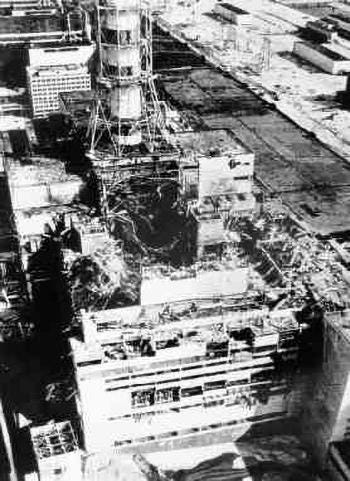
The Chernobyl Accident
On May 23, 2025, President Trump signed four Executive Orders to promote the development of nuclear energy. These actions build on previous administrations’ efforts to reinvigorate the U.S. nuclear industry, but they go too far by putting safety and security at risk. According to three former NRC Chairs, taking shortcuts by circumventing the rigorous regulatory standards of the Nuclear Regulatory Commission increases the likelihood of accidents and puts the future of nuclear energy at risk.
Nuclear energy in the United States has a mixed record. The country once led the world in enthusiasm for the peaceful uses of the atom and in the deployment of nuclear power plants, eventually operating over 100 nuclear power reactors and generating a fifth of the electrical power in the country. The United States also led the world in nuclear exports and used its dominant position to set high standards for nuclear safety and nonproliferation. But predictions that nuclear power would be “too cheap to meter” failed to materialize. Nuclear fuel was relatively cheap, but building nuclear reactors was and remains expensive. The public also became skeptical of the safety of reactors and their highly radioactive spent fuel.
The Nuclear Regulatory Commission was established in 1975 to separate the missions of promoting nuclear energy and overseeing its safety. The NRC was given the mission to protect public health and safety. This came at the height of the environmental movement, when independent regulators were seen as essential for avoiding conflicts of interest between promoting industry and protecting the public. Since that time, independent regulation of the nuclear industry has become a bedrock principle of nuclear safety worldwide.
In addition to high costs, major nuclear accidents dealt a series of blows to the nuclear industry. The 1979 reactor meltdown at Three Mile Island caused minimal harm but led to massive economic losses. Public confidence in nuclear power plummeted and many reactor construction projects were abandoned. The 1986 Chernobyl disaster reinforced the turn away from nuclear power, particularly in Europe. And just as climate change was spurring revived interest in carbon-free energy, a massive earthquake struck the Fukushima Daiichi nuclear power plant in Japan. There is an adage in nuclear safety that an accident anywhere is an accident everywhere. The loss of confidence knows no boundaries.
Each of these accidents spurred advances in nuclear safety, both in terms of improved regulatory oversight and in the intrinsic safety of reactor designs and operations. Newly built reactors are not vulnerable to the same types of accidents.
This improved safety record and the growing impacts of climate change have again revived interest in nuclear power, as has the growing electricity demand from data centers. With broad bipartisan support, Congress appropriated funds for the Energy Department to explore new reactor concepts and passed legislation in 2019 and 2024 to strengthen and streamline the regulatory process for advanced reactors. These factors have spurred a surge in nuclear startups pushing new reactor designs. These include smaller, modular variants of existing reactors as well as novel and unproven designs that raise novel questions about their safety and security.
But while Congress directed that the NRC modernize regulatory functions, President Trump’s Executive Order “Ordering the Reform of the Nuclear Regulatory Commission” seeks their wholesale replacement. It effectively eliminates the NRC’s independence by directing it to review and rewrite its regulations within 9 months. The order relies on misleading complaints about the NRC’s inefficiency, falsely blaming the NRC for the low number of reactor licenses when escalating costs and unreliable supply chains have driven utilities away from nuclear power in favor of natural gas and renewables. It dictates an 18-month deadline for approving license applications to build and operate novel reactors. The Executive Order also seeks to circumvent the NRC’s independent review by directing it to rely on prior risk analyses by the Departments of Energy and Defense for reactor designs deployed on their sites. And it would undermine the NRC’s ability to draw on outside expertise by hobbling its Advisory Committee on Reactor Safeguards.
The future of nuclear power depends on its safety and on public confidence in its continued safety. The independence and expertise of the NRC have been essential to both. President Trump’s Executive Orders to promote nuclear power by gutting regulatory oversight put both public safety and the future of the nuclear industry at risk.
Mark Goodman is a senior scientist who retired from the State Department after a thirty-year career in nuclear policy. He has extensive experience in multilateral nuclear nonproliferation and disarmament issues. Dr. Goodman is a non-resident fellow at the Center for Nonproliferation Studies, a Fellow of the American Physical Society, and a member of The Steady State.
Founded in 2016, The Steady State is a nonprofit 501(c)(4) organization of more than 340 former senior national security professionals. Our membership includes former officials from the CIA, FBI, Department of State, Department of Defense and Department of Homeland Security. Drawing on deep expertise across national security disciplines including intelligence, diplomacy, military affairs and law, we advocate for constitutional democracy, the rule of law and the preservation of America’s national security institutions.