
America Once Knew How to Name Fascism
Over the past several months, the Departments of Defense and Homeland Security have become unusually active in communicating directly with the American public, particularly through social-media platforms. Much of this material shares a common aesthetic and rhetorical profile: a romanticized vision of a homogeneous American past, heavy reliance on martial symbolism, and language that frames politics as an existential struggle between insiders and enemies. Many observers have noted that this style bears an uncomfortable resemblance to official propaganda produced by authoritarian regimes in the twentieth century—most notably Germany in the 1930s.
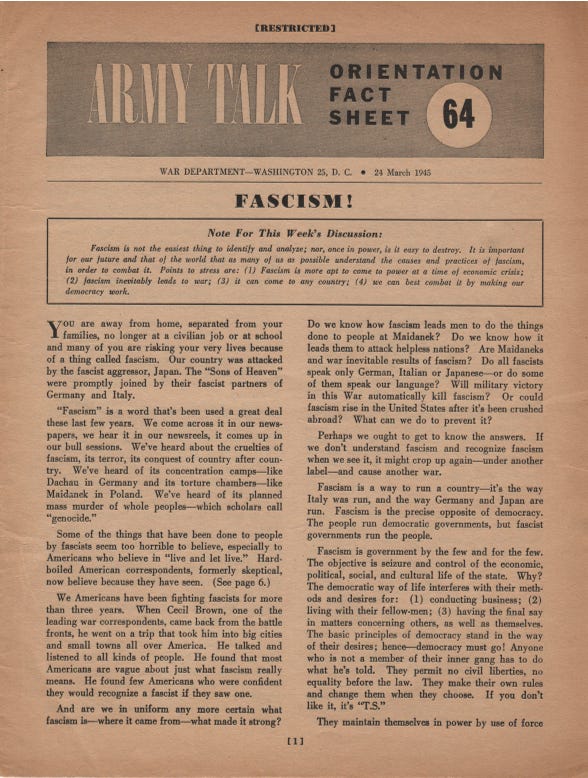
In March 1945, just weeks before the defeat of Nazi Germany, the U.S. War Department issued Army Talk 64, a pamphlet with a blunt, one-word title: “FASCISM!” It was part of a broader series—Army Talks—distributed to American service members in the European theater. The purpose was not morale-boosting or cheerleading. It was civic education.
As historian Heather Cox Richardson recently explained, the Army Talks were designed to help soldiers “become better-informed men and women and therefore better soldiers.” The War Department understood that fighting fascism required more than weapons. It required clarity—about what fascism is, how it operates, and why it poses a mortal threat to democratic societies.
What is striking about Army Talk 64 is not merely its historical provenance, but its enduring relevance. The pamphlet warned that fascism does not announce itself with a single uniform or symbol. It grows gradually, exploiting fear, resentment, and nostalgia. It thrives, the document cautioned, on indifference and ignorance.
The pamphlet reminded American soldiers that freedom is not self-executing. It requires vigilance—not only against foreign enemies, but against domestic practices that corrode democratic norms. “If we permit discrimination, prejudice, or hate to rob anyone of his democratic rights,” the authors warned, “our own freedom and all democracy is threatened.”
This was not radical language. It was official U.S. government doctrine.
The men and women reading Army Talk 64 were preparing to liberate Europe from fascist rule. But the War Department understood that the ideology they were fighting was not confined to foreign soil. Fascism, the pamphlet made clear, is a recurring political disease. It can emerge anywhere citizens lose the habit of critical thinking or surrender democratic responsibility in exchange for a promise of restored greatness.
That clarity stands in stark contrast to our present moment.
Today, public discourse often treats “fascism” as either an insult or a taboo—too inflammatory to name, too dangerous to define. Yet the United States once insisted that its soldiers confront the concept directly, analytically, and without euphemism. The government trusted Americans to understand the warning.
Re-engaging with Army Talk 64 would not be an act of nostalgia. It would be an act of democratic self-respect. The document is not partisan. It does not target any individual or movement by name. Instead, it offers a framework—rooted in American experience—for recognizing when political culture begins to slide toward authoritarianism.
The lesson is simple and unsettling: democracies do not fail only because of force. They fail when citizens stop paying attention.
Nearly eighty years ago, the United States told its soldiers that the defense of freedom begins with understanding what threatens it. That message was true in 1945. It is no less true today.
The question is whether we are still willing to hear it.
Steven A. Cash served as a prosecutor in the Manhattan District Attorney’s office before joining the CIA in 1994 as Assistant General counsel and subsequently serving as an intelligence officer in the Directorate of Operations. In 2001 he joined the Senate Select committee on Intelligence as Counsel and designee-staffer to Senator Diane Feinstein). He later served as a senior staffer in the House Select Committee on Homeland Security, the Department of Energy, the Senate Judiciary Subcommittee on Terrorism, Technology and Homeland Security and the Department of Energy. In the private sector he has advised on national security, counterintelligence, and technology policy and served on the Biological Sciences Experts Group under the Director of National Intelligence. Mr. Cash is currently the Executive Director of The Steady State.
Founded in 2016, The Steady State is a nonprofit 501(c)(4) organization of more than 360 former senior national security professionals. Our membership includes former officials from the CIA, FBI, Department of State, Department of Defense and Department of Homeland Security. Drawing on deep expertise across national security disciplines including intelligence, diplomacy, military affairs and law, we advocate for constitutional democracy, the rule of law and the preservation of America’s national security institutions.
Powered by WPeMatico