
Are We The Baddies Funny But It Hurts
“We built our national security institutions to ensure we would never become what we once fought.”
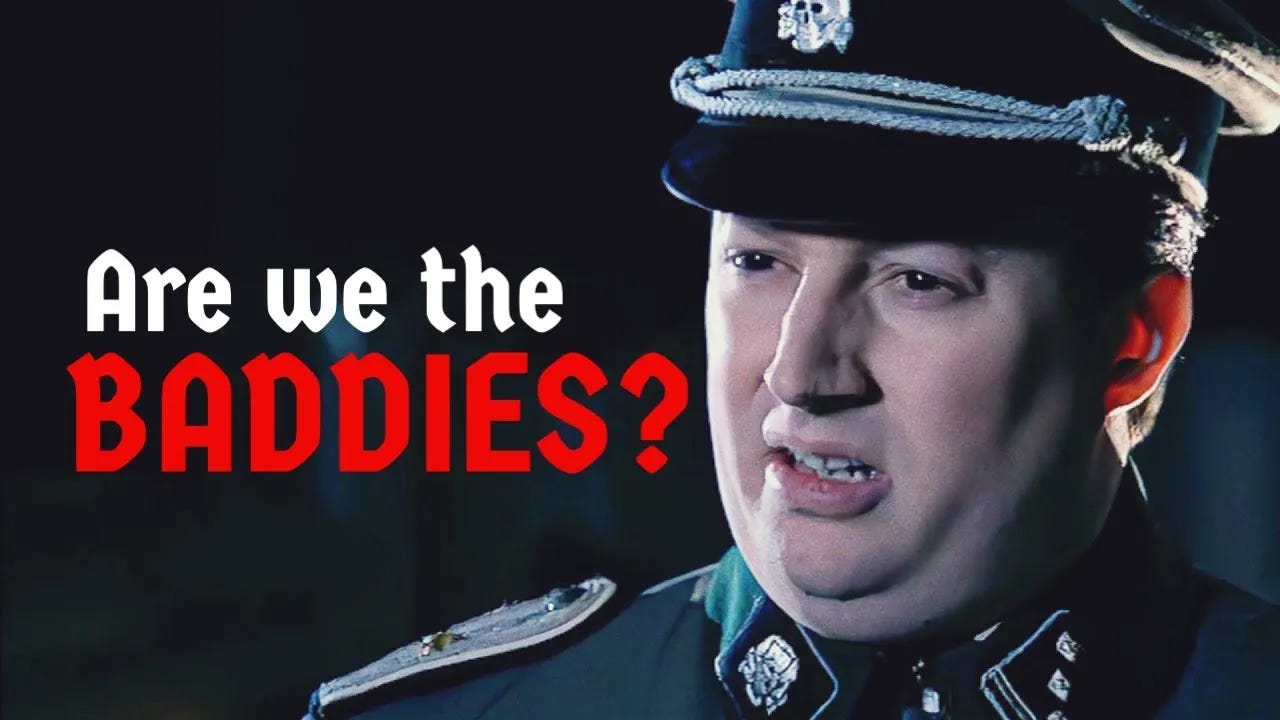
Earlier this week, The Steady State posted on social media a short YouTube clip on social media—a famous British comedy sketch from the 1970s titled “Are We the Baddies?” It’s a very funny skit, but also deeply unsettling. Beneath the humor lies a question that has haunted societies for generations: when do people serving their nation become instruments of repression rather than defenders of it?
For members of America’s national security community, that question is not theoretical. The modern U.S. national security apparatus, created in 1947 with the passage of the National Security Act, was shaped profoundly by the lessons of World War II—by the memory of the real “baddies.” Those experiences were not funny. They revealed how institutions—military, intelligence, and police—can be twisted into tools of tyranny when unmoored from law, ethics, and democratic oversight.
Since 1947, our military, intelligence, and law-enforcement institutions have wrestled, imperfectly but earnestly, with that danger. We have built systems meant to ensure that even the most powerful instruments of state security operate within the limits of the Constitution and the values it embodies. There have been missteps and excesses, and we must continue to confront them honestly. But the central awareness—that unchecked power can corrode the republic from within—has become a core element of training, doctrine, and professional culture across the national security enterprise.
That same awareness animates The Steady State today. We were formed by former national-security professionals who see, once again, the warning lights blinking red. Our recently issued analytic assessment of democratic institutions in the United States reflects that sense of urgency. The habits of democratic restraint we have tried to preserve within our institutions are being tested as never before.
We are watching with growing alarm as the Department of Homeland Security, particularly its enforcement arms—ICE and Customs and Border Protection—risk transformation into something resembling Russia’s Ministry of the Interior or other internal-security organs of autocratic regimes. We see the Director of National Intelligence speak repeatedly about arresting and prosecuting opponents of the President. We see the Department of Justice reduced to an arm of the White House, pursuing the President’s perceived enemies with a vengeance tempered (for now) only by incompetence. When Americans begin to fear an unmarked SUV with tinted windows on their street, or hesitate to answer a late-night knock at the door, or fear arbitrary treatment at a traffic stop, we are entering dangerous territory.
“Are We the Baddies?” was meant as a joke. But it is also a warning. For those of us who have spent our careers inside the national security community, that question is the one we must keep asking—of ourselves, our institutions, and our leaders. The health of our democracy depends on it.
Steven A. Cash served as a prosecutor in the Manhattan District Attorney’s office before joining the CIA in 1994 as Assistant General counsel and subsequently serving as an intelligence officer in the Directorate of Operations. In 2001 he joined the Senate Select committee on Intelligence as Counsel and designee-staffer to Senator Diane Feinstein. He later served as a senior staffer in the House Select Committee on Homeland Security, the Department of Energy, the Senate Judiciary Subcommittee on Terrorism, Technology and Homeland Security and the Department of Energy. In the private sector he has advised on national security, counterintelligence, and technology policy and served on the Biological Sciences Experts Group under the Director of National Intelligence. Mr. Cash is the Executive Director of The Steady State.
Founded in 2016, The Steady State is a nonpartisan, nonprofit 501(c)(4) organization of more than 290 former senior national security professionals. Our membership includes former officials from the CIA, FBI, Department of State, Department of Defense and Department of Homeland Security. Drawing on deep expertise across national security disciplines including intelligence, diplomacy, military affairs and law, we advocate for constitutional democracy, the rule of law and the preservation of America’s national security institutions.