
Waltzing Off To War A Dance With
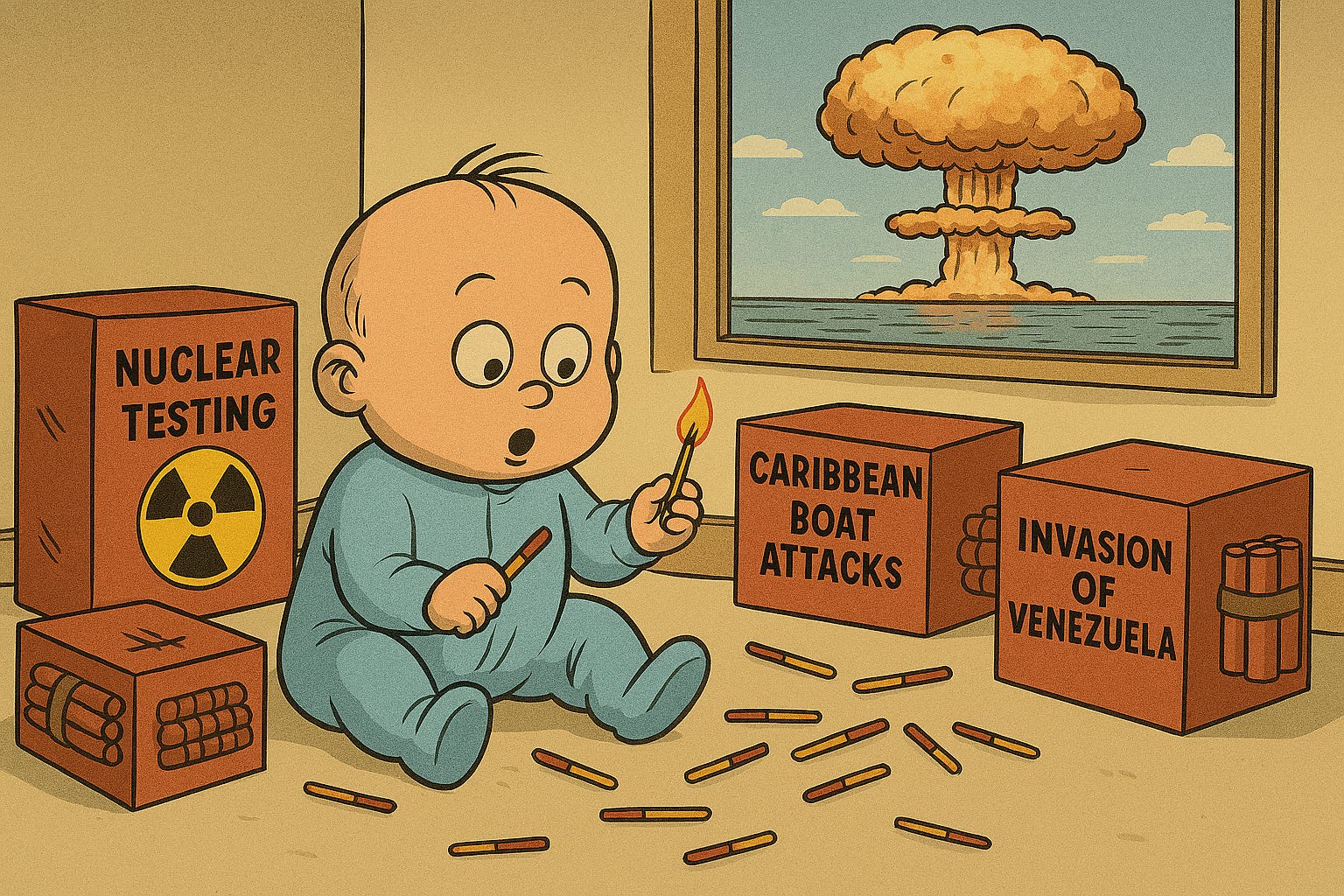
Dwight D. Eisenhower, architect of the Normandy Invasion and the eventual defeat of Nazi Germany, and 34th president of the United States, once said, “War settles nothing.” The Italian strategist and philosopher, Niccolo Machiavelli, wrote, “Wars begin when you will, but they do not end when you please.” Given the Trump administration’s actions in the Caribbean and the president’s recent announcement that the U.S. would resume nuclear testing, these are thoughts that should be on the mind of every American.
We are only four years out from the end of the longest war in American history, the debacle in Afghanistan, which began in 2001, after the September 11 terrorist attacks that were orchestrated by al-Qaeda, which was harbored by the Taliban regime in Afghanistan. The objective of Operation Enduring Freedom was to dismantle al-Qaeda and remove the Taliban from power. The second goal was achieved within a few months, but the Taliban regrouped and launched an insurgency against the U.S.-installed government, igniting a conflict that lasted for twenty years, surpassing the war in Vietnam by almost a year.
Since early September, the U.S. has conducted military strikes on 14 boats alleged to be smuggling drugs, killing 61 people. There were three alleged survivors from two of the attacks. In one attack in the Caribbean, the U.S. Navy recovered two survivors who were then repatriated to Ecuador and Colombia, their countries of origin. In one Pacific strike, Mexico rescued one survivor. In none of these 14 attacks has the U.S. provided any concrete evidence to support verbal claims that the boats were operated by ‘narcoterrorist networks’ or actually carrying large quantities of illicit drugs. U.S. President Donald Trump has announced covert CIA operations inside Venezuela and teased ground attacks, raising tensions throughout the region.
One has to wonder whether the president or his secretary of defense has thoroughly considered the long-term implications of their actions and rhetoric, or whether operational planners in the Pentagon and Southern Command have dared to outline possible scenarios and their potential outcomes.
From my years as a contingency plans officer on the staff of the ROK/US Combined Forces in Korea, I can think of three possible scenarios, none of which work out well for either side in the conflict.
The U.S. forces currently deployed in the Caribbean could conduct precision strikes on military assets, suspect drug trafficking operations, and strategic infrastructure, using air attacks, missile/drone strikes, naval blockades, and/or cyber-attacks. The downsides of this include possible civilian casualties and an asymmetric retaliation that could devolve into a much longer and deadlier conflict.
The use of Special Operations forces and local insurgency groups to pressure the Maduro regime, or even overthrow it, has less potential for civilian casualties, but could spark asymmetric retaliation and destabilize other countries in the region, leading to border conflicts.
The least likely and most undesirable option would be to launch a full-scale invasion, with occupation of Caracas and major Venezuelan urban centers, with a goal of regime change. Experience in the recent conflicts in Iraq and Afghanistan argues against this option, which would involve massive casualties on both sides and a prolonged occupation to stabilize the country.
Tensions and concerns over potential conflict in the Caribbean have been further roiled by the president’s recent announcement of the resumption of ‘nuclear weapons testing.’ The lack of specificity in Trump’s announcement, regarding whether this means testing of nuclear warheads or delivery systems, only adds to the atmosphere of uncertainty and introduces a global dimension to a potential regional conflict.
There hasn’t been much evidence of sober staff discussion or planning at the NSC or senior cabinet level in any of what looks to me like knee-jerk reactions to news stories, and the response from Congress, the arm of government with the constitutional authority to declare war, has been underwhelming. The president appears to be quickly approaching war without any serious causal evidence, and without consultation with and between the national security agencies, not to mention the American people. This is right out of his authoritarian playbook: he is going to war “because he can.” Just like all the other autocrats in a club he wants to join.
As we watch this situation unfold, I can only hope that there’s someone, somewhere in the government who understands that when you dance with the devil, you risk getting burned.
Charles A. Ray served 20 years in the U.S. Army, including two tours in Vietnam. He retired as a senior US diplomat, serving 30 years in the U.S. Foreign Service, with assignments as ambassador to the Kingdom of Cambodia and the Republic of Zimbabwe, and was the first American consul general in Ho Chi Minh City, Vietnam. He also served in senior positions with the Department of Defense and is a member of The Steady State.
Founded in 2016, The Steady State is a nonprofit 501(c)(4) organization of more than 340 former senior national security professionals. Our membership includes former officials from the CIA, FBI, Department of State, Department of Defense, and Department of Homeland Security. Drawing on deep expertise across national security disciplines, including intelligence, diplomacy, military affairs, and law, we advocate for constitutional democracy, the rule of law, and the preservation of America’s national security institutions.