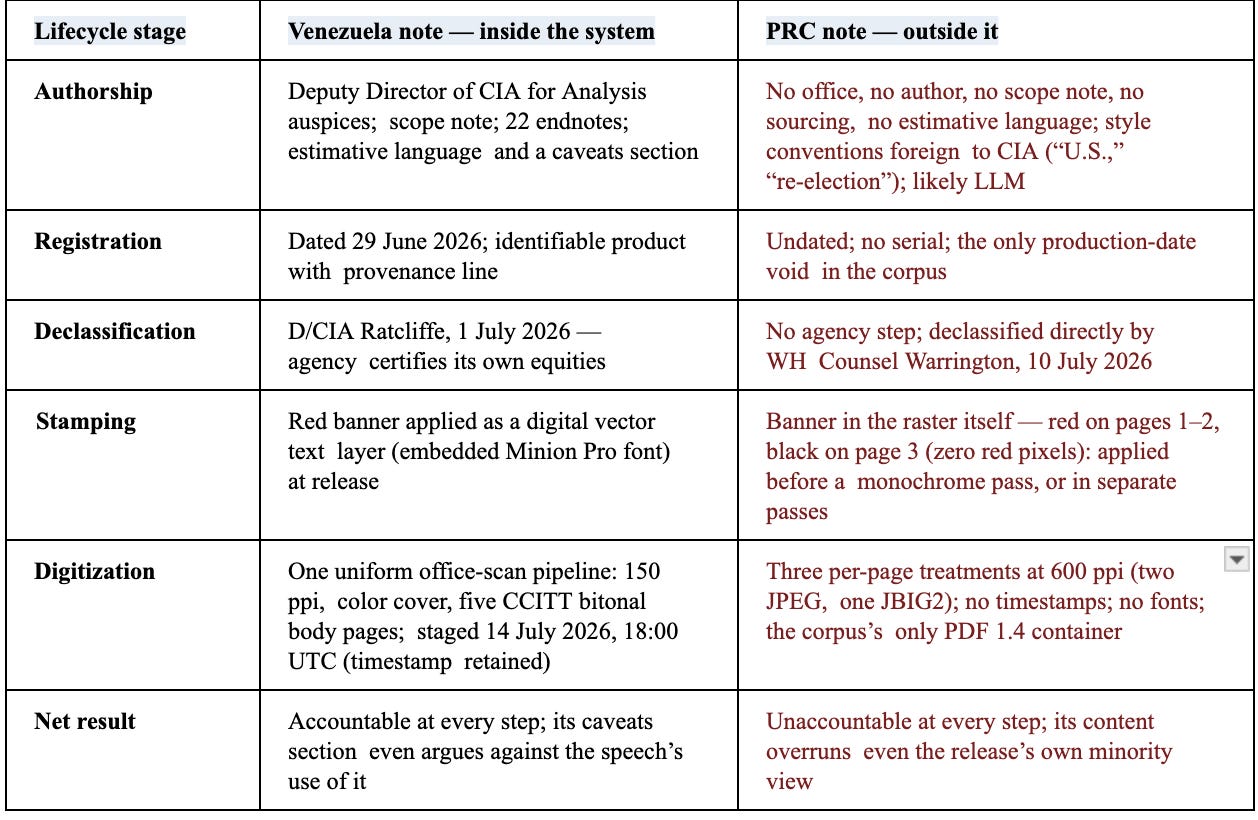
The note is probably a cherry-picked compilation based on genuine CIA raw-reporting streams, probably assembled at White House direction for the President’s speech. Agency leadership most likely routed the China interference product around CIA’s analytic directorate and tasked Directorate of Operations personnel to draft it — possibly with input from the White House Transparency Task Force — while redacting any accountable feature: no author, date, office, serial, sourcing, or agency review.
The leading alternative — a hasty but innocently intended release artifact compiled by a non-analytic office — survives on the same evidence and differs mainly in intent. What the evidence does settle is that this document existed outside normal CIA channels at every stage of its life, in contrast to the Venezuela note, its functional sibling in the same release.
The technical and administrative anomalies are one story, not two: a document with no owning office has no office workflow to digitize it, no product registration to date it, no equity holder to certify it, and no staging pipeline to stamp it — so it surfaces exactly as this one did: routed around normal review to the White House Counsel, stamped unevenly across separate passes, and scanned ad hoc into a history-free container.
1. What is established
Across five independent evidence layers, every screen isolates this document:
• Content: flat assertions of settled Chinese intent from mid-2018 (“make him resign or prevent his re election”) that conflict with the coordinated NICA (“Beijing did not intend to try to affect the election”), the WIRe, and even the release’s own minority view (“low-level, exploratory steps”). The individual reporting themes, however, align with genuine streams attested elsewhere — tariff targeting, paid-influence cultivation, “black materials,” swing-state resourcing — which matters for the theory ranking below.
• Tradecraft and style: zero estimative or sourcing language against a genre norm of 8–38 hedging markers per 1,000 words; conventions such as “U.S.” and “re-election” depart from uniform IC house style; no serial, date, office, or portion-sourcing; likely LLM or comparably mechanical drafting.
• Administrative: the only CIA-branded document in the release declassified by the White House Counsel with no visible agency-equity review — while its sibling took the normal two-step (D/CIA 1 July, Counsel release 10 July).
• Container: the only document in the release using PDF version 1.4; no embedded fonts; no timestamps. • Imagery: three pages, three encoding treatments; the release stamp red on two pages and black on the third — direct evidence the three pages of one document took at least two imaging paths.
2. Theories, ranked
Theory 1 — Purpose-built advocacy compilation (assessed likely)
A 2026 product assembled for the release: someone with access to the underlying raw disseminations — at the senior CIA or White House level (e.g., the White House Transparency Task Force) — compiled the intent-supporting excerpts into a single CIA-styled note, plausibly using LLM summarization, to supply the President’s address with the intent claims the finished analytic record would not provide. Explains every observation: missing document numbers, redacted office name and date (details that would invite verification), style conventions (a drafter outside
CIA drafting culture), zero hedging (no caveats), routing around normal CIA review (the Directorate of Analysis would not certify it).
Theory 2 — Hasty release artifact, innocently intended (plausible alternative)
A non-analytic component — front office, congressional-affairs, or declassification-review staff — compiled raw reporting excerpts into a summary under deadline pressure during the first week of July, without analytic review. Explains the style, the haste artifacts, and the missing process markers as sloppiness rather than design. Strains against three facts: the systematic completeness of the anonymity (haste usually leaves some fingerprint — a date, an office, a serial); the selection bias (a neutral compilation would have included the same counter-indications, which the NICA shows existed); and the routing (even hasty compilations of CIA equities go through CIA release review — this one did not).
Theory 3 — Genuine 2020-era internal document, stripped in release (unlikely)
A real contemporaneous CIA working aid whose header, date, and sourcing blocks lie under the redaction bars. Cannot be fully excluded — the bars sit where apparatus would be — but the in-text evidence weighs against it: the style conventions and zero sourcing descriptors are in the sentences themselves, not the redacted margins; no authentic raw reporting compilation in the release (compare the FBI Albany IIR, wrapped in reliability warnings) looks like this; and a genuine CIA product had the Ratcliffe path available and did not take it.
Theory 4 — Whole-cloth fabrication of content (remote)
The reporting items themselves invented. Weakest theory: the items align too well with authentic streams attested elsewhere in the release, fabrication was unnecessary when curation of real raw reporting could achieve the same effect, and no content element has been affirmatively falsified. The document’s defect is characterization and accountability, not necessarily invented facts.
3. Why it differs from the Venezuela note at every step
The comparison is the assessment’s strongest evidence because it controls for everything else: same release, same agency branding, same document genre, same two-week window, same ultimate releasing authority. Every divergence between the two files is therefore attributable to how each was produced and handled — and the divergences are total, stage by stage. The Venezuela note demonstrates that the system tasked for this release was fully capable of producing an accountable raw-reporting summary on deadline. The PRC note is what it looks like when that system is not used.
4. Most plausible reconstruction
Late June–early July 2026: the release package is assembled around the four document sets. The finished analytic record — NICA, WIRe, minority NICM — supports espionage and preference but refuses the intent claim the address requires. The Venezuela note shows a parallel need being met properly: DA is tasked, produces a caveated summary by 29 June, and D/CIA declassifies it 1 July.
For the China intent claim, no equivalent product exists and none could survive analytic review — the FBI’s 2020 objections to far weaker versions of the claim were already in the package. A compilation is therefore produced from the raw streams, outside the DA — by the CIA front office, the DO, or the White House; drafted flat and unhedged, plausibly by or with an LLM; printed and stamped, with at least one page passing through a monochrome step; scanned ad hoc into a minimal PDF; and inserted into the 10 July Warrington tranche, where White House Counsel authority substitutes for the agency review it never received. Released 10 July; the package staged 14 July; deployed in the address 16 July as the anchor for the speech’s strongest intent allegations.
Confidence: moderate for the overall shape; the identity of the tasking authority and drafter is not determinable from the released material — deliberately or otherwise, nothing in the document points to a person, and that anonymity is itself the finding.
5. What would change this assessment
• A native digital file or authoring metadata: would settle drafting tool and date instantly, and could elevate Theory 2 over Theory 1 (or confirm Theory 1) within a day.
• The unredacted header/footer blocks: a genuine serial and date under the bars would move Theory 3 sharply upward and require reassessment.
• The underlying disseminations with original source descriptors: would test whether the note’s flat assertions faithfully compress hedged originals (toward Theory 2) or systematically strip them (toward Theory 1).
• The release-package transmittal chain: whoever introduced the file into the 10 July tranche knows its origin; the 14 July staging timestamps give investigators the assembly session to trace.
Basis: page-by-page review of all thirty-five release documents; quantitative stylometry; PDF container and image level forensics; declassification-stamp analysis. Companion documents: “Forensic Review of the July 2026 Election Intelligence Release” and annexes.