
Common Sense Take II: States, Schools, and the Generational Roadmap – Part Two
By Max Estevao
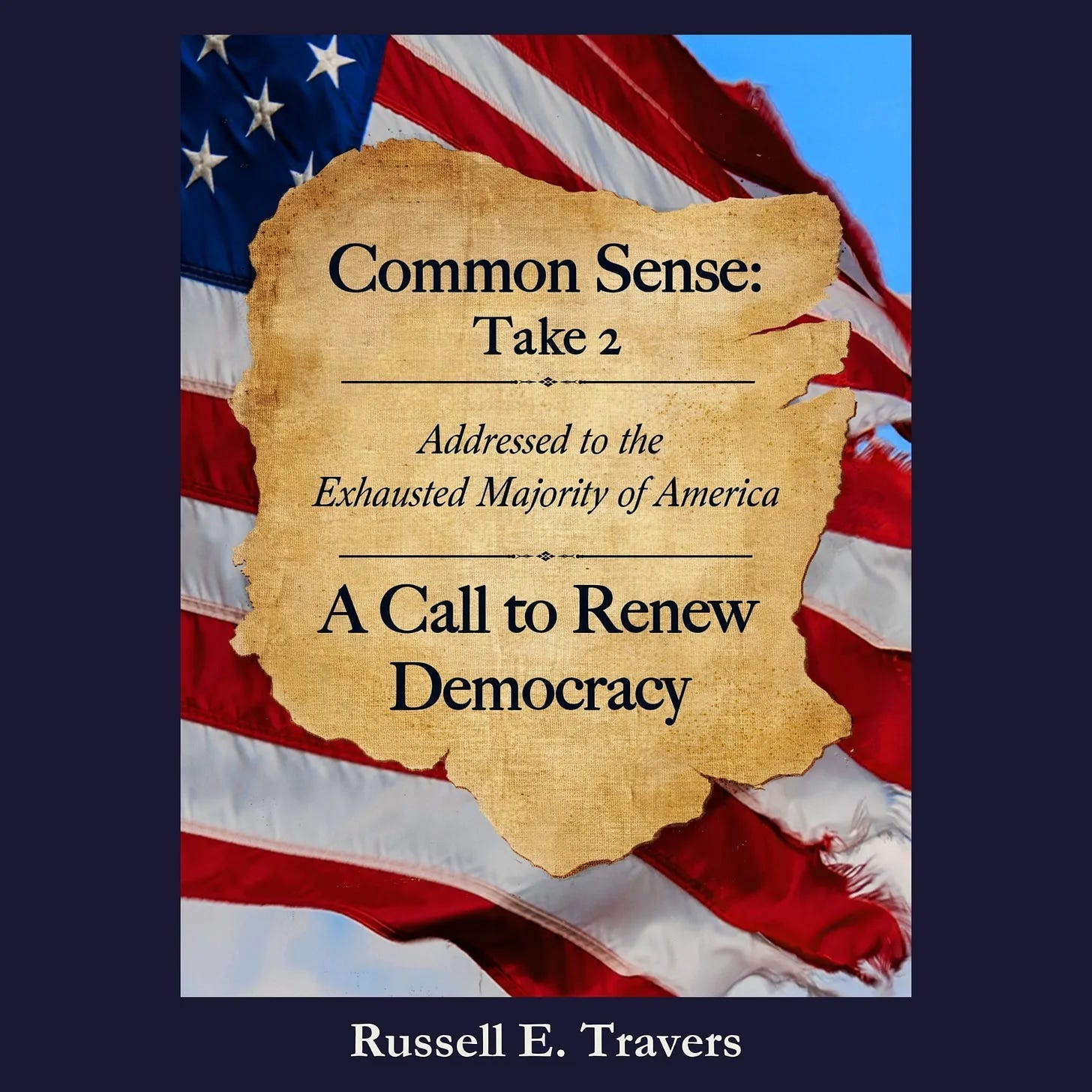
A new book, Common Sense: Take 2, A Call to Renew Democracy, contends that the United States is confronting not simply a political crisis but a deeper crisis of democratic capacity. Written by Russ Travers, a career public servant across multiple administrations who retired as Acting Director of the National Counterterrorism Center, the book focuses on the institutional, civic and cultural work needed to address this crisis.
Over a period of five weeks, members of The Steady State provide commentary on each of the book’s five themes. This essay, written Max Estevao, is the second essay this week to address the 5th theme: States, Schools, and the Generational Roadmap: Democracy isn’t a Thing We Have, it’s a Thing We Do
Democracy survives because ordinary people know how to participate. Civic education doesn’t simply teach students how government works; it teaches future citizens how to govern themselves. If America is to reverse democratic backsliding, we must stop treating democracy as an inheritance and start practicing it as a habit.
With July 4th upon us, the surrounding pomp and discourse often portray American democracy in one of two lights. For the administration, the word “democracy” is a shield against accusations of authoritarianism. This administration has invoked electoral victory as proof of democratic legitimacy and has viewed the 2024 election and a vote for Trump as a mandate for impunity, excusing attacks on constitutional limits. Others, however, describe democracy as a precious thing to defend, and they have tirelessly defended it through their right to peaceful protest, speaking out against executive overreach and attacks on the rule of law, and on the campaign trail. For both sides, however, “democracy” is portrayed as a static gift, something Americans established 250 years ago and have simply managed to preserve.
Democracy treated as an inheritance is indeed grand and special, but it is also abstract. That abstraction makes it, paradoxically, less valuable. Rising authoritarianism in the US is often difficult to articulate to the general public because concepts like “democracy,” “authoritarianism,” “civic engagement” are intangible. Worse, in our hyper-partisan environment, democracy itself can become another tribal weapon. A loss in November can be framed as the loss of everything “we” worked for, creating incentives for extreme action to maintain and regain power. Undoing this dynamic will take not just time, but a reframing of how we, as citizens, relate to our government at all levels, and to the concept of democracy itself.
Democracy as a Practice
This moment is an opportunity to push ourselves as a political culture to recognize democracy as a practice rather than a singular event or defining attribute. Such a conception is perhaps mundane, but also far more empowering. Democracy practiced is not a thing Americans are, it is a thing we do, with elections just one facet of a culture in which all citizens have inherent worth and dignity, and by extension both a right and a duty to engage in shaping civic life. In the introduction to Common Sense: Take 2, Travers describes Americans as worn down by being excluded from the institutions claiming to represent their interests, stating “We are exhausted not because we have given up, but because we have been left out.” Consider the distance many Americans feel from the levers of government, reflected in consistently low voter turnout compared to peers and a prevalence of uncontested legislative races, democratic renewal requires us to rebuild the habits of participation.
Democratic renewal is an all-hands-on-deck situation. We need courts, elected officials, and civic leaders to step up in defending the institutions and norms that facilitate the democratic process. But this is the work of a generation, not an election cycle, and moving forward requires a population with the capability to practice democracy. Our zeitgeist describes Americans as seeing themselves as fundamentally separate from their government. We approach those elected, and those appointed or empowered to act on their behalf, frustrated by the distance between policymaking and their lived experience. Yet it is not enough to demand change from the perspective of an outsider. A community whose citizens know how to recall an official, file public records requests, attend public meetings, petition for action, press for an investigation, and run for office, understands their government as not distinct from and answerable to the people- it is the people.
Local and State Engagement – Critical Tools
As the the strained relationship between the federal government and the states worsens, and as many communities experience Washington as more distant from their daily lives, this kind of participation, particularly at the state and local level, becomes critical. Although building the capacity for civic engagement will require years, and perhaps decades, of sustained participation, we already have many of the tools to do it. For example, local journalism equips citizens with the information to make informed decisions and expose conflicts of interest. Our existing civic institutions provide lifelong pathways for engagement and organization with the added benefit of fostering resilient community networks outside formal government structures.
Civic education plays a particularly critical role in sustaining this effort. Our public schools across the country can help our youth develop critical thinking skills and understand democracy as a participatory endeavor. That is the deeper role of civic education, not simply teaching the mechanics of government, but helping each generation develop the knowledge, habits, and skills needed for a lifelong, productive engagement in a healthy constitutional democracy.
Civic education, then, is not simply another subject in school. It is one of the ways a democracy teaches each generation how to participate, how to evaluate information, how to disagree without abandoning shared responsibility, and how to understand government as something citizens shape rather than merely endure. If democratic renewal is the work of decades, then civic institutions, including schools are where that renewal is practiced long before it is reflected in national elections.
Democratic backsliding didn’t happen overnight, but strengthening and using these civic tools may yet help us carve a path forward, and moving forward requires a population with the capacity to practice democracy.
Max Estevao is a former FBI Intelligence Analyst who covered Latin America and Middle East counterintelligence issues. He left federal service in 2025 and now works in private strategic intelligence and security consulting. He is member of The Steady State.
Founded in 2016, The Steady State is a nonprofit 501(c)(4) organization of more than 400 former senior national security professionals. Our membership includes former officials from the CIA, FBI, Department of State, Department of Defense, and Department of Homeland Security. Drawing on deep expertise across national security disciplines, including intelligence, diplomacy, military affairs, and law, we advocate for constitutional democracy, the rule of law, and the preservation of America’s national security institutions.
Powered by WPeMatico