
Culture And Courage
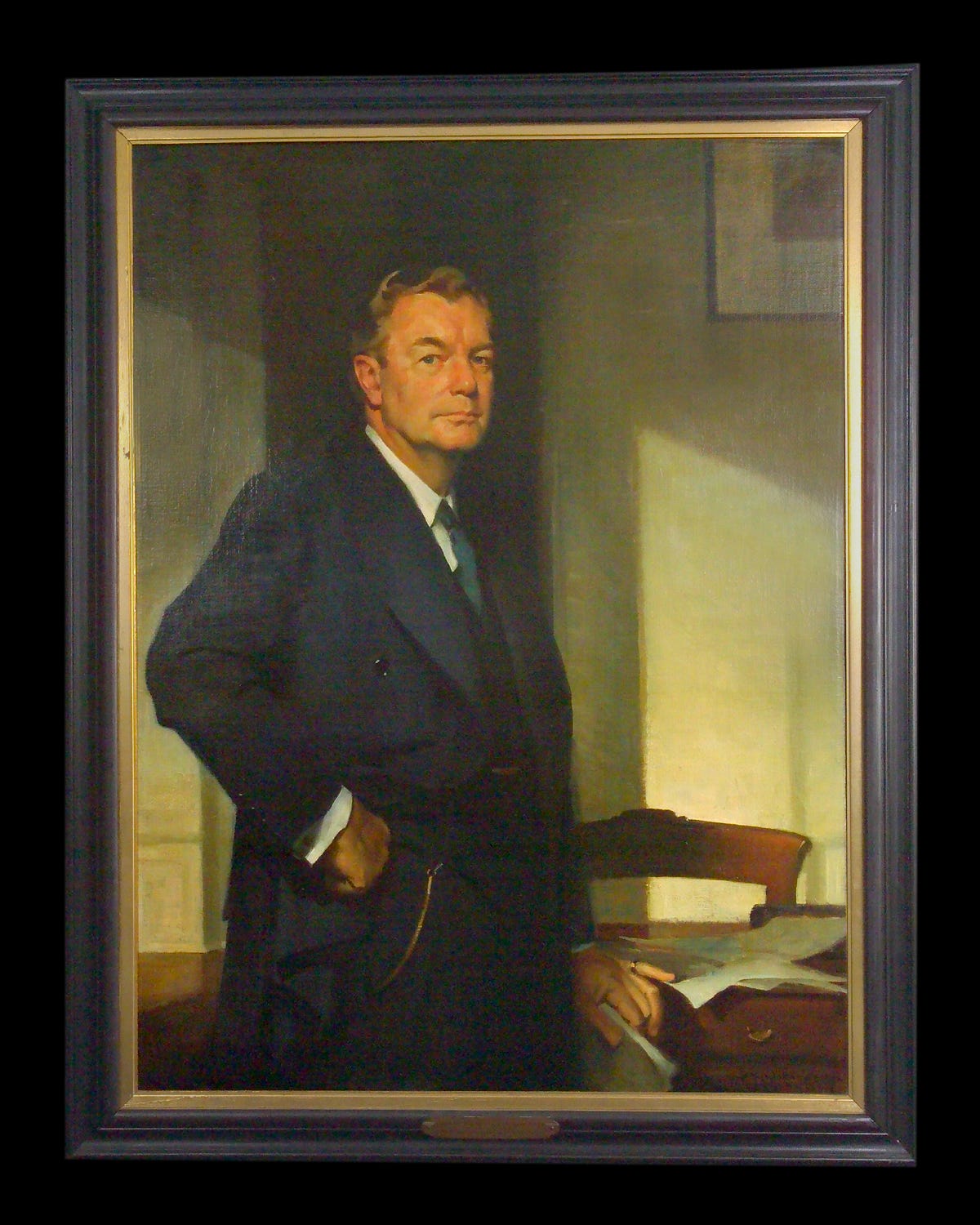
Supreme Court Justice Robert Jackson
The prosecutor has more control over life, liberty, and reputation than any other person in America. While the prosecutor at his best is one of the most beneficent forces in our society, when he acts from malice or other base motives, he is one of the worst…. Therein is the most dangerous power of the prosecutor: that he will pick people he thinks he should get, rather than pick cases that need to be prosecuted….
This 1940 quote from Supreme Court Justice Robert Jackson, who was Attorney General at the time, leads the outstanding amicus brief supporting James Comey’s motion to dismiss for vindictive prosecution, filed by over 100 former DOJ officials.1 Those officials, largely Presidential appointees, span the administrations of both parties.
Jackson’s quote, and the arguments within the brief, are well known to career prosecutors, and present a compelling case: Ultimately, those deciding who should be prosecuted are vested with vast and nearly unlimited authority. In exchange, they must exercise that authority in a scrupulously fair and ethical manner.
Ultimately where, as Justice Scalia noted, “so little is law and so much is discretion,” 2the men and women who make such decisions must understand that being a prosecutor is simply not an extension of politics by other means. Rather, as the Supreme Court has said, a prosecutor is “the representative not of an ordinary party to a controversy, but of a sovereignty whose obligation to govern impartially is as compelling as its obligation to govern at all; and whose interest, therefore, in a criminal prosecution is not that it shall win a case, but that justice shall be done.”3
The good news is that Justice Jackson’s admonitions, and others like it, have become part of the culture of the Department of Justice. It is not by accident that there wasn’t a single career prosecutor in the Eastern District of Virginia’s U.S. Attorney’s office who was willing to sign onto Comey’s indictment, and that the politically appointed U.S. Attorney chose to leave (or be fired, depending on whose version you credit) than to move forward with a politically motivated, factually and legally insufficient indictment.
History is full of examples of government counsel standing up for the higher principle of justice and fidelity to the Constitution, starting with the famous “Saturday Night Massacre” in the Nixon Administration, to Comey himself, as acting Attorney General in 2004 who, along with Attorney General Ashcroft and FBI Director Robert Mueller, threatened to resign rather than permit an unauthorized surveillance program. In the waning weeks of the first Trump term, acting Attorney General Jeff Rosen and acting Deputy Attorney General Richard Donoghue told the President they would quit rather than send a letter disputing the election results and that there would be “hundreds of resignations” by DOJ lawyers.
More recently, there were mass resignations as a result of prosecutors being ordered for political reasons to dismiss the Eric Adams fraud indictment. The acting U.S. Attorney for the Southern District of New York, resigned but before doing so, wrote a tightly reasoned defense of why dismissing the indictment was “inconsistent with [her] ability and duty to prosecute federal crimes without fear or favor…” Within a week, that resignation was followed by that of the acting Chief of the Criminal Division, the acting Chief of the Public Integrity section, and three other lawyers who worked there. They chose to quit rather than sacrifice the fundamental principles articulated by Justice Robert Jackson. Assistant U.S. Attorney Hagan Scotten, on the Adams trial team, summarized his emphatic refusal: “I expect you will eventually find someone who is enough of a fool, or enough of a coward, to file your motion. But it was never going to be me.”
There are dozens of other examples. My former colleague and the Criminal Division chief of the D.C. U.S. Attorney’s Office, Denise Cheung, resigned rather than pursue a legal action when there was insufficient evidence. She chose her integrity over her job. “This office is a special place,” she wrote when she resigned. “I took an oath of office to support and defend the Constitution, and I have executed this duty faithfully.”
I could list more.
At a time when political and personal courage seems to be in retreat, it is heartening to see men and women in the Department choosing to speak truth to power. They have stood up for the Constitution, and for the ethos and culture of the Department that I know and love, and risked retribution by crossing a notoriously vengeful administration. It speaks well of the best traditions and culture of the Department.
But relying on personal and professional courage is a tenuous perch on which to rest the health of the Constitution and a vitally important institution. The career prosecutors’ willingness to sacrifice themselves has exacted a terrible and probably unsustainable cost, in terms of individual careers and the effectiveness of the offices in which they serve. And the administration will no doubt find “fools or cowards” to step in, as evidenced by the fact that the Department imported Assistant U.S. Attorneys from other jurisdictions to handle the Comey prosecution.
That is why others, such as the lawyers in this amicus brief, must stand up and reinforce Justice Jackson’s admonitions. Ultimately, our Constitution and our institutions are only as good as the people who are willing to defend them.
Amicus Curiae Brief of Former Department of Justice Officials supporting Defendant’s Motion to Dismiss the Indictment, United States v Comey, No. 1:25-cr-00272 (E.D. Va. Oct. 27, 2025) (filed Oct. 28, 2025)
Morrison v Olson, 487 U.S. 654 (1988)
Berger v United States, 295 U.S. 78, 88 (1935)
The Honorable John Roth was appointed by President Obama to be the Inspector General at the Department of Homeland Security, where he served from 2013-2017. Prior to that, he was a career lawyer at the Department of Justice for 25 years, prosecuting cases and supervising others in three U.S. Attorney’s Offices, leading two litigation sections in the Criminal Division at Main Justice, and as Chief of Staff to the Deputy Attorney General during the George W. Bush administration. He also served as Senior Counsel and Team Leader on the 9/11 Commission, contributing to the final report and co-authoring a treatise of terrorist financing. He is a member of The Steady State.
Founded in 2016, The Steady State is a nonprofit 501(c)(4) organization of more than 360 former senior national security professionals. Our membership includes former officials from the CIA, FBI, Department of State, Department of Defense and Department of Homeland Security. Drawing on deep expertise across national security disciplines including intelligence, diplomacy, military affairs and law, we advocate for constitutional democracy, the rule of law and the preservation of America’s national security institutions.