Does Donald Trump Understand What
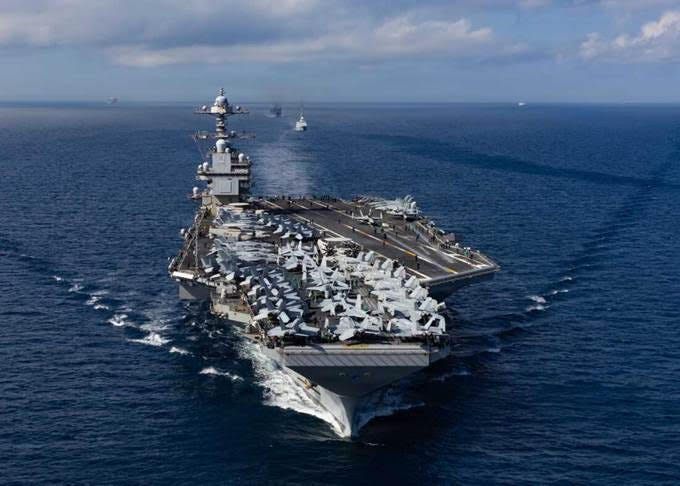
(photo from The backstory of the USS Gerald R. Ford aircraft carrier : NPR)
Much has been written about Trump’s shoddy stewardship of American foreign policy. He is ignorant and contemptuous of the world’s complexity, he does not trouble to learn, and he does not seem to realize or care about how little he understands. He expects the rest of the world to accept American demands willingly, and his sense of successful diplomacy — really, a perversion of the concept — is that he wins and someone else loses. While that might work (occasionally) in real estate deals – where he might not need to care about the bested party – other countries, their resentments and needs, and their opposition to or turning away from America continue to pose complicated, unavoidable issues. Trump loves commanding the blunter instruments of American power, having discarded or dismantled many of the softer, but very effective, ones.
But Trump does this without comprehending – and this is the dangerous and truly frightening part – how to use them, not for his own vainglory or enrichment, but to benefit the nation’s security and the American people. Examples of this behavior occur daily; my colleague Steven Cash recently detailed Trump’s lies about the Saudi Crown Prince’s responsibility for Jamal Khashoggi’s murder and Trump’s family’s substantial financial relationship with the kingdom.
Despite the fact that Trump took office thundering about America needing to get out of overseas military commitments (an important promise to many of his supporters), he has not been shy about wielding military resources. The current, volatile case in point is the significant deployment of warships and aircraft (including the largest U.S. carrier, the USS Gerald R. Ford, pictured above) off the coast of Venezuela while continuing to summarily destroy small boats and their crews for alleged drug-running. In early September, I wrote that “While this ‘feel good’ act (the first such deadly attack) might conceivably make an impression on those orchestrating international drug flows, it is more likely to be either a ‘one off’ lashing-out or possibly a first step in a spray-gun, clumsy use of the U.S. military.”
Update: the death toll is now twenty-one small boats, with some eighty people killed. In international human rights terms, these have been “extra-judicial killings;” (ie, without any due process or judicial proceedings). More plainly described, they are murders. The Trump Administration, in one of its typically wobbly legal interpretations, has claimed these people are “enemy combatants” or vaguely designated “terrorists,” and thus legitimate targets. Legal experts widely dispute this, since these people – whether or not they have been running drugs (unlikely to be headed for the U.S. in any case) — are not members of organized armed forces belonging to any party engaged in armed attacks or imminent attacks on the United States. In fact, the U.S. has called on other countries to help repatriate survivors of the strikes, undercutting its own claims.
Having now deployed additional forces in the Caribbean, some of them close enough to the Venezuelan and Trinidadian coasts to frighten local fishermen from pursuing their livelihoods, Trump has still left us wondering about his strategic goals and objectives. His statements on the subject vary according to the day. In addition to stopping alleged drug trafficking, Trump has publicly threatened Venezuela in vague ways – pointedly, though, not ruling out getting rid of the admittedly loathsome dictator Maduro – with the deployment as his muscle. My colleague Charles Ray has well described the possibility that Trump’s authoritarian bent could lead him to launch a conflict as a distraction from troubles at home (When Things Get Tough, Rogues Start Wars).
Although the Executive and Legislative branches have often sparred over their respective War Powers, Congress has also notably failed to demand that Trump define a strategy, comply with the law regarding his responsibilities to the legislature, and make the effort to win its and public support. Experts define “strategy” this way:
a rigorously thought-out determination of one’s goals, concrete objectives to be achieved along the way, available capabilities, and mechanisms to stay on track despite unanticipated, unintended, and/or negative consequences.
Trump actually seems to believe that not defining goals gives him an advantage of “strategic ambiguity” by keeping adversaries off-balance. In fact, this approach just complicates adversaries’ own risk calculations, making it easier for them to make mistakes, heightening the danger to us. More broadly, his approach also confuses friends, the American people, and probably himself as well – all serious errors, too.
U.S. forces off Venezuela have reportedly moved into a high state of readiness. Withdrawal without some goal being achieved would seem unlikely. Are any eventual hostilities going to be anywhere as “clean” (i.e., not endangering U.S. forces) and brief as the June bombing of Iran (an operation that seems to have produced only partial success)? Sharper thinking about U.S. goals could well show them to be ambitious, problematic, dangerous, and possibly elusive as well. So what is the plan?
Do Trump, Secretary Hegseth, and their advisors have a strategy as defined above? Are they even capable of formulating one? The record up to now suggests that the answer to both questions is unfortunately no. I suspect that the recent captive audience at Quantico, where the entire general-officer corps got unfiltered doses of both men up close, means that the men and women in uniform know this, too. Not all will resign, as SouthCom Commander Admiral Holsey (the senior officer responsible for commanding all U.S. forces in the region) unexpectedly did recently, but I am sure many harbor serious doubts that the Commander-in-Chief of all U.S. armed forces knows what he is doing. Congress is beginning to stir, but it is also a long way from living up to its own responsibilities to protect the American people’s interests.
Tom Wolfson is a former senior U.S. diplomat who has lived and worked in six foreign countries, occasionally multiple times. His work representing the U.S. has included assignments at the United Nations, in the U.S. Congress, and with an international democracy-building organization. He is a member of The Steady State.
Founded in 2016, The Steady State is a nonprofit 501(c)(4) organization of more than 360 former senior national security professionals. Our membership includes former officials from the CIA, FBI, Department of State, Department of Defense and Department of Homeland Security. Drawing on deep expertise across national security disciplines including intelligence, diplomacy, military affairs and law, we advocate for constitutional democracy, the rule of law and the preservation of America’s national security institutions.