
Fredonia Project Sitrep 19 Us Domestic
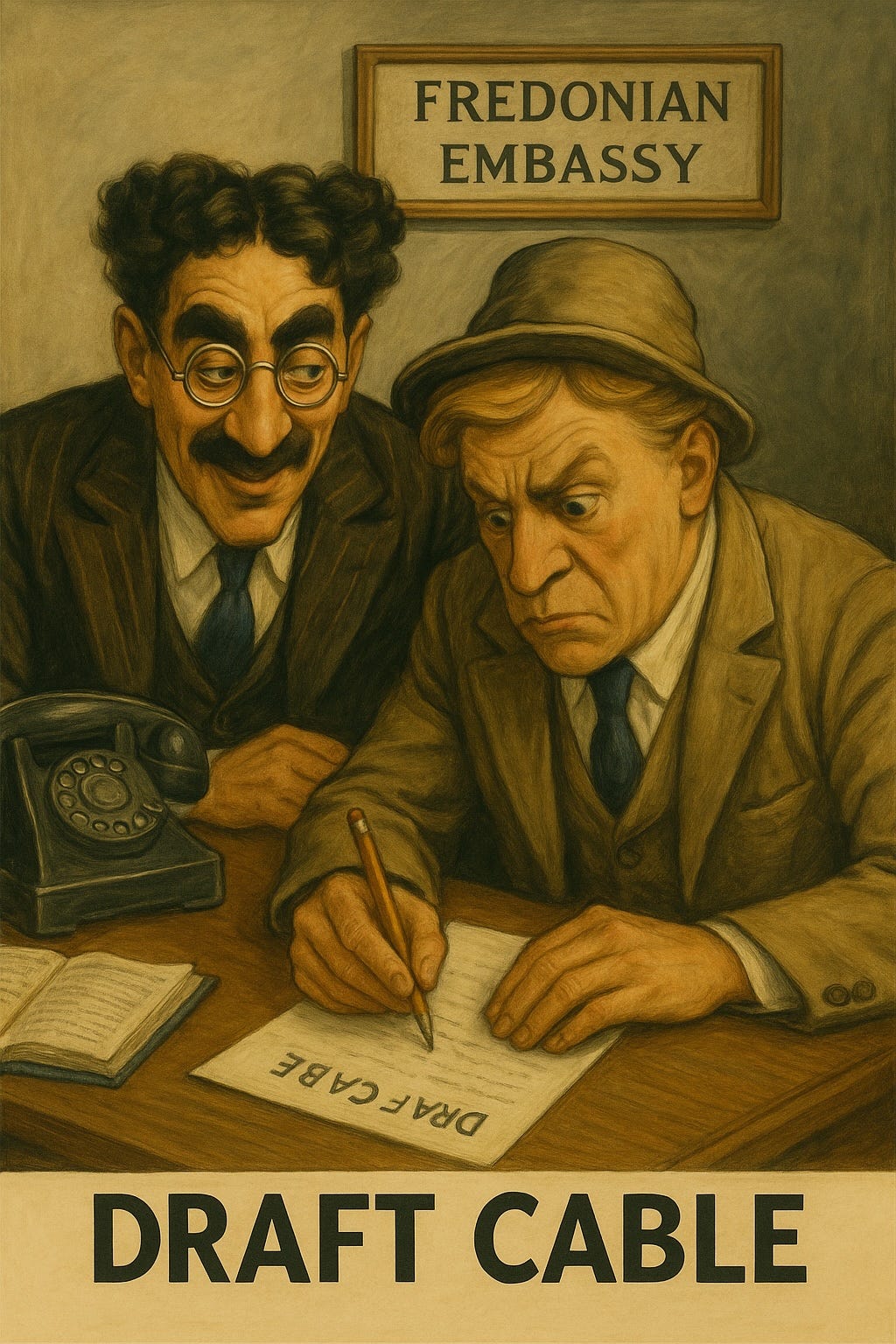
DATE-TIME GROUP: 31 1800ZOCTOBER25 FROM: EMBASSY OF FREDONIA, WASHINGTON, D.C.
TO: MFA NAGADOCHES
CLASSIFICATION: CONEOFSILENCE // FREDONIAN EYES ONLY
SUBJECT: SITREP 019 “THE FREDONIA PROJECT” – OBSERVATIONAL DISPATCHES FROM AMERICA IN CRISIS 1-31 OCTOBER 2025
SUMMARY:
IN ACCORDANCE WITH MFA DIRECTIVE 1826-APRIL-1, THIS EMBASSY HAS INITIATED A REGULAR SERIES OF ANALYTICAL DISPATCHES REGARDING THE INTERNAL DYNAMICS OF THE UNITED STATES. THE SERIES, DESIGNATED “THE FREDONIA PROJECT,” WILL BE CIRCULATED UNDER STANDARD SITREP PROTOCOL. UNAUTHORIZED PUBLICATION HAS BEEN OBSERVED VIA THIRD-PARTY ENTITY KNOWN AS “THE STEADY STATE.” PRESUMED LEAK. NO ACTION REQUIRED.
The period between October 1 and October 31, 2025 was a busy one for the Trump Administration. The Administration worked with their Congressional allies to shut down the US government and go home, all the while refusing to negotiate with the Democrats to end the shut down, pay thousands of employees and feed millions of children. It has been a study in cruelty, bigotry, stupidity and hate; in other words just another set of days in the Trump II administration. (Ambassador Comment: are these legislators being paid through this shut down? Are the Cabinet Secretaries being paid now? They are not working and are shut down; if they are being paid, that might be something important to highlight to people who are also not being paid.)
1. Major actions & statements
Trade and economic / tariffs:
On October 1, Trump’s tariffs on imported branded drugs, heavy trucks and furniture took effect. Trump is now selling this as part of the administration’s use of tariffs as a foreign-policy and economic leverage tool. He needs this justification, since prices will rise, and supplies may be limited. (Ambassador comment: It seems likely that these tariffs are a way to make up revenue lost from enormous tax cuts on the very rich in the “One Big Beautiful Bill. It is difficult to understand how higher prices, which will result from these tariffs will improve the American economy.)
On October 10, 2025, Trump threatened to impose a 100% tariff on all Chinese imports starting November 1 in retaliation for China’s newly announced export controls on rare-earth elements. Needless to say, this tariff rate seems likely to have changed once Trump met with Xi during his late October trip to Asia. His justification consisted of a characterization of China as “holding the world captive” by restricting access to technologies used in chips, lasers, jet-engines, etc.
It is likely that these moves will trigger inflation and supply chain disruption, and contribute to global trade instability. (Ambassador comment: As of the morning of 30 October, it seems that Trump has revised down his tariffs. They will still result in higher prices for goods coming out of China. Otherwise, these are great ideas!)
b) Military / security escalation:
On October 1, the Trump administration formally notified Congress that the U.S. was in a “non-international armed conflict” with unspecified “unlawful combatants” (i.e., drug cartel organizations) in the Caribbean. The legal basis of this has been challenged. (Ambassador comment: there have been 14 boats targeted and at least 13 airstrikes. There have been some 57 people killed. At no time has anyone in the Trump Administration provided a scintilla of evidence that any of these boats was engaged in drug running. It is important to note that all of these attacks have been called by some to be extrajudicial killings. Which is extra-not legal or remotely moral. Once again, we are watching the Trump Administration toss away any moral decency and all claims to international leadership by the US, and to continue the race toward the bottom of the list of world’s nastiest players.)
On October 24, the Pentagon notified the deployment of the aircraft carrier USS Gerald R. Ford and its strike group to the Caribbean/Latin America as part of a campaign against “transnational criminal organizations” (i.e., drug-cartels) under the Trump directive. The move significantly expanded U.S. military presence in the region.
These actions mark a sharper turn toward militarized intervention in Latin America under the guise of anti-drug/terror operations. (Ambassador comment: we have seen these shaky explanations for military build up from other presidents. It would pay to look carefully at the Trump insistence that these attacks are justified before the US moves closer to full warfare.)
c) Domestic protest and civil-liberties blowback:
On October 18, the “No Kings Protests” took place across the U.S. (in >2,500 locations) with what promised to be millions participating (estimates of 5–8 million). Protesters cited concerns about authoritarian drift, militarization of domestic policing and federal law-enforcement targeting immigrants. Critics, including Trump Congressional allies, spent the two weeks leading up to the marches predicting violence and mayhem, none of which occurred.
In New York alone more than 100,000 people marched peacefully.
President Trump responded by calling the marches “anti-American” and accused protesters of “hate America” activity. (Ambassador Comment: The Trump/Republican attacks and slanders didn’t dissuade anyone, and the protests were enormous. Trump “retaliated” by releasing an animated short showing him in a crown and flight suit, piloting a US jet fighter over the demonstrations, and then releasing feces over the demonstrators. So much for being fully qualified to be awarded the Nobel Peace Prize.)
d) The Epstein-files:
The debates over the release of the Epstein files pre-date October. From 1-27 October, the “files” issue continued to fester politically even as Trump repeatedly dismissed the matter as a “hoax” and told supporters to “stop wasting time” on it.
On October 17, the House Oversight Committee released a tranche of documents in the ongoing investigation into Jeffrey Epstein. The documents include call logs with redactions, one showing two calls from someone listed as “Donald Trump.” The White House claimed “It’s not news that Epstein knew Trump” and reiterated Trump had kicked Epstein out of his club.
The Epstein files controversy is creating an unusual intra-GOP schism. While Trump publicly attacks those pressing him on the matter, some conservative influencers and backbench Republicans are uneasy. (Ambassador Comment: And those influencers and backbenchers SHOULD be uneasy. One of the original Trump fan girls, Marjorie Taylor Greene has repeatedly called for the files to be released, and is using this newly public distancing from Trump to loudly disagree with the House Republican majority’s shutdown, and other Johnson-sponsored priorities.)
2. International reaction to the tariffs and economic policies, and their impact
The EU and other allies are watching the tariff moves carefully: the threatened 100% tariff on Chinese imports raised major concerns in Asia and Europe about renewed trade war and supply-chain disruption.
The U.S. ‘s militarized approach in Latin America and unilateral use of force under Trump’s direction is unsettling to smaller democracies in the region which often depend on diplomatic rather than military engagement from the U.S. Per Le Monde, this is “worrying” and might violate international law. (Ambassador Comments: To quote a great American philosopher: D’oh.)
Because Trump’s approach emphases unilateralism, tariffs, militarized interventions and reduction of multilateral cooperation, smaller liberal democracies (e.g., in Europe, Latin America, Asia) that have relied on robust U.S. leadership and predictable liberal-international order are now facing increased uncertainty about U.S. reliability as an ally.
3. Impact on Small, Liberal Democracies (U.S. allies)
Many middle-sized liberal democracies (in Europe, Latin America, Asia) rely on the U.S. for stable trade, security guarantees, multilateral cooperation and leadership in institutions (NATO, WTO, U.N.). Trump’s tilt toward tariffs, unilateral military action and skepticism of multilateralism undermines that foundation.
In Europe or Asia, the threat of a U.S.–China tech trade war places these states in the cross-hairs: they may have to choose between U.S. alignment (and face Chinese economic retaliation) or accommodate China (and upset the U.S.). The unpredictability reduces the confidence smaller democracies can place in the U.S. as a strategic anchor.
Democratic norms: Before Trump, the U.S. was a model for rule-of-law, transparency and institutional stability. A U.S. presidency that appears to suppress transparency (Epstein-files), that deploys domestic and foreign forces beyond oversight, and that pushes labour/trade policy based on unilateralism weakens the global example, emboldening illiberal governments to justify their own erosion of democratic norms.
4. Illegal or ethically questionable moves or statements:
President Trump, with no approvals from any authority and in direct conflict with the Government Services Administration, the agency responsible for the federal government’s real estate, Congress and any one with any sense of history, tore down the East Wing of the White House and plans to replace it with a 90,000 square foot, goldleaf encrusted, Liberace-themed ballroom. The ballroom decor as publicly released to date, is eye poppingly tacky, which is totally and completely unsurprising. (Ambassador Comments: Much of the commentary about this addition to the White House compound has focused on the gilt and glitz of the proposed decor and the size of the building. It seems that at least one other issue might be more important: The building was not Trump’s to destroy. The White House is the people’s house, not the temporary tenant’s property. This destruction and property grab was the most blatant, in a series of extraordinarily moves to signal that the people don’t matter to Trump, that Trump isn’t planning to leave, and that too many Trump supporters – including elected officials – are OK, or too scared to go against, the permanent occupation of DC by Trump.)
The declaration of “armed conflict” with cartels and the use of naval/strike-group deployments in Latin America raise significant questions about legality (international law, war powers) and oversight. Analysts in Le Monde flagged the lack of legal authorization. (Ambassador Comments: There is negative, but by no means universal, reaction to these unusual and likely illegal military attacks. There is some call, but again, not nearly enough, for the Administration to release any evidence that the boats and their occupants are engaged in any illegal activities; and at least one of these boats had turned away from the US before it was attacked.)
The handling of the Epstein-files: refusal to release full documents, contradictory statements, the use of shutdown/tactical delay, and dismissal of the issue by Trump as a “hoax” raise concerns about obstruction or at least selective transparency. While this has not been proven to be illegal, it is clearly ethically questionable for Trump to refuse to share documents that detail the actions of a convicted felon. (Ambassador comment: ethically questionable is the kindest way to explain Trump’s refusal to share documents that are not his and that shine a light on his activities with a convicted child sex abuser.)
The tariff announcements: While legal under many of the president’s trade-authorities, the aggressive use of tariffs as foreign-policy coercion (100% China, 50% furniture, etc) is destabilizing and may be proven to be contrary to trade-deal obligations.
Federal domestic civil-liberties concerns: The massive federal response to protests and increased, apparently unending, presence of federal officials in law enforcement capabilities in local jurisdictions and militarized posture in civil society raise concerns about democratic accountability and due-process. (Ambassador comments: There have been reports of increasingly frequent and disapproving public comments by members of the US National Guard and military officers. Per CBS News, “Two Illinois National Guard members told CBS News they would refuse to obey federal orders to deploy in Chicago as part of President Trump’s controversial immigration enforcement mission—a rare act of open defiance from within the military ranks.“It’s disheartening to be forced to go against your community members and your neighbors,” said Staff Sgt. Demi Palecek, a Latina guardswoman and state legislative candidate from Illinois’s 13th District. “It feels illegal. This is not what we signed up to do.”Both Palecek and Capt. Dylan Blaha, who is running for Congress in the same district, described growing unease among Guard members after the White House federalized 500 troops – including members of the Illinois and Texas National Guard – to secure federal immigration facilities and personnel in the Chicago area.
October 2025 has been a busy and aggressively disruptive month of chaos leveled by the Trump Administration at the population, government, medical establishment and major institutions of the United States. There are hopeful signs that it has also been a month during which the American population began to move, albeit slowly, against Trump and his top lackeys (a singularly unpleasant gaggle of people). The illegal power grabs, the “legal” actions against people who Trump dislikes (and likely fears), the juvenile Trump insults, the casually dropped negative slurs and innuendos, and the constant ratcheting up of military or military-style actions against the people of the United States may be goosing the population toward action. More people protested against Trump and his wannabe reign on October 18th in more places in the United States and abroad than have joined before. And, more people seem to believe that the country is no longer in the slide toward autocracy but is now a competitive autocracy – with elections and governmental functions that appear vaguely normal but no longer are. That said, this week alone, there were at least two Senate votes that went against Trump. It feels somehow different now. The elections scheduled for the first week in November will provide another data point or two. Fredonia’s representatives here are hopeful.
Founded in 2016, The Steady State is a nonprofit 501(c)(4) organization of more than 340 former senior national security professionals. Our membership includes former officials from the CIA, FBI, Department of State, Department of Defense and Department of Homeland Security. Drawing on deep expertise across national security disciplines including intelligence, diplomacy, military affairs and law, we advocate for constitutional democracy, the rule of law and the preservation of America’s national security institutions.