
How America Lost Canada – A Canadian Perspective
The Canadian Guest Author’s Name is Withheld
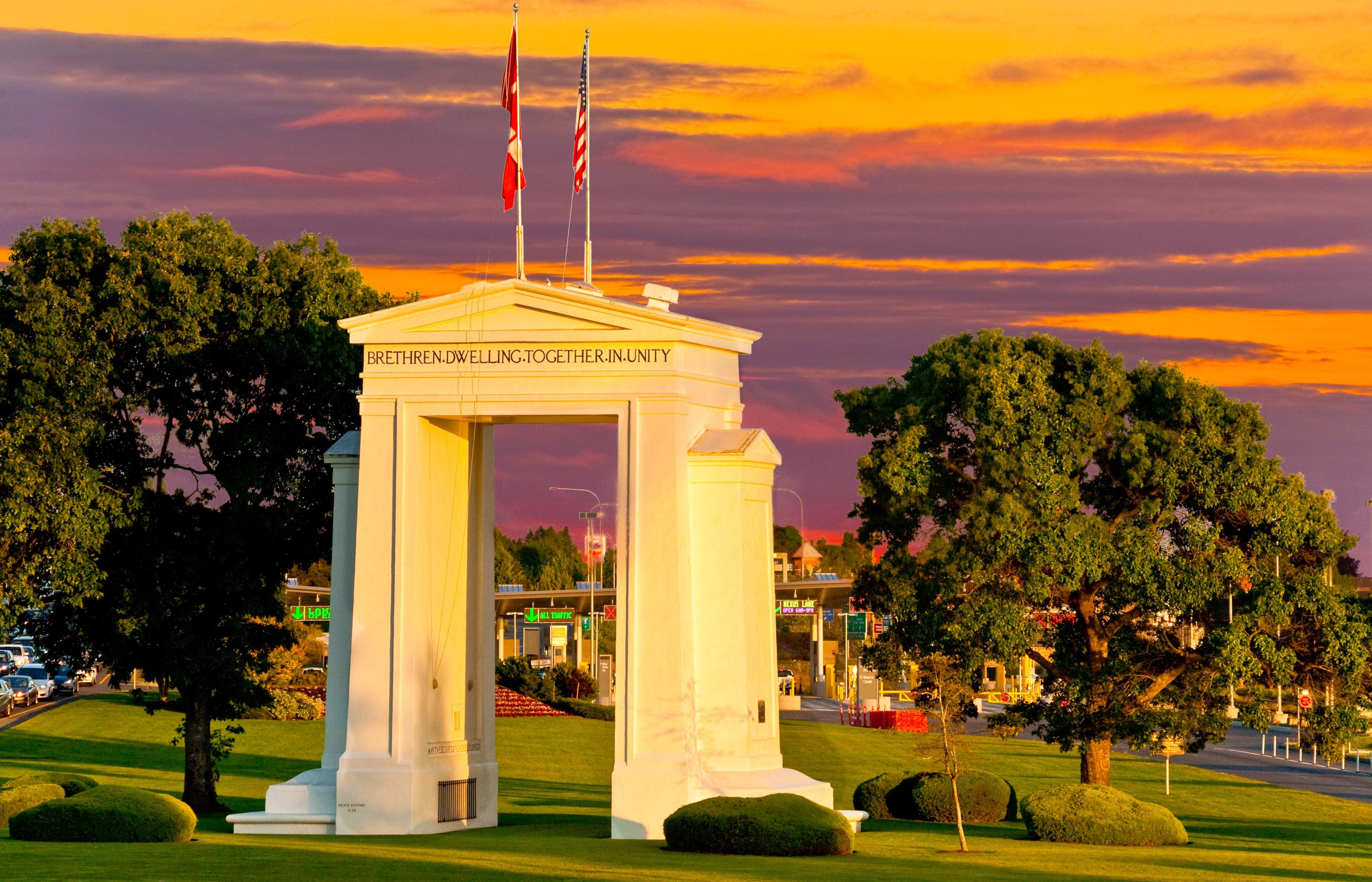
The Peace Arch
Tariffs, annexation rhetoric, and uncertainty about NATO have done what decades of geopolitical rivalry never could: convince many Canadians that the United States itself has become their greatest strategic concern.
The Canadian Reaction
Canadians have become disenchanted with the United States, not with Americans per se, but with their Leader who is now often characterized as unreliable, unpredictable, and unencumbered by facts. A recent Nanos survey for Bloomberg shows 55% of Canadians now view US/Trump as their top threat, (China is at 15% and Russia at 14%).* Why have Canadians become so disenchanted with their closest friend and ally? As outlined below, there are no surprises here. Also summarized is how Canadians are coping with this discouraging turn of events, both officially and at a personal level.
Trump’s Two-Pronged Global Attack
Frustrated by far too many “adults in the room” during his first presidency, Trump was better prepared to unleash his ideological trade and security tsunami upon the world right from the start of his second presidency. This time Trump wielded a powerful trifecta: hordes of MAGA true believers, a neutered GOP and feeble Democratic Party, and a cabinet full of generally incompetent sycophants.
Trump’s first shockwave was his unleashing of tariffs, far and wide, on friends and foes alike, including on at least one uninhabited island. Trump’s frontal assault on the post-WWII economic order achieved a chaotic result in quick time, one not necessarily to his advantage. His ongoing tariff wars and demands for trade restitution became even more confusing with his TACO decisions and indecisions. Trump’s bully trade tactics will have far-reaching implications for the upcoming US-Mexico-Canada (USMCA) talks as well as “deals” already reached with the European Union (EU) and elsewhere. Indeed, Trump’s tariff tactics encourage old friends and trading partners to seek alternative trade options as part of their economic risk management strategies even as they review and redefine their own security needs. Ironically Canada, the EU and Association of Southeast Asian (ASEAN) members are exploring closer trade opportunities with China despite their perceptions of China as a security threat and their well-founded concerns about China’s commercial retaliation over perceived affronts. Trump’s pilgrimage to the Middle Kingdom produced no paradigm shifts. Meanwhile Trump’s destructive zero-sum “winner-take-all” remains official US economic dogma.
Trump’s second shockwave of distancing the US from NATO has caused friends and allies to wonder just how reliable the US would be in a military crisis. Trump’s skepticism of NATO has long been known. Xi and Putin can only be happy every time that Trump verbally attacked NATO members, over how to open the Strait of Hormuz (“Cowards!”). Trump’s desires to buy Greenland and to turn Canada into the 51st state have also not enhanced alliance trust. Trump’s insults of those friends and allies who spilt blood and treasure in Afghanistan along with their American comrades have equally been unhelpful. Trump’s friendliness towards Putin led NATO members to wonder how NATO would collectively respond to a blatant Russian incursion into Eastern Europe. One bonus, however, from Trump’s attacks on NATO is that Canada and the Europeans are getting more serious about defence spending.
Trumpian trade and foreign policy (perhaps better described as pinball thoughts created in the middle of the night and implemented via Truth Social) do seem to be a strategic retreat. The current drama with Iran, including questions about its real origins and unclear objectives, continues to play itself out. Trump’s bombast, his claims of victory and changing deadlines for changing objectives all seem hollow. Trump’s “excursion in Iran” has also taken his attention away from Putin’s War on Ukraine and even helped that “special military operation” when the US dropped sanctions on Russian oil sales. Trump’s National Security Strategy, so praised by the Kremlin, is more focused on dreams of US hegemony in the Western Hemisphere, aka the “Donroe Doctrine”, than a vision of America’s future role in the world. This, when Xi Jinping, with global ambitions, continues to play a new “Great Game” with the assistance of his enthusiastic junior partner Putin. Both Xi and Putin successfully gamed Trump during his first term. It is happening again. Putin continues his slog against Ukraine. Meanwhile Xi watches and waits intently.
Canada’s Response: Diversity
In 2018 at the conclusion of North American Free Trade Agreement (NAFTA) renegotiations Trump called USMCA “the most modern, up-to-date, and balanced trade agreement in the history of [the US].” OK. Now Canadians have been battered by Trump’s new tariffs, his personal insults and his threats to make Canada the 51st state. Prime Minister Carney, of recent Davos fame (“We are in the midst of a rupture, not a transition.”), has stated that what had been Canada’s strengths, close trade and security integration with the US, have turned into vulnerabilities. His conclusion: Canada must look to other options while keeping critical trade and security agreements with the US intact.
Under Carney’s leadership Canada is preparing for USMCA negotiations along with Mexico. Canadian concerns include additional Trump tariffs on aluminum, steel, autos and lumber. At the same time, however, Canada is looking for practical trade diversification away from the US. This means closer trade ties with the EU and UK, closer strategic partnerships with South Korea and Japan, and quickly concluding Free Trade Agreements with the South American trade bloc, India and ASEAN. As well, Canada has upgraded its relationship with China after several years of strain.
NATO and North American Aerospace Defense Command (NORAD) remain Canada’s central security components. While talks of the 51st state have been temporarily muted (perhaps because of the visit to Washington by the King of Canada), doubts about US military reliability have spurred Canada to establish complementary security arrangements. Canada and the Nordic Five have agreed to deepen their commitment to Arctic security. While Canadian military purchases remain overwhelmingly from the US, Canada’s new Defence Industry Strategy looks to foster greater military manufacturing within Canada as well as potential military sales from non-US sources. Canada will host the Defence Security and Resilience Bank to provide long-term low-cost financing for Defence projects within NATO. Canada’s new contribution to NORAD includes an Australian early warning system. Smaller purchases of F35s may be complemented by Swedish Gripens. NATO is looking to buy a Swedish-Canadian airborne warning system. Canada is examining the purchase of Korean or German-Norwegian submarines. Meanwhile Canada must decide whether to join Trump’s questionable Golden Dome enterprise with its implications for NORAD.
Outside of the high politics of tariff/trade negotiations and military defence options, ordinary Canadians are expressing their own personal unhappiness with Trump. There have been large public “Never 51st State” rallies. Based on University of Toronto tracking of cellphone activity, Canadian visits to the US have declined by 42% since early 2025. Statistics Canada has shown a 33% decline in road travel and a 20% decline in air travel to the US over the past year, serious hits to the US tourism industry. Detentions of Canadians by ICE have not enhanced a welcoming image. “Buy Canadian!” is the battle cry. US alcohol sales to Canada have fallen by 63%, a sobering $143 million loss, according to Fox News. Canadian grocery shoppers have been looking for alternative food sources, including from Mexico. Canadian consumer habits are not likely to change as a new USMCA gets negotiated.
Bottom Line: Sorrow and Some Anger
It is now a waiting game. These days Canadians remember TV clips of masked ICE-men in military fatigues carrying guns in American cities. Images of armed Marines and National Guard soldiers on American city streets will not fade away anytime soon. This is not the America that Canadians have long admired and cherished. This is an alien America. Trump remains unreliable, unpredictable, and unencumbered by facts. The USMCA negotiations will set the tone for US-Canada relations for the rest of the Trump presidency. Mostly in sorrow, but with some restrained anger, Canadians are hunkering down.
And in the would-be hegemon’s backyard: “Viva Cuba libre”?
The Guest Author served in the Canadian Army and Foreign Service.
Founded in 2016, The Steady State is a nonprofit 501(c)(4) organization of more than 400 former senior national security professionals. Our membership includes former officials from the CIA, FBI, Department of State, Department of Defense, and Department of Homeland Security. Drawing on deep expertise across national security disciplines, including intelligence, diplomacy, military affairs, and law, we advocate for constitutional democracy, the rule of law, and the preservation of America’s national security institutions.
Powered by WPeMatico