
ICYMI: “He’s Trying to Destroy the First Amendment” – Bob Drogin on Trump’s War on the Press
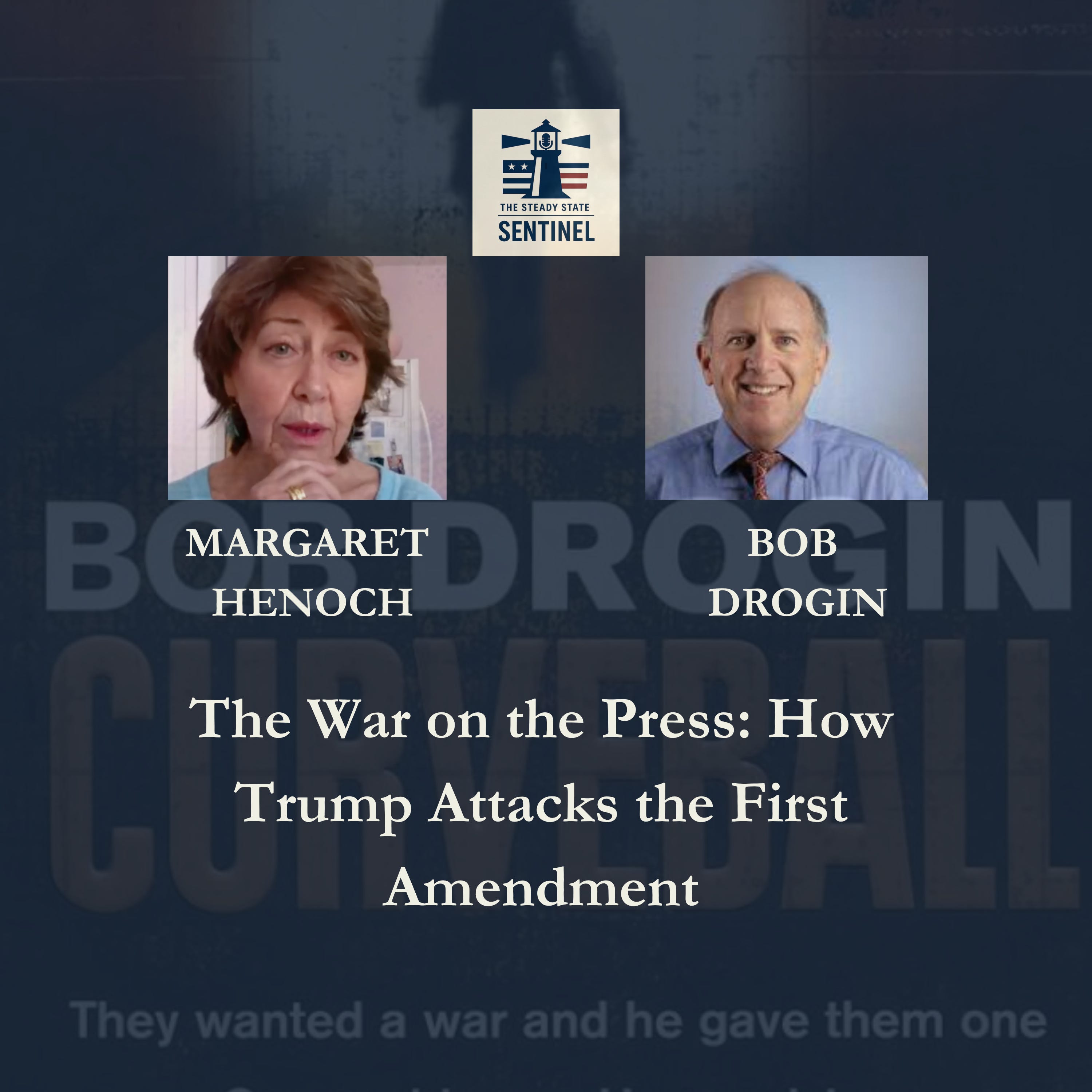
In the latest episode of The Steady State Sentinel, Margaret Henoch (former senior CIA Operations Officer) sits down with Bob Drogin– a 38‑year veteran of the Los Angeles Times who served as a national correspondent, foreign correspondent, and ultimately White House editor during the first Trump administration. Drogin covered intelligence and national security for years, wrote Curveball: Spies, Lies, and the Con Man Who Caused a War, his book about the false WMD intelligence that helped lead the Bush administration into Iraq. He has seen journalism from its “golden age” to its current atomized, billionaire‑owned crisis.
Drogin is deeply alarmed, though not without a few reasons for hope. But he is clear‑eyed – and he has a list.
Here is what you need to know.
The List: Trump’s Assault on the Press
Drogin spent the night before the interview trying to catalog what the Trump administration has done to the media. The list is longer than most people realize.
“He is conducting an unprecedented, full‑out war against freedom of expression, against journalism, and against the First Amendment.”
Among the highlights:
Cutting funding for NPR and PBS
Threatening to revoke broadcast licenses for every network except Fox
Filing punitive lawsuits against the New York Times, Washington Post, Wall Street Journal, BBC, Des Moines Register, CNN, and even the board that issues Pulitzer Prizes
Barring the Associated Press from the White House briefing room because it won’t use Trump’s preferred name for the Gulf of Mexico
Taking over the White House press pool (a dedicated group of reporters that has been run independently by the White House Correspondents’ Association since FDR)
Banning reporters from the Pentagon unless they agree to use only government-approved handout material
Creating the “Wall of Shame,” a White House website where people can complain about specific journalists
Censoring government data and taking down websites on vaccines and climate change
Dismantling Voice of America and every other U.S. government‑backed broadcast outlet overseas
Installing cronies at the FCC
Arresting Don Lemon
Invading a reporter’s house and stealing her notes
Detaining and deporting journalists
At the same time, corporate owners have been settling frivolous lawsuits for millions of dollars: CBS paid $16 million. ABC/Paramount paid $16 million. YouTube paid $25 million.
“All of this has tremendous implications for freedom of the press and for democracy. He’s following the playbook of Viktor Orbán in Hungary, Vladimir Putin in Russia, Mussolini.”
What Happens When You Suppress the Press
Henoch asks the critical question: what does this do to democracy?
Drogin’s answer is straightforward. The whole point of the First Amendment is to provide an independent account of what the government does.
“We’re supposed to be watchdogs – not lapdogs and not attack dogs. And we have less and less access to the kind of information people need to make educated choices.”
The Iran war is a perfect example. Between the Iranians and Trump, it’s a blackout. No one knows what’s happening.
And because Trump creates so many outrages simultaneously – ICE raids, the war in Iran, blowing boats out of the water in the Caribbean – the incremental assault on the press gets lost.
“You add it up and you suddenly think, my God, he’s trying to destroy the First Amendment.”
The White House Correspondents Dinner Security Threat: What Drogin Thinks it Revealed
Drogin offers his iconoclastic view of the night a would-be attacker apparently targeted the White House Correspondents Dinner but never made it into the ballroom.
First, thank God no one was hurt – and if anyone had been, it almost certainly would have been journalists.
Second, thank God Trump didn’t get to give his speech. He had promised it would be “the most inappropriate speech of all time.” Drogin is sure he would have spent an hour insulting and demeaning every journalist in the room.
Third, and here’s where Drogin becomes a self‑described hypocrite: he has attended the dinner 15 to 17 times, but he thinks it should be canceled.
“It’s an abomination. It should be shrunk back down to its original purpose – raising money for scholarships and giving awards – and get rid of all the celebrity suck‑up stuff.”
He recalls the 2011 dinner, where Obama famously insulted Trump. Trump has always denied that’s why he decided to run for president. “But who knows? He lies about everything.”
The real news that night, Drogin says, was that Obama had just signed off on the bin Laden raid. It was postponed because of weather and happened the next day. Trump was not the big story.
The Golden Age Was Brief – And We’re Going Back to the Past
Drogin debunks the myth that newspapers have always been trustworthy and steadfast.
Go back 100 years: every town had multiple papers. Big cities had 10 or 20. Press lords like Joseph Pulitzer (father of yellow journalism) and William Randolph Hearst (who pushed the U.S. into the Spanish‑American War) dominated. The Chandlers in Los Angeles and the Annenbergs in Philadelphia ran right‑wing papers.
The “golden age” of journalism began with Watergate and lasted only about 30 years – until eBay and then social media ate the business model.
Now we are back to an atomized landscape, with billionaire owners like Jeff Bezos (Washington Post) and Patrick Soon‑Shiong (Los Angeles Times) pulling editorials they don’t like. CBS made changes involving Barry Weiss, whom Drogin described as far more political than the previous CBS News leadership. Ellison is about to take over CNN and is expected to turn it into a Trump mouthpiece.
“We’re going back to the past – what it looked like 100 years ago. The good old days were maybe 30 years.”
How to Find Trusted News in the Supermarket of Information
Henoch asks the question everyone is struggling with: where should people go for reliable information?
Drogin admits there are no easy answers. Everyone gets to pick their own topics now. He personally reads The Steady State every day, along with Foreign Policy, The Atlantic, the New York Times, the Wall Street Journal, and the Washington Post.
“Not every story in the New York Times is 100% correct. But overall, they are trying. Nobody is deliberately putting their thumb on the scale.”
He also follows a number of Substack writers and spends too much time staring at screens. He just signed up for an online course on Shakespeare’s Hamlet and King Lear because he needs to get his head out of the news for a little while.
For younger people? Drogin laughs.
“No young person has ever asked me for any advice. Ever.”
When he tried to warn his own children about what they put on the internet, his son innocently asked, “What’s a front page?”
What Gives Him Hope?
Despite everything, Drogin finds a few reasons for hope.
First, Trump isn’t entirely succeeding. Courts have thrown out his $10 billion lawsuit against the Wall Street Journal and lawsuits against the Post and the New York Times. There is starting to be pushback.
Second, the midterms could change things – though he warns not to trust polls. (Ask President Hillary Clinton or President Kamala Harris about polling.)
Third, the sheer volume of information available today – even with AI and deepfakes – is exciting. Everyone has a cell phone. Everyone is a witness.
“When I was a foreign correspondent, my job was to be the eyes and ears of our readers. Now everybody is taking pictures and video. In theory, there’s a much greater flood of information out there from which you can draw your opinions.”
But he ends with a sobering metaphor from a voter in Atlanta:
“Just because I don’t like my rabbi doesn’t mean I’m going to become a Catholic.”
Disliking Trump is not the same as embracing the alternative.
One Quote That Stays With You
“Thomas Jefferson famously said he’d rather have a media without a government than a government without a media. Look at Trump – he’s out of control.”
— Bob Drogin
Listen and Watch the full Podcast Here:
Founded in 2016, The Steady State is a nonprofit 501(c)(4) organization of more than 400 former senior national security professionals. Our membership includes former officials from the CIA, FBI, Department of State, Department of Defense, and Department of Homeland Security. Drawing on deep expertise across national security disciplines, including intelligence, diplomacy, military affairs, and law, we advocate for constitutional democracy, the rule of law, and the preservation of America’s national security institutions.
Powered by WPeMatico