
Indicators Of Authoritarian Drift
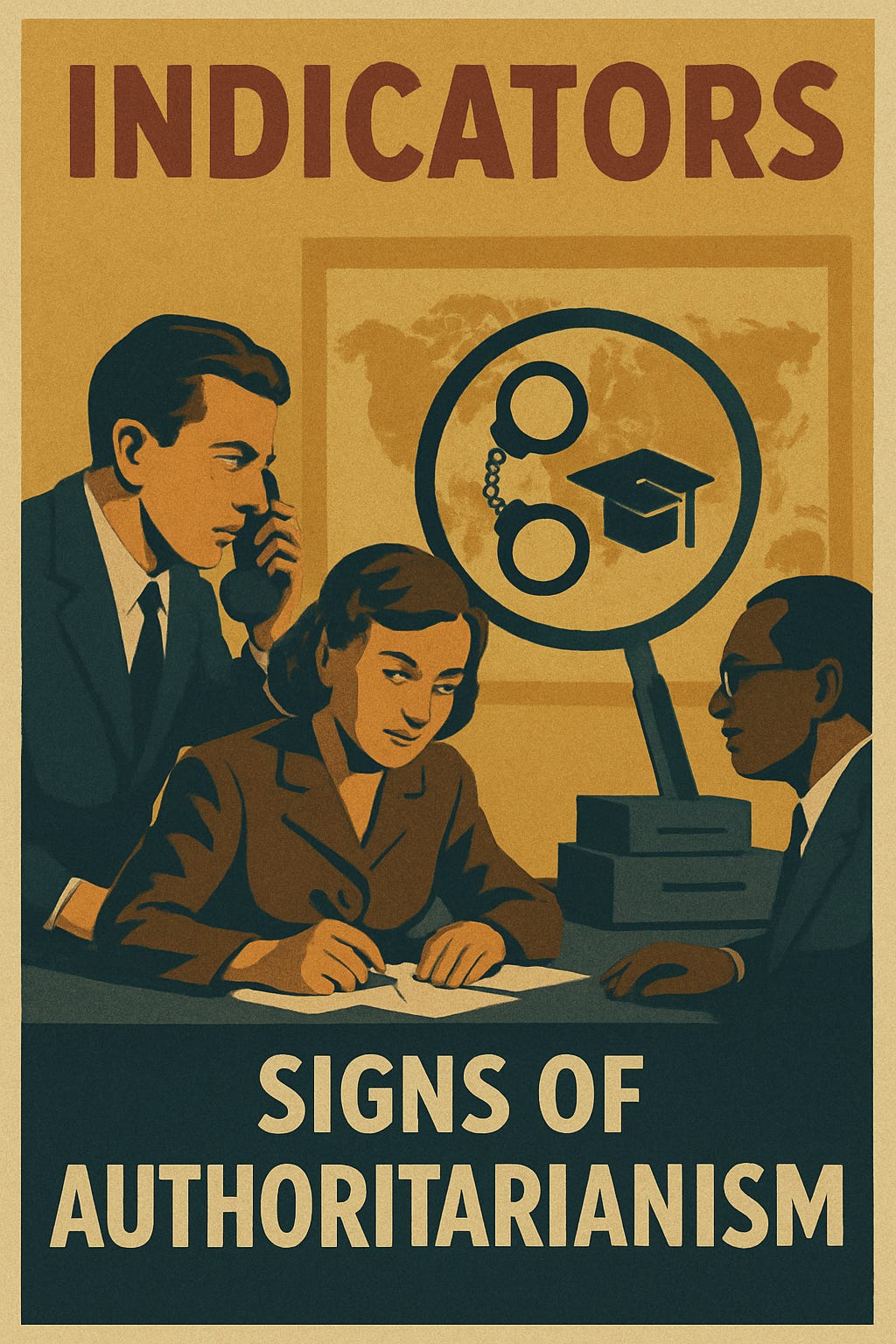
In modern intelligence analysis, the application of indicators to assess democratic decline or authoritarian drift is an increasingly vital function in an era of rising autocracy and democratic backsliding. While traditional warning indicators focused on military threats or coup preparations, today’s analysts often monitor a different set of political, legal, and institutional developments to detect the erosion of liberal democratic norms.
Authoritarianism rarely arrives overnight. It tends to progress through incremental steps that, while often lawful on their face, cumulatively undermine democratic institutions. To detect this trajectory, analysts rely on structured indicator sets informed by political science and comparative regime analysis. These indicators are not predictive in isolation, but when aggregated, they offer early warning of systemic decay.
Key Categories of Authoritarianism Indicators (Levitsky & Way, 2010; Bermeo, 2016)
1. Erosion of Institutional Checks and Balances
Analysts watch for moves to weaken independent oversight institutions like the judiciary, legislature, and electoral bodies. Specific indicators may include:
Expansion of executive control over judicial appointments
Arbitrary removal of judges or legislative opposition figures
Transfer of key functions from independent agencies to the executive branch
2. Curtailment of Press Freedom and Civil Society
Authoritarian regimes often begin by constraining the information environment and silencing watchdog organizations. Indicators in this domain include:
Passage of “fake news” or anti-defamation laws used selectively against independent media
Government acquisition of major media outlets by political allies
Criminalization of NGO activity or foreign funding for civil society groups
3. Electoral Manipulation and Democratic Facade Maintenance
Even as authoritarian leaders maintain the appearance of democratic processes, analysts note changes that signal the loss of genuine electoral competition:
Harassment, disqualification, or imprisonment of opposition candidates
Gerrymandering and manipulation of voter rolls
Use of state resources for campaign purposes or information warfare
4. Politicization of Security Forces and Intelligence
Another critical set of indicators involves the use of the military, police, or intelligence services for internal repression or regime protection:
Shifting domestic surveillance mandates from civilian to military control
Targeted arrests of dissidents or protest leaders under vague national security pretexts
Loyalty purges or promotions within the armed forces based on political allegiance
5. Legalism and Rule-by-Law
One of the most difficult trends to detect is the use of legal frameworks to legitimize authoritarian behavior. Here, indicators may include:
Emergency decrees extended beyond reasonable duration
Retroactive legislation used to penalize political adversaries
Creation of parallel legal institutions (e.g., special courts) outside constitutional norms
6. Exerting State Control over Educational Institutions
Authoritarian governments control the flow of information, research, and academic priorities by:
Establish programs to control curriculums, admissions, faculty hiring, and arts & literature
Monitor what is taught in critical fields like political theory, history, and social science
Punish institutions by withholding funding, extorting administration officials, and imposing regulatory laws
In extreme cases, deploying troops to quell student protests
Methodological Sources and Frameworks
Analysts often draw from established indicator frameworks developed by research institutions. For example, the Varieties of Democracy (V-Dem) Project uses over 450 indicators to assess liberal democracy, including granular data on media freedom, judicial independence, and civil liberties. Freedom House’s annual Freedom in the World Report similarly codes changes in political rights and civil liberties across nearly 200 countries.
The U.S. intelligence community and the State Department may use these academic tools alongside classified reporting, diplomatic cables, open-source monitoring, and human intelligence (HUMINT) to refine their own country-specific indicator lists. These are sometimes embedded in early warning systems like USAID’s Center for Democracy, Human Rights and Governance’s Democracy, Human Rights, and Governance Strategic Assessments Framework, which flags countries at risk of democratic collapse.
Importantly, analysts apply these indicators not just descriptively, but comparatively and dynamically. They assess not only whether indicators are present, but how rapidly they are accumulating and whether they represent reversals from earlier democratic gains.
From Indicators to Policy
When such indicators are flagged, analysts may assess a country’s classification on the democratic-authoritarian spectrum: for example, moving from Economist Intelligence’s “flawed democracy” to “hybrid regime,” or from “competitive authoritarianism” to “closed autocracy”. These assessments inform U.S. policy decisions on foreign aid, sanctions, arms transfers, and diplomatic engagement.
In sum, indicators of authoritarianism serve as both analytical scaffolds and practical tools to help intelligence and foreign policy communities identify, monitor, and respond to the quiet consolidation of power before it becomes irreversible.
References
-Bermeo, Nancy. “On Democratic Backsliding.” Journal of Democracy, Project MUSE. 2016. https://dx.doi.org/10.1353/jod.2016.0012.
-Economist Intelligence. “Country Analysis service – for political and economic analysis”. EUI Viewpoint. 2025. https://www.eiu.com/n/solutions/viewpoint/political-and-economic-analysis/.
-Freedom House. “The Uphill Battle to Safeguard Rights”. Freedom in the World 2025: Report. 2025. https://freedomhouse.org/report/freedom-world/2025/uphill-battle-to-safeguard-rights.
-Levitsky, Steven, and Lucan A. Way. “Competitive Authoritarianism: Hybrid Regimes after the Cold War”. Cambridge University Press. 2010. https://doi.org/10.1017/CBO9780511781353.
-USAID Democracy, Human Rights, and Governance. “Governance Strategic Assessment Framework: Agency Priority Goal”. USAID Action Plan FY24 – Q3. 2024. https://assets.performance.gov/APG/files/FY2024/Q3/FY2024_Q3_USAID_Progress_Democracy_Human_Rights_and_Governance.pdf.
-V-Dem Institute. “Democracy Report 2025: 25 Years of Autocratization – Democracy Trumped?”. Democracy Reports. 2025. https://www.v-dem.net/publications/democracy-reports/.