
Is Putin Winning Without Firing a Shot?
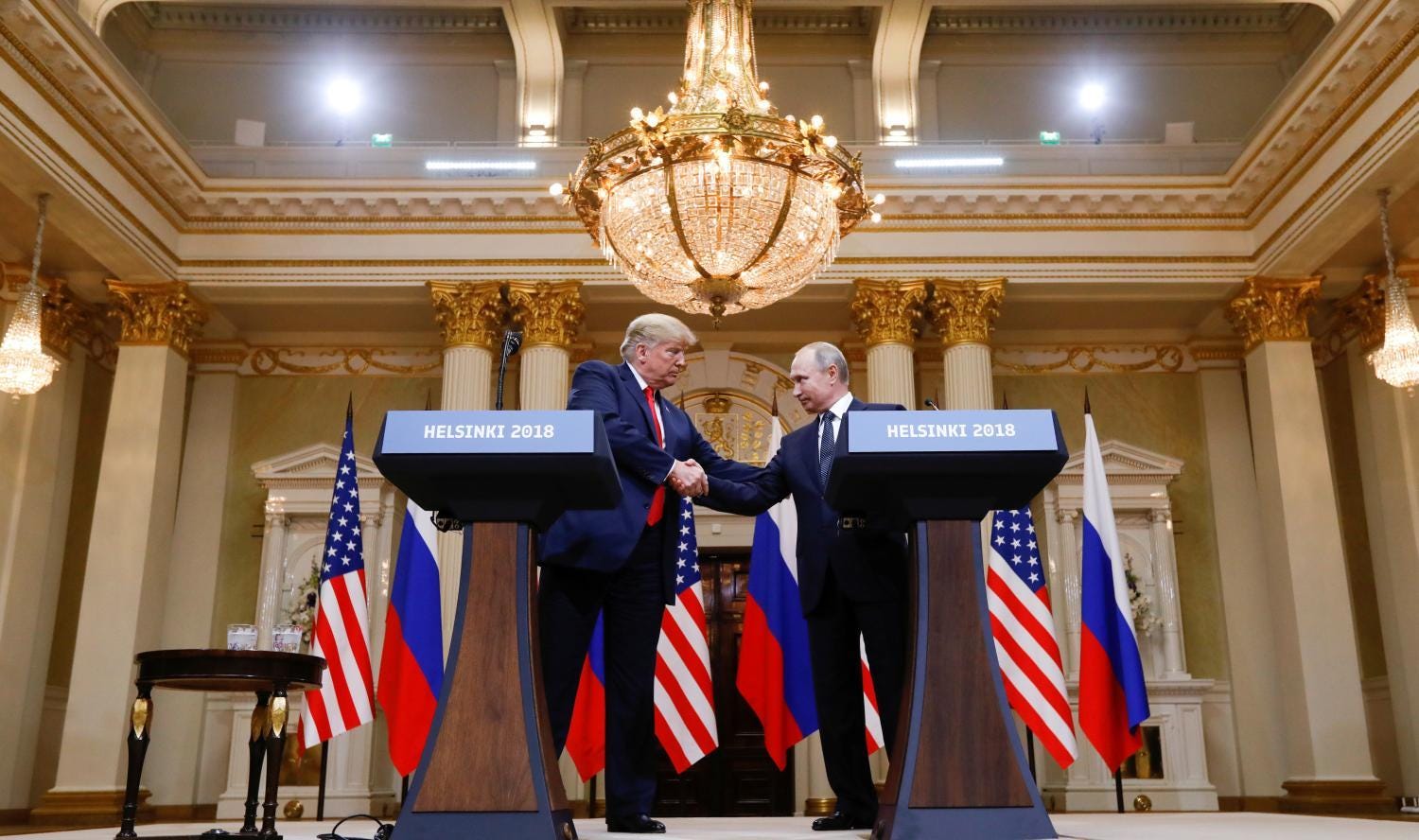
For decades, conservatives saw Russia as a threat to freedom. Today, many admire the very qualities that once made Moscow dangerous: strongman rule, contempt for institutions, and politics driven by grievance and loyalty. Putin’s greatest success may not be abroad—it may be here.
Is Russia Now America’s Ally?
For nearly eighty years, the answer would have been obvious.
Russia, first as the Soviet Union and later under Vladimir Putin, was viewed by both Republicans and Democrats as one of America’s principal adversaries. Conservatives, in particular, built much of their modern foreign policy identity around opposition to Moscow’s authoritarianism, aggression, and contempt for democratic institutions.
Ronald Reagan called the Soviet Union an “evil empire.” Republicans championed NATO, democratic alliances, and resistance to Kremlin influence around the globe.
While there was some hope in the 1990’s following the fall of the Soviet Union that Russia would seek to join the family of nations, it soon reverted to instinctual opposition to the West, and the U.S. in particular. Anything the U.S. was for, Moscow was against.
Now, astonishingly, large parts of the American right speak about Russia with admiration, sympathy, or open defensiveness. Vladimir Putin is praised as “strong,” “smart,” or a defender of “traditional values.” Meanwhile, America’s democratic allies are attacked as corrupt, weak, or ideologically suspect.
How did this happen?
The answer cannot be separated from the strange and deeply consequential relationship between Donald Trump and Vladimir Putin.
For nearly a decade, Trump has treated Putin differently from every other foreign leader. He has repeatedly praised him personally, accepted his denials over the conclusions of U.S. intelligence agencies, minimized Russian interference in American democracy, and framed conflicts involving Moscow in terms strikingly favorable to Kremlin narratives. Even after Russia’s invasion of Ukraine, Trump described Putin’s actions as “genius” and “savvy.”
At the same time, Putin’s Russia has become the global model for a particular kind of modern authoritarianism: hyper-nationalist, grievance-driven, contemptuous of independent media, hostile to democratic institutions, obsessed with internal enemies, and centered on personal loyalty to a strongman leader rather than constitutional principles. Portraying America as the enemy to blame has also remained consistent.
The growing sympathy between parts of the American authoritarian right and Putinism is not really about foreign policy. It is about shared instincts. Both movements portray democratic institutions as weak and corrupt. Both attack independent journalism as “fake.” Both elevate loyalty to a leader over loyalty to institutions. Both frame political opponents not as fellow citizens, but as enemies of the nation itself. As Steady State member John Sipher commented in “The Atlantic”, “Trumpism shares a disturbing amount in common with Putinism, including promoting racist hatred of outsiders; the belief that the rich are above the law; the reflexive use of propaganda lies and denial; and the shredding of legal and political norms.”
Russia recognized this opening years ago. The Kremlin’s objective was never simply to make Americans “pro-Russia.” It was to weaken democratic cohesion from within by fueling polarization, distrust, and admiration for authoritarian models of power. Russia’s goal is not persuasion, but paralysis. As John Sipher wrote in “Moscow on the Potomac,” The Kremlin does not need Americans to love Russia. It only needs Americans to hate one another.”
In many respects, it has worked.
The most disturbing development is not that Americans debate Russia policy. Democracies should debate foreign policy vigorously. The danger is that many Americans no longer appear instinctively opposed to authoritarianism itself. Indeed, some increasingly seem attracted to it, provided it is wrapped in the language of nationalism, strength, and cultural grievance.
No formal alliance exists between the United States and Russia. Russia still spies on America, spreads disinformation, assassinates its enemies, threatens NATO allies, and wages brutal war abroad. But politically and culturally, something extraordinary has changed. A movement that once defined itself through opposition to Moscow now often echoes its worldview.
The real question is not whether Russia is America’s ally.
It is whether parts of American politics have begun to see Putin’s authoritarianism not as a threat, but as a model.

Steven A. Cash served as a prosecutor in the Manhattan District Attorney’s office before joining the CIA in 1994 as Assistant General counsel and subsequently serving as an intelligence officer in the Directorate of Operations. In 2001 he joined the Senate Select committee on Intelligence as Counsel and designee-staffer to Senator Diane Feinstein). He later served as a senior staffer in the House Select Committee on Homeland Security, the Department of Energy, the Senate Judiciary Subcommittee on Terrorism, Technology and Homeland Security and the Department of Energy. In the private sector he has advised on national security, counterintelligence, and technology policy and served on the Biological Sciences Experts Group under the Director of National Intelligence. Mr. Cash is currently the Executive Director of The Steady State.
Founded in 2016, The Steady State is a nonprofit 501(c)(4) organization of more than 400 former senior national security professionals. Our membership includes former officials from the CIA, FBI, Department of State, Department of Defense, and Department of Homeland Security. Drawing on deep expertise across national security disciplines, including intelligence, diplomacy, military affairs, and law, we advocate for constitutional democracy, the rule of law, and the preservation of America’s national security institutions.
Powered by WPeMatico