
July 11 2025 A Sad Day For American
On July 11, over 1,100 Civil Servants and nearly 250 Foreign Service Officers were summarily fired from their domestic jobs at the State Department. Billed as an effort to combat bureaucratic bloat and radical ideology, this mass firing was designed mostly to punish elements of the department that carried out policies of the previous administration that the new administration did not like and to undermine the culture of public service throughout the Department. This self-inflicted lobotomy will harm U.S. interests around the world for many years.
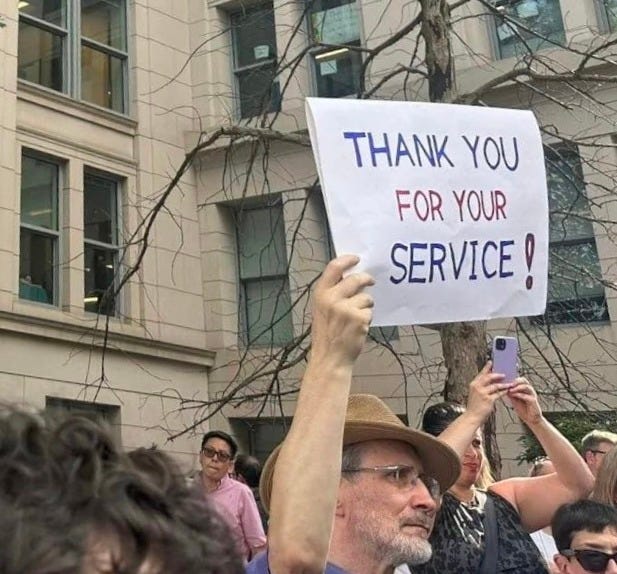
Around a hundred people held a rally outside the State Department headquarters to where speakers decry the damage to U.S. national interests and to show support for the dedicated public servants who had lost not only their jobs but their dreams of serving a cause larger than themselves. I brought a sign saying “Thank you for your service” and comforted former colleagues as they left the building, some teary and some struggling to hold back tears.
Five former State Department officials and three members of Congress spoke at the rally. They pointed out the cuts to the diplomatic corps weaken America and cede international leadership to our rivals and adversaries, particularly China and Russia. They said the elimination of bureaus and offices responsible for democracy, human rights, refugees, and migrants was out of step with America’s interests and values and emphasized the importance of defending those values at home and abroad. They honored the patriotism of the public servants who worked to advance America’s interests and called on citizens to continue to defend America’s core values.
I will not try to catalog all the losses from the Friday morning massacre in this short essay. They are too broad and indiscriminate to do justice to the scale and depth of the devastation. Here are a few that I am particularly close to:
Some of the cuts were expected, but some were a surprise, like the elimination of the entire office responsible for multilateral disarmament diplomacy. The Department has offered no explanation or rationale, but it’s natural to suspect that this cut reflects a distaste for arms control and multilateralism. This is shortsighted. Organizations like the Conference on Disarmament and the disarmament bodies of the United Nations continue to meet. Assuming we will continue to participate, there will be no one left with the experience necessary to guide that participation and defend our national interests in these multilateral fora. This leaves the field open to those who seek to undermine our interests. If we want to prevent nuclear war and nuclear arms races, we should be pursuing disarmament diplomacy, not disarming our diplomatic corps.
The cuts also eliminated offices responsible for policy coordination throughout the Department. This includes the office in the nonproliferation bureau that led efforts to contain nuclear threats from Iran and North Korea and to coordinate with our allies to limit the danger of nuclear war and the threat from all kinds of weapons of mass destruction. It also includes the counterpart office in the European Affairs bureau. Those responsible for Friday’s massacre seemed to see coordination not as an essential skill but an extra layer of bureaucratic red tape. In fact, foreign affairs involves the complex interplay of policy, political, administrative, and legal imperatives. This can be a source of frustration for officials at all levels, but it is inherent to the work and essential for doing that work well. And in fact, bureaucratic dysfunction most often occurs because people lack the skills and habits of working together across those organizational lines. Eliminating those offices will make that dysfunction worse.
When planned reorganization was first announced in April, including plans to eliminate entire offices, Foreign Service Officers (FSOs) pointed out that they are supposed to be able to seek competitive assignments elsewhere in the Department. You would think that the Department’s leadership would want to hold onto its top performers, but instead they responded cynically by rewriting the rules and redefining the “competitive areas” so narrowly that FSOs had nowhere else to turn. This contradicts the central tenet of the Foreign Service to cultivate generalists with a wide range of skills and experiences.
The most devastating blow from this slash-and-burn attack on the professional staff of the State Department is the loss of the next generation of leaders in public service. This downsizing is not about improving efficiency or improving focus. It is an attack on the very concept of public service, that those who work for the federal government serve the American people and devote themselves not to their personal interests but to the public interest and the national interest.
Public service is not just a career or a calling. It is a culture that depends on transmission of knowledge from one generation to the next. At my retirement ceremony in February, I looked back over a career in which I learned from my predecessors, built my own expertise and worked to strengthen the nuclear nonproliferation regime, and then tried to pass on what I had learned. I assured those in the next generation that they would figure out what needed to be done.
But now that next generation is in tatters. It will be hard to recover from these blows. I take some solace in the fact that so many talented and dedicated people are now motivated and free to fight back for America’s interests at home and abroad.
Mark Goodman is a senior scientist who retired from the State Department after a thirty-year career in nuclear policy. He has extensive experience in multilateral nuclear nonproliferation and disarmament issues. Dr. Goodman is a non-resident fellow at the Center for Nonproliferation Studies, a Fellow of the American Physical Society, and a member of The Steady State.
Founded in 2016, The Steady State is a nonpartisan, nonprofit 501(c)(4) organization of more than 300 former senior national security professionals. Our membership includes former officials from the CIA, FBI, Department of State, Department of Defense and Department of Homeland Security. Drawing on deep expertise across national security disciplines including intelligence, diplomacy, military affairs and law, we advocate for constitutional democracy, the rule of law and the preservation of America’s national security institutions.