
Militarization Of Our Streets Is
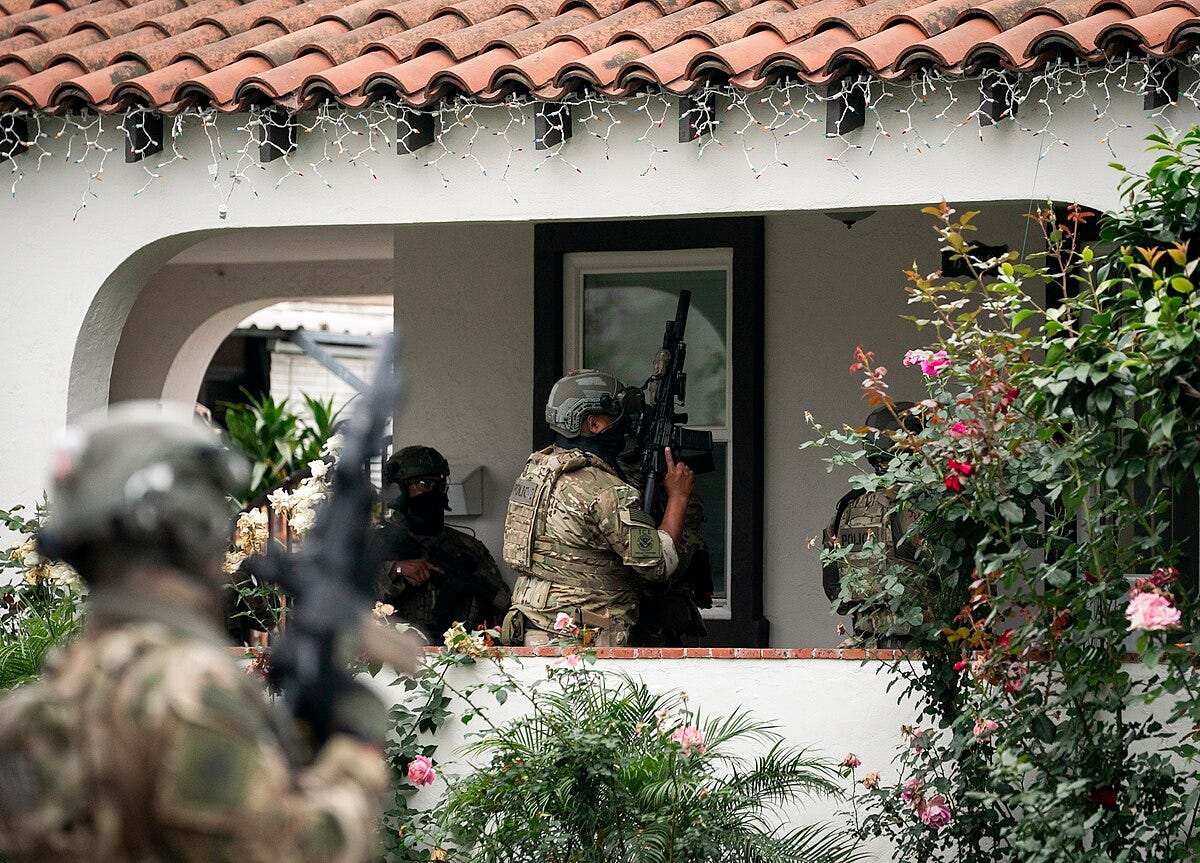
Immigration and Customs Enforcement (ICE) Enforcement and Removal
Los Angeles, California, June 12, 2025
Remember “The Deporter in Chief? That was President Obama, at a time when deportations far exceeded those by President Trump. Whether you supported those deportations or not, oddly enough they were completed without undue violence.
Today, it’s a different story. The methods being employed for apprehending prospects for deportation rely on a show of overwhelming force. Indeed, the intimidation and the cruelty are the point. Let us stipulate here that there are times when an overwhelming display of armed force is necessary. Just as a police SWAT team might be required to deal with a violent criminal or a barricade situation, so might ICE have to deal with illegal immigrants who are violent criminals.
To be sure, there have been recent cases of violence against ICE. The incidents at the Portland ICE facility and in Alvarado, Texas, are condemnable and those involved should face the appropriate consequences for instigating them. But let us say plainly: These were in an ICE detention facility. Not on our neighborhood streets. Most ICE activities are the equivalent of traffic stops. Police officers don’t use SWAT teams for traffic stops.
I was a Green Beret. For ten of my 23 years in the Army I was on operational Special Forces teams in war and quasi-peace. I know what it is like to gird for battle. Many days and nights – virtually every day in wartime – my teammates and I would strap on the dress and accouterments of war. The ritual is much the same as in a football locker room before a game. There is a certain reassurance to be preparing as part of a team – a bonding – and a heightened sense of anticipation at the contest to come. It was probably the same experience for the Roman legions.
But we were making forays into War Zone D in Vietnam, not Home Depot.
Granted we did not have the sophisticated and exotic-looking equipment that special operations forces have today, but we had the best there was for our time. The way we looked, though, would have paled in comparison to the appearance of today’s ICE and Border Patrol officers gathering to arrest Rosa, the hotel housekeeper. Gearing up like Delta Force to indiscriminately round up brown-skinned people off the street is unnecessary for protection. It is performative. Assembling 30 armed officers supported by tactical vehicles to breach an apartment occupied by a family with children is not the result of mission analysis. It is cosplay. They get to dress up, maybe even feel a bit of the same sense of bonding and anticipation as a Special Forces team or a football team, but without the prospect of real violence. Despite the masks, it is clear some of the officers are enjoying themselves.
Oh yes, the masks. There are cases where the real Delta Force or Seal Team 6 operators must have their faces blurred in photos or wear masks when there are visitors to their facilities. They might at some point be operating covertly in, say, Iran. That is real danger. Mexican police need to wear masks when encountering cartel members. That is real danger. As an excuse for wearing masks ICE pleads that their officers might be doxxed. In many localities, police officers, who deal with far more violent and dangerous criminals than Miguel, the gardener, park their police cars in front of their home to advertise their presence in the neighborhood. Even with all their weaponry and their imposing appearance, ICE officers must be very fragile indeed.
In truth, the masks are part of the cosplay. And, let us say it again clearly: The masks are un-American. No matter who they are, people in America deserve to know who is enforcing the laws, to include identity and badge number. The images of anonymous masked men hustling people off the street into unmarked vehicles, commonplace in Russia, have no place in our democratic and open society.
To a large extent, ICE has created its own problem. When a large segment of the population is treated as an enemy there is bound to be a self-fulfilling element that results in pushback. It might be illegal, it might be unacceptable, but it is understandable. And what is the administration’s response to this self-induced security problem? A larger show of force by deploying National Guard and Marines to provide security for the ICE and Border Patrol officers (as heavily armed as they are). And why would the administration take such a step?
It is clear that President Trump has been itching to invoke the Insurrection Act, which gets around that pesky Posse Comitatus Act prohibiting the use of the armed forces for law enforcement purposes without the consent of Congress. On the first day of his second term he directed the Secretary of Defense and Secretary of Homeland Security to study possible invocation of the Insurrection Act to deal with “conditions at the southern border.” The two secretaries did not advocate using the Insurrection Act, but a work-around was found by declaring a long and narrow strip of the border a military zone. Although there was no military reason to take this action, it does empower the military to arrest anyone entering the zone without authorization.
The Insurrection Act would hand the president a blank check in the involved state once invoked. Such flimsy restraints on Executive Branch authority as have survived would be shredded there. And there is no guarantee that a president would not view it as an open-ended opportunity to use the armed forces not as an instrument of national defense, but of domestic repression. That is a much more dangerous prospect than that of ICE officers playing dress-up. If ICE and Border Patrol officers raiding the 7-11 reverted to a law enforcement posture and abandoned the bullying paramilitary approach, that prospect would be less likely.
The author is a retired US Army Special Forces officer who is a member of The Steady State
Founded in 2016, The Steady State is a nonpartisan, nonprofit 501(c)(4) organization of more than 300 former senior national security professionals. Our membership includes former officials from the CIA, FBI, Department of State, Department of Defense and Department of Homeland Security. Drawing on deep expertise across national security disciplines including intelligence, diplomacy, military affairs and law, we advocate for constitutional democracy, the rule of law and the preservation of America’s national security institutions.