Opinion Power Dominance And The Authoritarian
History shows that authoritarian leaders often justify power through dominance—over institutions, rivals, and entire regions. Figures such as Venezuela’s Nicolás Maduro and Panama’s Manuel Noriega relied on a familiar playbook: centralizing authority, sidelining independent checks, suppressing dissent, and framing coercion as necessary for national security or sovereignty. I lived under the Noriega regime.
That pattern is worth revisiting as the United States embraces an increasingly muscular vision of hemispheric power.
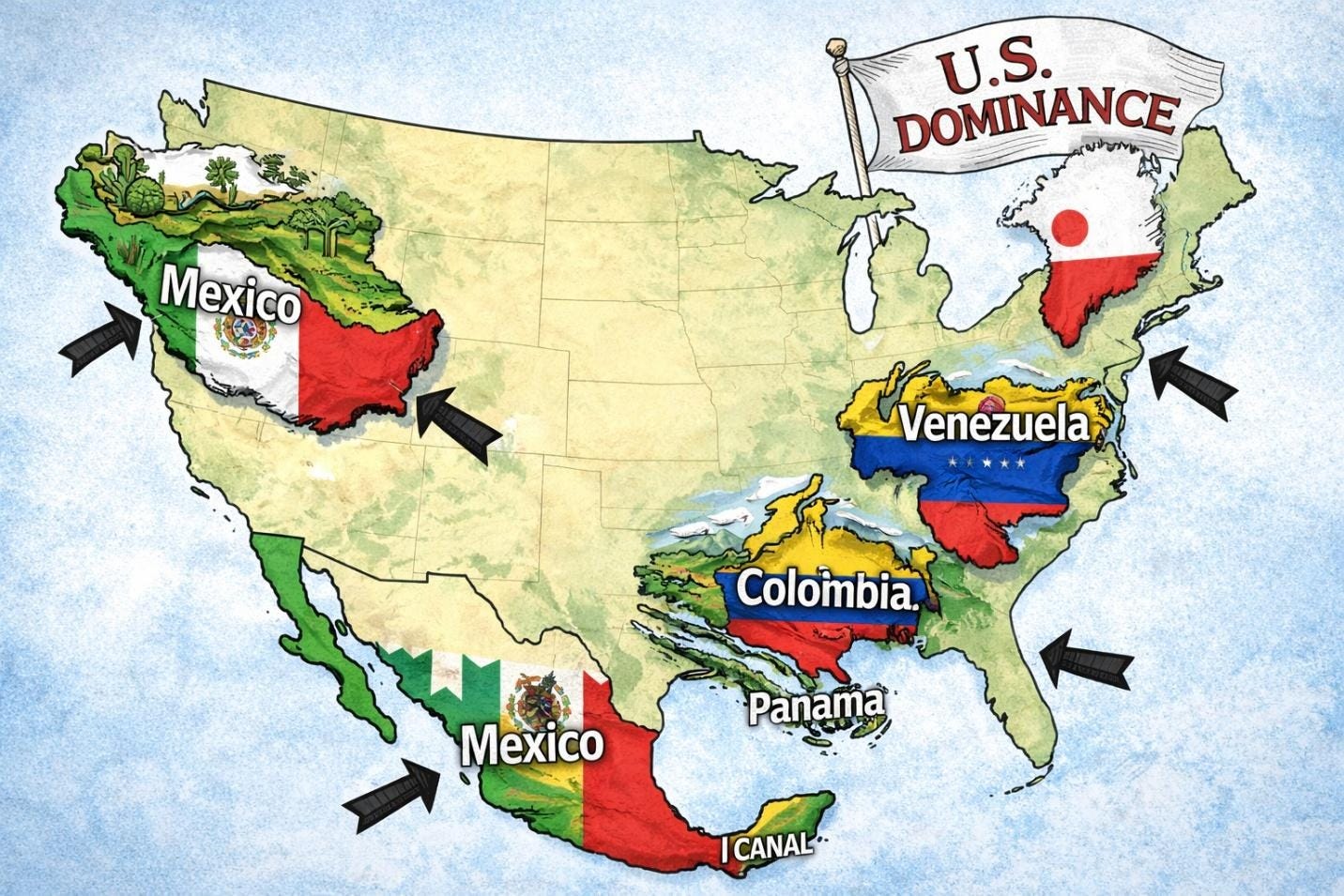
The December 2025 National Security Strategy explicitly calls for reasserting “American dominance in the Western Hemisphere,” a phrase the president later reinforced by declaring that U.S. dominance “will never be questioned again.” The document frames this approach as a renewed enforcement of the Monroe Doctrine, recast by administration officials as the “Trump Corollary” or “Donroe Doctrine”—an unapologetically unilateral effort to deny rivals such as Russia and China influence, infrastructure access, or military presence in the Americas. Supporters describe the strategy as long-overdue realism. Critics see echoes of a worldview in which power justifies itself—and accountability becomes secondary.
The Authoritarian Personality Revisited
Political scientists have studied this mindset for decades. In The Authoritarian Personality (1950), Theodor W. Adorno and his colleagues identified recurring traits associated with authoritarian leadership: rigid deference to authority, hostility toward perceived outsiders, intolerance of dissent, and an exaggerated fixation on strength and dominance. The framework remains influential because it focuses less on ideology and more on how leaders relate to power—and how societies normalize that relationship.
From Dictatorships to Democracies
In outright dictatorships, these traits are easy to spot. Maduro has relied on electoral manipulation and repression to entrench power, while Noriega fused military authority with corruption and personal loyalty. In both cases, foreign policy became an extension of regime survival, wrapped in nationalist rhetoric and enforced through coercion rather than consent.
Democracies, of course, are different. Constitutional checks, elections, courts, and a free press matter. But scholars increasingly warn about democratic backsliding and executive aggrandizement—processes by which leaders accumulate power incrementally while preserving the outward appearance of democratic governance. The Carnegie Endowment has documented how these shifts often occur under the banner of security, nationalism, or crisis management. https://carnegieendowment.org/research/2025/08/us-democratic-backsliding-in-comparative-perspective?lang=en&utm_source=chatgpt.com
Dominance as Policy—and as Signal
The administration’s Western Hemisphere posture emphasizes military presence, economic pressure, sanctions, and explicit threats against governments deemed uncooperative. It prioritizes control over migration flows, trade leverage, energy resources, and strategic infrastructure—often sidelining multilateral diplomacy in favor of unilateral action.
Such policies are not inherently authoritarian. Great powers have long pursued spheres of influence. But when dominance becomes personalized, celebrated rhetorically, and detached from institutional restraint, it begins to resemble the logic authoritarian leaders use elsewhere: loyalty over law, force over legitimacy.
Warnings Worth Heeding
Former intelligence officials, legal scholars, and international observers have increasingly warned that democratic norms erode not all at once, but gradually—when leaders test boundaries and institutions fail to respond. Commentary in outlets such as The Guardian has framed these developments not as proof of dictatorship, but as signals that vigilance is required even in long-standing democracies.
The Real Question
The issue is not whether the United States has become Venezuela or Panama under Noriega. It has not. The more important question is whether democratic institutions remain strong enough—and citizens attentive enough—to ensure that power remains constrained, accountable, and subordinate to the rule of law.
History suggests that dominance, once normalized, rarely stops where its architects expect it to.
Martha Duncan is a retired U.S. Department of Defense senior executive with 37 years of service, including 23 years as an officer in the U.S. Army Reserves, where she also served as Reserve Attaché. She had three operational deployments to Panama, Bosnia, and Afghanistan. At DIA, she worked as a Latin American analyst for 11 years. A specialist in human intelligence (HUMINT), she is recognized for her leadership in intelligence operations, coalition-building, and enterprise-level policy development across the Defense Intelligence Agency (DIA), the U.S. Army, and the broader Intelligence Community. She grew up in Panama during the rise of Manuel Noriega and was instrumental in his capture.
Founded in 2016, The Steady State is a nonprofit 501(c)(4) organization of more than 360 former senior national security professionals. Our membership includes former officials from the CIA, FBI, Department of State, Department of Defense, and Department of Homeland Security. Drawing on deep expertise across national security disciplines, including intelligence, diplomacy, military affairs, and law, we advocate for constitutional democracy, the rule of law, and the preservation of America’s national security institutions.