
Rule of Law vs. Rule of One
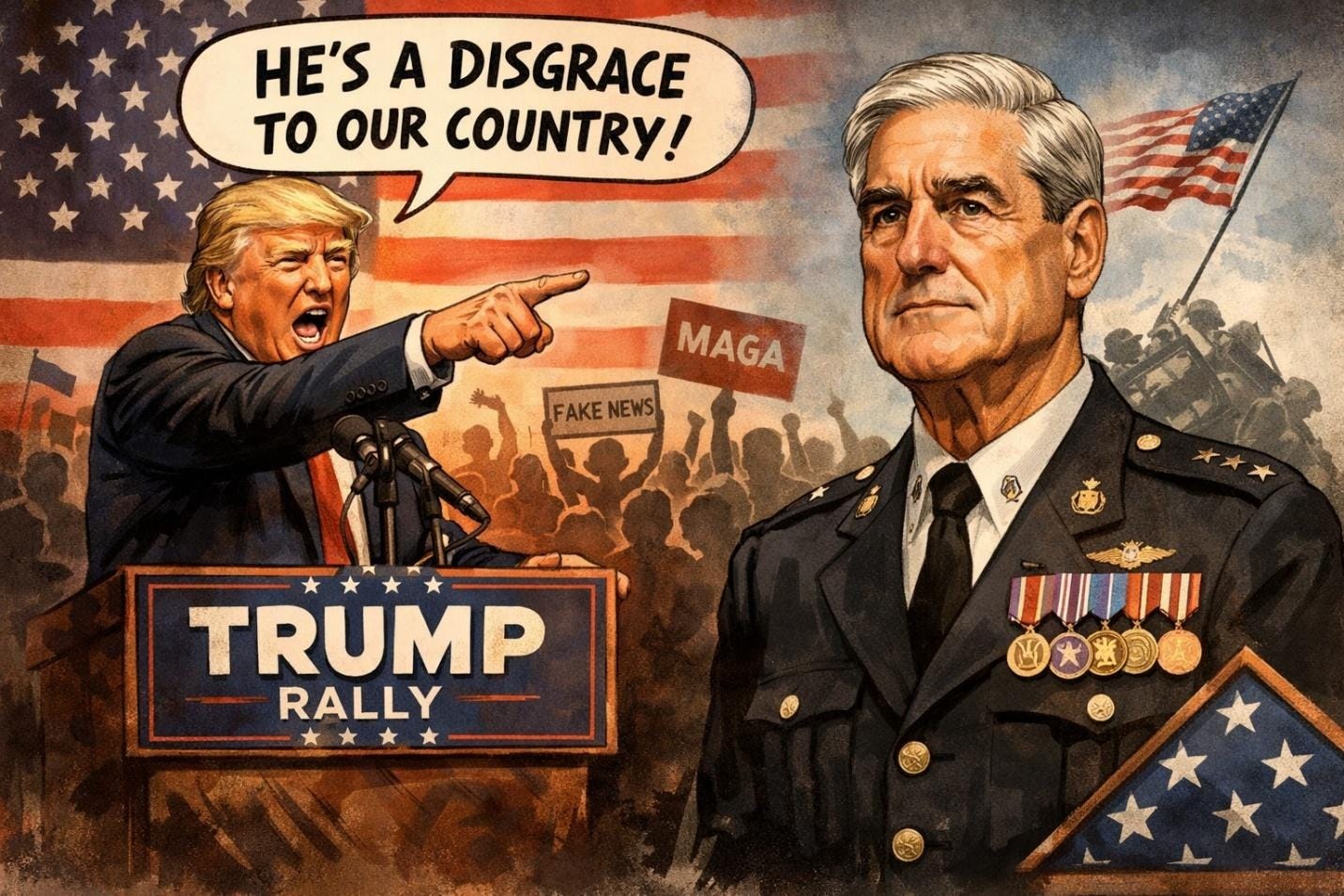
A former FBI director, a decorated Marine, and a lifelong public servant, Robert Mueller, was publicly denounced as “a disgrace to our country” by a sitting president. This was a moment in recent American life that should give us pause, not only because it was crass personal and political rhetoric, but because it revealed a collision between two fundamentally different visions of power.
On one side stood a man whose career was defined by restraint, process, and fidelity to the rule of law. Mr. Mueller was not a political showman. He did not campaign, posture, or trade in spectacles. His authority came from something quieter, and rarer: credibility earned over decades of service. Mr. Mueller’s career reflected an unwavering fidelity to the rule of law, echoing Aristotle’s insight that it is better to be governed by laws than by even the best of men.
On the other side is a president who demonstrates a vision of laws as obstacles and of public servants not as guardians of fairness, but as instruments to be wielded or dismissed.
In a constitutional democracy, Mr. Mueller represented the epitome of what the system hopes to produce: professionals tasked with applying the law impartially, regardless of who holds power. But to a President who demands fealty to his personal rule, to autocracy, those same individuals become liabilities: A person committed to evidence, procedure, and legal boundaries cannot be easily pressured, flattered, or threatened with altering conclusions. They do not bend narratives to suit political needs. They do not confuse loyalty to a leader with loyalty to a country.
Such individuals are dangerous to an autocratic wannabe, not because they seek power, but because they refuse to misuse it; integrity cannot be controlled. I lived under such an autocrat: Panama’s General Manual Noriega. The language may be different, but the logic is the same: those who cannot be controlled must be discredited. And when such leaders begin to disparage those who uphold rules and norms, it is rarely an isolated act. It is part of a broader pattern, one in which independent institutions must be weakened, critics must be delegitimized, and accountability is reframed as persecution.
What makes this dynamic particularly dangerous in a democracy is that it does not always arrive with dramatic events. It often unfolds gradually, through normalization. Each attack is written off as just another headline. Each erosion of trust becomes just another partisan dispute. Until one day, the democratic system is no longer there.
So as tempting as it is to see the Trump-Mueller moment as evidence of just another personal dispute or one leader attacking one official, we must recognize it for what it is: A wannabe autocrat discrediting the values Mr. Mueller lived:
Rule of Law over Personal Allegiance
Credibility shaped by Integrity
Loyalty to the Constitution
A nation is not ultimately defined by its leaders alone, but by what it chooses to honor. If those who follow the law are mocked, while those who challenge it are celebrated, the inversion is not merely rhetorical; it is structural. Figures like Robert Mueller are not beyond criticism. No public servant is. But when integrity itself becomes the object of attack, something more fundamental is at stake.
The health of a republic depends on whether its citizens can still distinguish between power and principle, and whether they are willing to defend the latter when it comes under fire. Because once integrity is treated as a liability rather than a virtue, the question is no longer about any one investigation, or any one presidency. It is about what kind of country we are becoming.
Martha Duncan is a retired U.S. Department of Defense senior executive with 37 years of service, including 23 years as an officer in the U.S. Army Reserves, where she also served as Reserve Attache. She had three operational deployments to Panama, Bosnia, and Afghanistan. At DIA, she worked as a Latin American analyst for 11 years. A specialist in human intelligence (HUMINT), she is recognized for her leadership in intelligence operations, coalition-building, and enterprise-level policy development across the Defense Intelligence Agency (DIA), the U.S. Army, and the broader Intelligence Community. She grew up in Panama during the rise of Manuel Noriega and was instrumental in his capture.
Founded in 2016, The Steady State is a nonprofit 501(c)(4) organization of more than 400 former senior national security professionals. Our membership includes former officials from the CIA, FBI, Department of State, Department of Defense, and Department of Homeland Security. Drawing on deep expertise across national security disciplines, including intelligence, diplomacy, military affairs, and law, we advocate for constitutional democracy, the rule of law, and the preservation of America’s national security institutions.
Powered by WPeMatico