
Strange Bedfellows and the Defense of Democracy – No Kings!
Signs of the Times
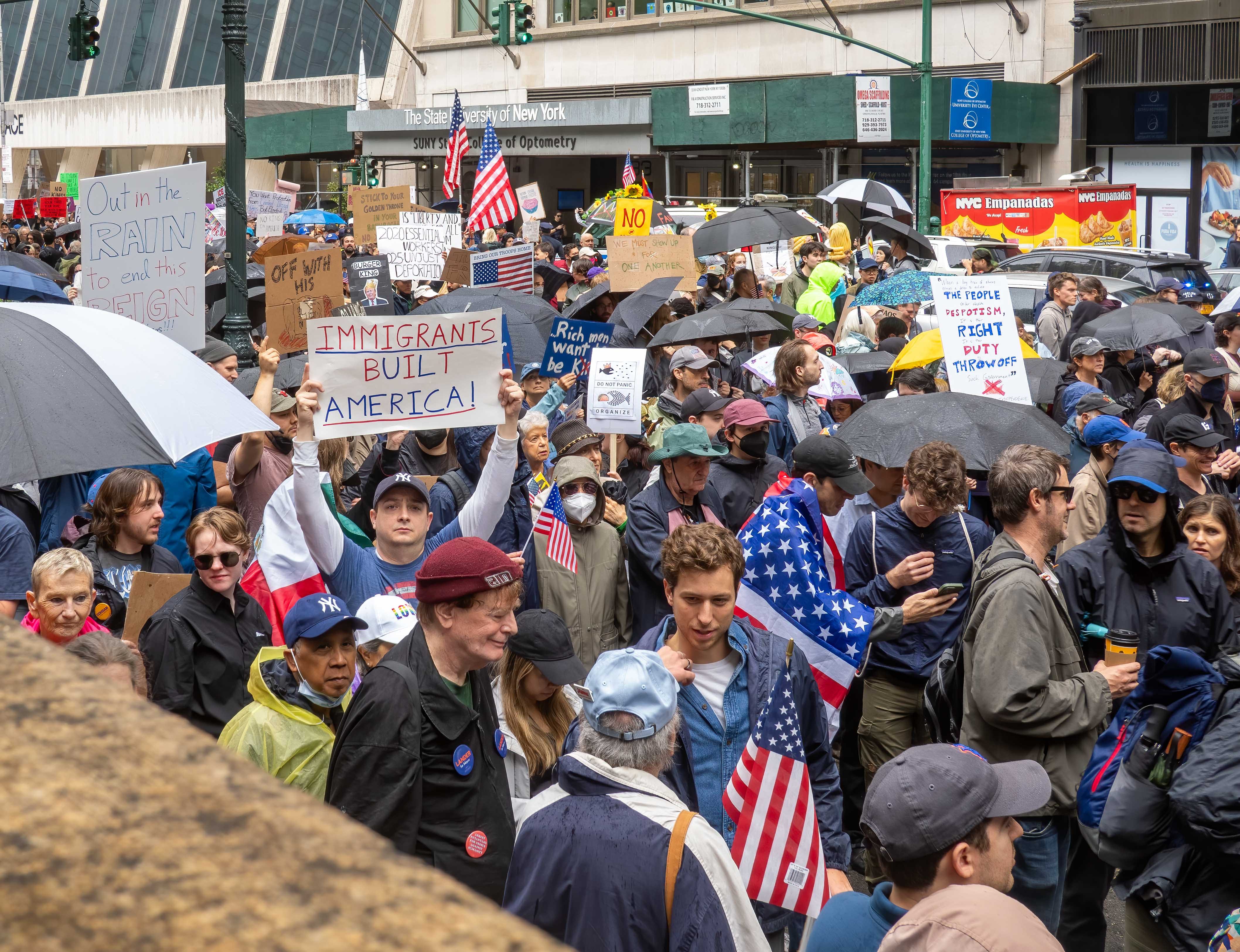
March 28, tens of thousands of people across the country will participate in demonstrations under the banner “No Kings.” The Steady State has joined that coalition of organizations supporting these protests. For an organization composed largely of former national security professionals—people who spent careers in intelligence agencies, the military, diplomacy, and law enforcement—that choice may strike some observers as unusual. After all, marching in the streets is not typically what former national security officers are best known for. But in this time and place, it is exactly what our country needs from us.
Many members of the Steady State have spent decades studying and confronting threats to democratic systems around the world. Many of us served overseas in places where democratic institutions weakened and authoritarian systems consolidated power. When those systems began to erode, we observed that the most successful resistance to authoritarianism was rarely ideologically pure. Instead, it was broad, inclusive, and often uncomfortable. People who disagreed about almost everything else discovered that they shared a common interest in defending the democratic framework that allowed those disagreements to exist in the first place. Our nation faces the same kind of authoritarianism that we have seen overseas; unless we Americans do something about it.
We have described this concept as “Strange Bedfellows.” We recently wrote “resistance to authoritarianism succeeds when it is inclusive and appeals to the broadest swath of the population. It succeeds when people who disagree on many things agree on the things that matter most.” That concept explains why The Steady State has partnered with other organizations planning the March 28 demonstrations.
In normal times, political life in a democracy is defined by disagreement. Citizens argue over taxes, regulation, foreign policy, education, social questions, and the size and scope of government. Those arguments are not signs of dysfunction. Those arguments are the lifeblood of democratic politics; they occur within a shared framework of rules and institutions. Courts remain legitimate. Elections settle disputes. Opponents remain fellow citizens.
Authoritarian movements attempt to weaken the framework of disagreement. They turn disagreement into division and division into isolation. Institutions are attacked. Independent expertise is dismissed. Citizens are encouraged to believe that only certain voices are legitimate. When that process succeeds, opposition fragments into isolated camps that no longer recognize a common interest in defending the system itself.
Breadth and diversity in movements that oppose moves toward autocracies matter because opposition that is narrow and easily caricatured benefits authoritarian movements. A movement that can be labeled, marginalized, or dismissed is easy to isolate. But When resistance spans professions, regions, political traditions, and communities, it becomes far more difficult to ignore.
This is why the March 28 coalition must be large and diverse. The organizations involved represent a wide range of political traditions, professional communities, and civic groups. Many of them do not ordinarily work together. Some have spent years arguing with one another on policy matters. Every involved group and each member of each group share a common understanding that the preservation of democratic norms and constitutional governance must come before any particular policy agenda.
The Steady State’s participation may seem especially unusual. As a group of former national security professionals, our members are not generally known for protest politics. Most of our careers were spent working quietly inside institutions rather than demonstrating outside them. It is fair to say that the image of a group of former intelligence analysts and diplomats marching through city streets might qualify as an unexpected sight.
But that is precisely the point.
The presence of hundreds of former national security professionals in a public demonstration is itself an indicator that this demonstration is against something new, and more dangerous.
These are not activists who have spent decades organizing protests. Nor are they, to borrow one of Donald Trump’s preferred phrases, “leftist lunatics.” When individuals with that professional background conclude that it is necessary to show up in public alongside a broad coalition of civic organizations, it signals that the concerns about growing authoritarianism are not theoretical. They are real.
Coalitions like the one forming for March 28 are rarely tidy. They involve people and organizations that may return to open disagreement once the immediate danger passes. As we observed in the “Strange Bedfellows” essay, “the alliances are sometimes fragile and often uncomfortable. But they are broad. And their breadth is their strength.”
Founded in 2016, The Steady State is a nonprofit 501(c)(4) organization of more than 390 former senior national security professionals. Our membership includes former officials from the CIA, FBI, Department of State, Department of Defense, and Department of Homeland Security. Drawing on deep expertise across national security disciplines, including intelligence, diplomacy, military affairs, and law, we advocate for constitutional democracy, the rule of law, and the preservation of America’s national security institutions.
Powered by WPeMatico