
The Staffing Of Trump 20 Part 2 Rules
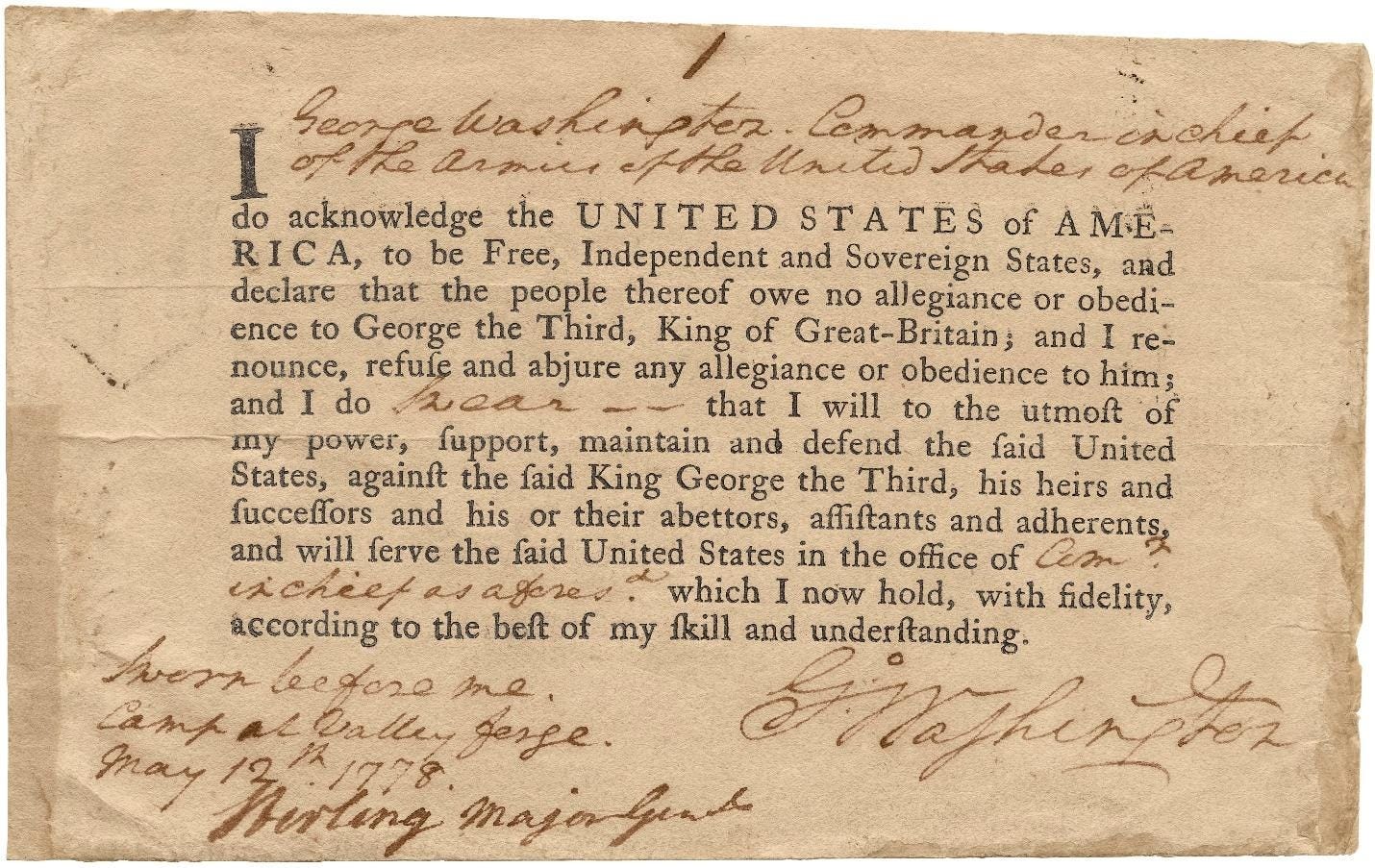
The oath of allegiance taken by George Washington while encamped at Valley Forge, due to a Congressional Resolve of Feb. 3, 1778, that directed ‘every officer who holds or shall hereafter hold a commission or office from Congress’ to take such oath. (National Archives 12043370)
In the first part of this series, we examined first-year hires in the Trump administration who were brought on board with the administration bypassing or ignoring the usual rules for hiring government employees, such as failing to conduct security background checks or ignoring red flags that would disqualify most candidates. In this part, we’ll look at the types of checks usually mandated for anyone applying for government employment—especially for positions dealing with sensitive or classified information—and why ignoring the rules puts this country at risk.
Determining the level of risk and background check requirements
All federal jobs are assigned a risk level to determine the type of security background investigation an applicant must undergo to be placed in the position. Risk designations are made commensurate with the degree of damage that an individual in a position or performing the duties of the position could do to national security or the efficiency of the employing department or agency.
Positions such as those described in part one are designated as public trust positions and have the following duties or responsibilities: policy making, responsibility for major programs, public safety and health, law enforcement, monetary responsibilities, or activities demanding a significant degree of public trust.
Background investigations are required for all federal employees, including interns and volunteers, to ensure that applicants are reliable, trustworthy, and suitable for their positions. The background investigation seeks information about an applicant’s employment, criminal history, and personal history to assess behavioral reliability and integrity. They are conducted to determine if any historical facts would interfere with an applicant’s ability to perform the job, and include any violations of the law. Factors investigated include an applicant’s employment history, past illegal drug use, and previous criminal records. In addition to collecting information directly from the applicant, background information may be obtained from other sources who know the subject, including former employers, co-workers, friends, and neighbors. Applicants are fingerprinted for an FBI criminal history check. Individuals applying for jobs that require a security clearance, for access to classified or sensitive information, are subject to a more intensive background check.
Jobs requiring polygraph (lie detector) tests
Some federal jobs, particularly in the intelligence community (IC) or federal law enforcement, require only a counterintelligence (CI) polygraph; certain positions require a full scope polygraph examination. The full-scope polygraph combines elements of CI and lifestyle polygraphy and delves into an individual’s personal life and conduct. Its purpose is to detect deception across a wide range of security concerns, including espionage, sabotage, terrorist activities, and unauthorized disclosure of classified information; it also encompasses criminal behavior, drug use, and the falsification of security questionnaires. This type of polygraph examination provides an agency with a comprehensive evaluation of any potential issues that could compromise national security. The full scope examination is often required for individuals requiring access to Top Secret/Sensitive Compartmented Information (TS/SCI), which includes roles in counterintelligence, certain law enforcement positions, and individuals involved in highly sensitive national security operations.
Government polygraph tests are conducted under Title 29 of the Code of Federal Regulations (29 CFR Part 801), which is designed to protect individual employee rights while ensuring the security of government information and programs.
The Trump administration is short-circuiting the vetting process
In one of his first acts as president, Donald Trump granted immediate Top Secret clearances, as well as access to Sensitive Compartmented Information (SCI) for a period of six months to several people, who were not publicly identified. Among the flurry of executive orders he signed on January 21, 2025, was one revoking the security clearances of individuals involved in the Hunter Biden laptop memo, and another granting interim eligibility to presidential appointees whose background investigations have not yet been completed. It appears that the granting of interim clearances even bypassed the less-intensive background-check process, providing interim clearance while the more intensive review is undertaken. While the six-month limit on interim clearances appears to indicate that the complete background check will be conducted, the absence of any check poses potential security risks.It also raises the possibility of placing people in positions for which they would not be eligible for a clearance.
There’s already a precedent for this from Trump’s first term, when his son-in-law, Jared Kushner, was denied clearance but was hired anyway.
Background investigations do take time, as I know from being on both sides of the process, first as the subject of several background investigations during my 50 years in government and as an operations officer at the US Army Intelligence Command from 1969 to 1970. But they are essential to ensure that individuals having access to some of the nation’s most closely guarded secrets are qualified and trustworthy, and not subject to potential exploitation by an adversary. Also, part of the clearance backlog that Trump railed at was his campaign’s own fault, as he failed to sign agreements with the White House and relevant agencies by the usual deadlines.
We may never know the damage caused by this administration’s short-circuiting of the employee hiring process, or, worse, the damage may not become apparent until long after the perpetrators are no longer in government. We don’t know, for example, the status of, or even the precise number of, employees of the executive branch who were granted six-month interim clearances at the beginning of the administration. The one thing that we can say for sure is that the damage has already been done. The question is, how much, and what will it take to undo it?
Charles A. Ray served 20 years in the U.S. Army, including two tours in Vietnam. He retired as a senior US diplomat, serving 30 years in the U.S. Foreign Service, with assignments as ambassador to the Kingdom of Cambodia and the Republic of Zimbabwe, and was the first American consul general in Ho Chi Minh City, Vietnam. He also served in senior positions with the Department of Defense and is a member of The Steady State.
Founded in 2016, The Steady State is a nonprofit 501(c)(4) organization of more than 360 former senior national security professionals. Our membership includes former officials from the CIA, FBI, Department of State, Department of Defense, and Department of Homeland Security. Drawing on deep expertise across national security disciplines, including intelligence, diplomacy, military affairs, and law, we advocate for constitutional democracy, the rule of law, and the preservation of America’s national security institutions.