
Trumps Ukraine Peace Plan Is A Gift
By excluding Kyiv and Europe and imposing a Thanksgiving deadline, Trump is normalizing territorial conquest and undermining U.S. allies
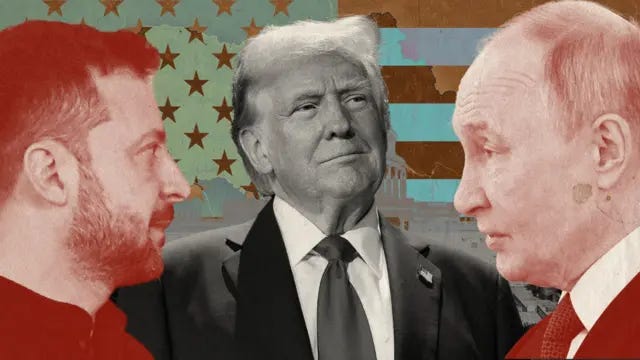
Donald Trump’s latest “peace plan” for Ukraine, rolled out through his real-estate-developer-turned-envoy, Steven Witkoff, tells us far more about Trump’s instincts and vulnerabilities than it does about any serious diplomatic effort. The proposal, which was developed without Ukraine or any European nation in the room, reads like it was drafted in the Kremlin cafeteria. It’s the newest data point in a now familiar pattern. Trump’s position on Ukraine shifts constantly, but the end point is always the same. Whatever benefits Russia.
It doesn’t take my 30+ years with the State Department to know that diplomacy is complex. It requires relationships, leverage, trust, and above all, legitimacy. Trump’s plan has none of these. Witkoff, who has no diplomatic experience and was sent to Moscow as Trump’s “special envoy,” held discussions only with Russian officials. No meeting with Ukraine. No meeting with the EU states that have shouldered much of the economic and military burden. No coordination with NATO. Not even the pretense of a multilateral process.
Imagine any previous American administration attempting to negotiate an end to a war in Europe without the attacked nation or its neighboring countries and allies at the table. The whole idea is beyond reason. Yet this White House treats it as business as usual. The result is as absurd as it is predictable: a “deal” designed to pressure Ukraine into concessions that no sovereign nation could accept.
This is Not a Peace Plan
Under Trump’s proposal, Ukraine would be required to cede sovereign territory currently occupied by Russia, effectively rewarding the invasion. Ukraine would have to shrink its military, leaving it less capable of defending itself against the very country occupying its land. To boot, they would have to abandon any path toward NATO membership, a core national aspiration supported by overwhelming majorities of Ukrainians. In return? A so-called security guarantee so weak, it doesn’t bind the United States or anyone else to respond to future Russian aggression.
Adding a twist that Zelensky’s team must be viewing as both coercive and deeply unserious, Trump has given Ukraine until Thanksgiving (next Thursday) to accept the deal. As if a democratically elected government defending its very existence should sign away its sovereignty on a U.S. holiday countdown clock. The artificial deadline underscores how little Trump understands about diplomacy, or how little he cares.
For President Zelensky and the Ukrainian people, this is not diplomacy. It’s capitulation dressed up as “peace.” A non-starter. They’ve fought, bled, and died for their independence. They’re not going to hand it over for a deal that gives them nothing and gives Moscow everything.
Policy by Last Phone Call
If the plan seems suspiciously aligned with Russia’s strategic goals, it’s because Trump’s foreign policy almost always mirrors the preferences of the last strongman he spoke to. His views on Ukraine rotate like a windsock, supporting lethal aid when Republican hawks were in the Oval Office, threatening to cut off support after a call with Putin, and insisting he could end the war “in 24 hours” without ever explaining how.
His Ukraine strategy isn’t a strategy at all. It’s improvisation in search of validation from whichever authoritarian voice he last heard. The lack of institutional guardrails inside his administration only amplifies this tendency. Hollowing out professional agencies, sidelining career diplomats, and elevating loyalists over experts has left the U.S. government unable even to warn him when he is walking into geopolitical traps. This peace plan is the predictable result. Policy made without data, process, or allies.
Cutting Out Europe—and Undermining America
Every major European capital learned of Trump’s proposal from the press, not from Washington. That is its own scandal. For three years, America’s closest allies have been desperate to keep the coalition supporting Ukraine intact in the face of Russian escalation. They have endured sky-high energy prices, absorbed millions of refugees, rebuilt their defense industries, and recommitted to NATO spending, largely because they believed America still had their back.
By floating a Russia-first peace deal behind their backs, Trump is not just undermining Ukraine. He is undermining the transatlantic alliance that has kept Europe stable for 80 years. He signaled that European security interests are optional and that the U.S. may go it alone, even when “alone” means “with Russia.”
Perhaps the most destabilizing aspect of Trump’s proposal is the message it sends beyond Ukraine. By rewarding Russia’s land grab and treating conquest as a valid negotiating position, Trump is effectively giving Moscow (and any other revisionist power) a green light to take more. If borders can be changed by force and then ratified by an American president in search of a deal, why wouldn’t Putin push further? Moldova, Georgia, even NATO’s eastern flank would all become more vulnerable overnight. Trump isn’t ending a war, he’s normalizing aggression.
The Bottom Line
A peace process that excludes Ukraine is not a peace process. A plan that rewards invasion is not a plan. And a president who sets holiday deadlines for surrender is not negotiating, he’s coercing. America can help end the war in Ukraine. But not like this.
Bruce Berton served as a U.S. diplomat for over three decades, ultimately rising to the senior ranks of the Foreign Service, including two years as Ambassador and Head of Mission at the Organization for Security and Cooperation in Europe’s (OSCE) Mission to Bosnia and Herzegovina. He is a native of the Pacific Northwest and a graduate of Pacific Lutheran University. He is a member of The Steady State.
Founded in 2016, The Steady State is a nonprofit 501(c)(4) organization of more than 360 former senior national security professionals. Our membership includes former officials from the CIA, FBI, Department of State, Department of Defense and Department of Homeland Security. Drawing on deep expertise across national security disciplines including intelligence, diplomacy, military affairs and law, we advocate for constitutional democracy, the rule of law and the preservation of America’s national security institutions.