
The Distance That Defines The Bureau
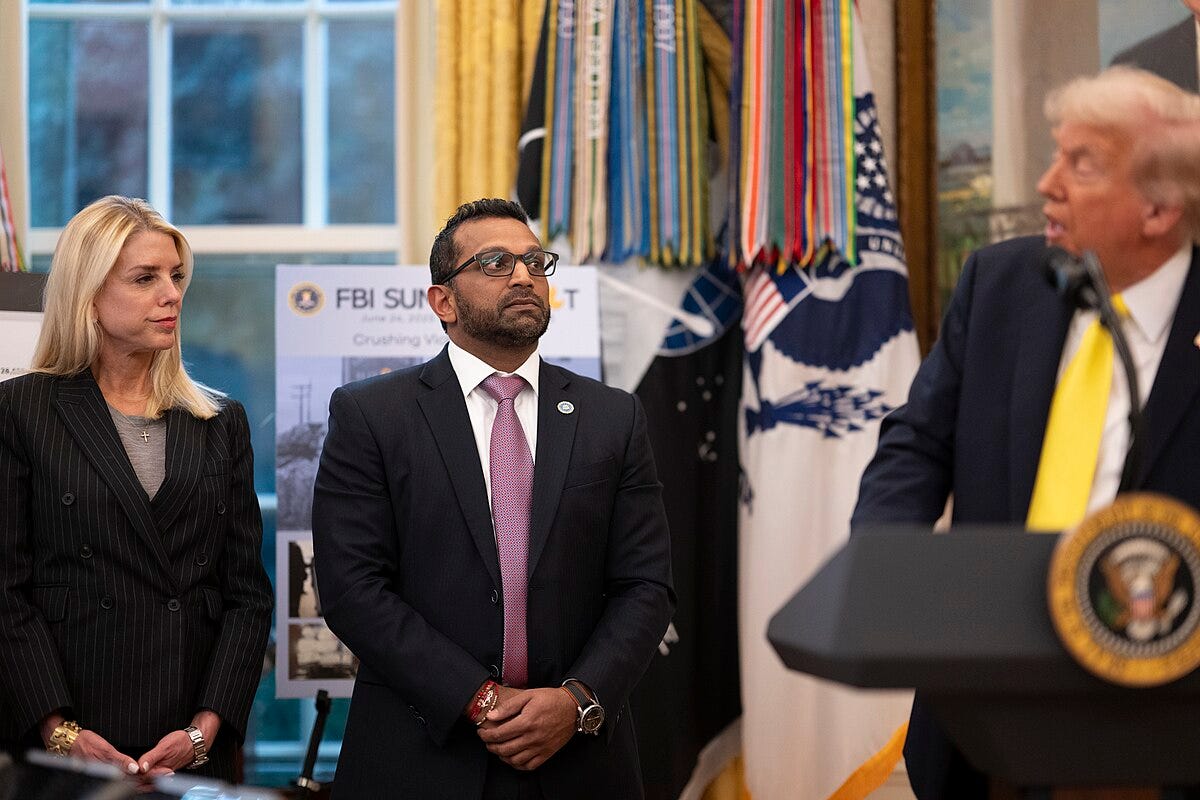
Donald Trump, FBI Director Kash Patel and Attorney General Pam Bondi, unveil the results of “Operation Summer Heat,” Wednesday, October 15, 2025, in the Oval Office.
During the years I worked in Embassies in Europe, Africa and the Middle East for the FBI, one of the things I heard repeatedly was how lucky we were to be free of political machinations by our political leaders. Many, if not most, of our counterparts were routinely subjected to political pressure – at times relentlessly so.
The FBI has maintained a delicate but critical boundary with the White House over the past 50 years—a boundary created by post-Hoover reforms. After Hoover’s death, Congress established a 10-year director term to ensure leadership outlasted any president, safeguarding FBI independence and preventing politicization. Every director since has understood this, every agent knows it, and every overseas partner expects it.
That’s why Director Kash Patel’s regular, visible presence in the White House is troubling—it’s a profound break with norms that have protected the Bureau and the nation for decades. His presence signals that the FBI is no longer keeping its distance. And that distance is imperative.
During my nearly 30 years in the FBI, I learned an essential truth: guard against even the appearance of political alignment. In the field, in headquarters, and abroad, our credibility rested on one principle—we work without fear or favor. We don’t do it for a president or party, but for the rule of law and the American people.
A Break With the Norms Every Director Before Patel Respected
Whatever one thinks of James Comey’s decisions, he, Robert Mueller, and their predecessors were meticulous about avoiding the White House, knowing that independence must be both protected and seen. In 2004, Mueller and Deputy Attorney General Comey nearly resigned over a surveillance dispute, willing to walk away to preserve the FBI’s boundary with politics and protect their employees from breaking the law.
Those moments defined the modern FBI, aligning the Bureau with democratic norms and accountability to law—not political power
Recent choices show how far from tradition the Bureau is drifting. Earlier this fall, the President publicly directed Attorney General Bondi to open investigations against several people, including Comey. After Comey was subsequently indicted, in an indictment currently under scrutiny by Federal judges, Patel pushed for a public ‘perp walk’ for Comey —a move contrary to DOJ policy. When a veteran agent refused to participate, calling it political, he was fired. Patel did not deny it and dismissed the criticism with an expletive. This turn toward spectacle and disregard for policy shows a misunderstanding of the institution itself.
Patel’s White House Presence Is Something Entirely Different
Patel’s presence at the White House is unprecedented—not only in meetings with political advisors, but also alongside Members of Congress when the President is pressuring them about FBI cases. The President cannot use the FBI as leverage in political negotiations, and the FBI cannot be seen as participating. Even the appearance collapses the firewall every prior director defended.
Further evidence of this erosion was Patel’s presence, alongside the President in the Oval Office, on October 15, 2025, to unveil the results of “Operation Summer Heat,” an initiative touted as a political win with more than 8,700 arrests and thousands of guns seized. The President framed the effort in explicitly political terms, with the FBI Director positioned as part of the White House’s public message. In a normal environment, this type of announcement is perfectly appropriate for the FBI Director, ideally with the Attorney General, at FBI Headquarters — not the White House. It also silently represented the continuing diversion of FBI resources to violent crime and immigration enforcement driven by presidential priorities rather than mission-based needs. In a system that is intended to function with distance between the FBI and the White House, a Director regularly standing at the President’s side to promote politically-framed operations is not routine or appropriate, and it erodes independence.
This lack of distance is destroying longstanding norms that have helped keep our democracy safe and independent.
Patel has never publicly stated he is acting on direct orders from the President, although he came close in the October 15 event, but his repeated presence at the White House—combined with his alleged remark in sworn litigation that agents “tried to put the President in jail and he hasn’t forgotten it”—raises serious concerns.
Once that line is crossed, restoring public trust and institutional independence is extraordinarily hard.
Why This Matters Now
For five decades, the FBI’s strength has come from restraint and adherence to law and its’ internal guidelines. That culture insists on objectivity, even under stress, which protects institutions from bias and corruption.
Patel’s choices threaten those lines at a moment when democratic guardrails are already under strain. The public expects—and deserves—an independent FBI and FBI Director, free from even the appearance of political manipulation. Many Americans, including critics who believe the Bureau was both politicized, and weaponized under the Biden administration, already question whether it can remain above partisanship and apply the law even-handedly.
The Path Back to Independence
The Director should sharply limit White House contact. When the FBI Director sits in the Situation Room while the President and senior officials press Representative Lauren Boebert (R-CO) to remove her name from a petition forcing a vote to release the Epstein files, the Director’s presence cannot be read as neutral – and it further erodes trust in the FBI’s neutrality.
DOJ and FBI leadership must openly reaffirm nonpartisanship. Congress must insist on transparency and reinforce the importance of an independent FBI. Agents must be able to do their jobs without fear of political retaliation. Independence and objectivity are the foundation that holds the FBI together.
This is a moment that demands restraint, clarity, and the courage to maintain distance—even when political power tries to pull you closer.
Once the FBI becomes an instrument of politics, it ceases to be the FBI Americans—and our allies—trust.
Lauren C. Anderson is a former FBI national security executive who spent nearly three decades running toward the crises most people run from. An Advisor to the U.S. Comptroller General and the U.S. Army, she is a member of the Council on Foreign Relations and The Steady State. She writes What We Choose to Defend, exploring the intersection of trust, security, conscience, and the rule of law.
Founded in 2016, The Steady State is a nonprofit 501(c)(4) organization of more than 360 former senior national security professionals. Our membership includes former officials from the CIA, FBI, Department of State, Department of Defense and Department of Homeland Security. Drawing on deep expertise across national security disciplines including intelligence, diplomacy, military affairs and law, we advocate for constitutional democracy, the rule of law and the preservation of America’s national security institutions