Venezuela After Maduro Six Questions
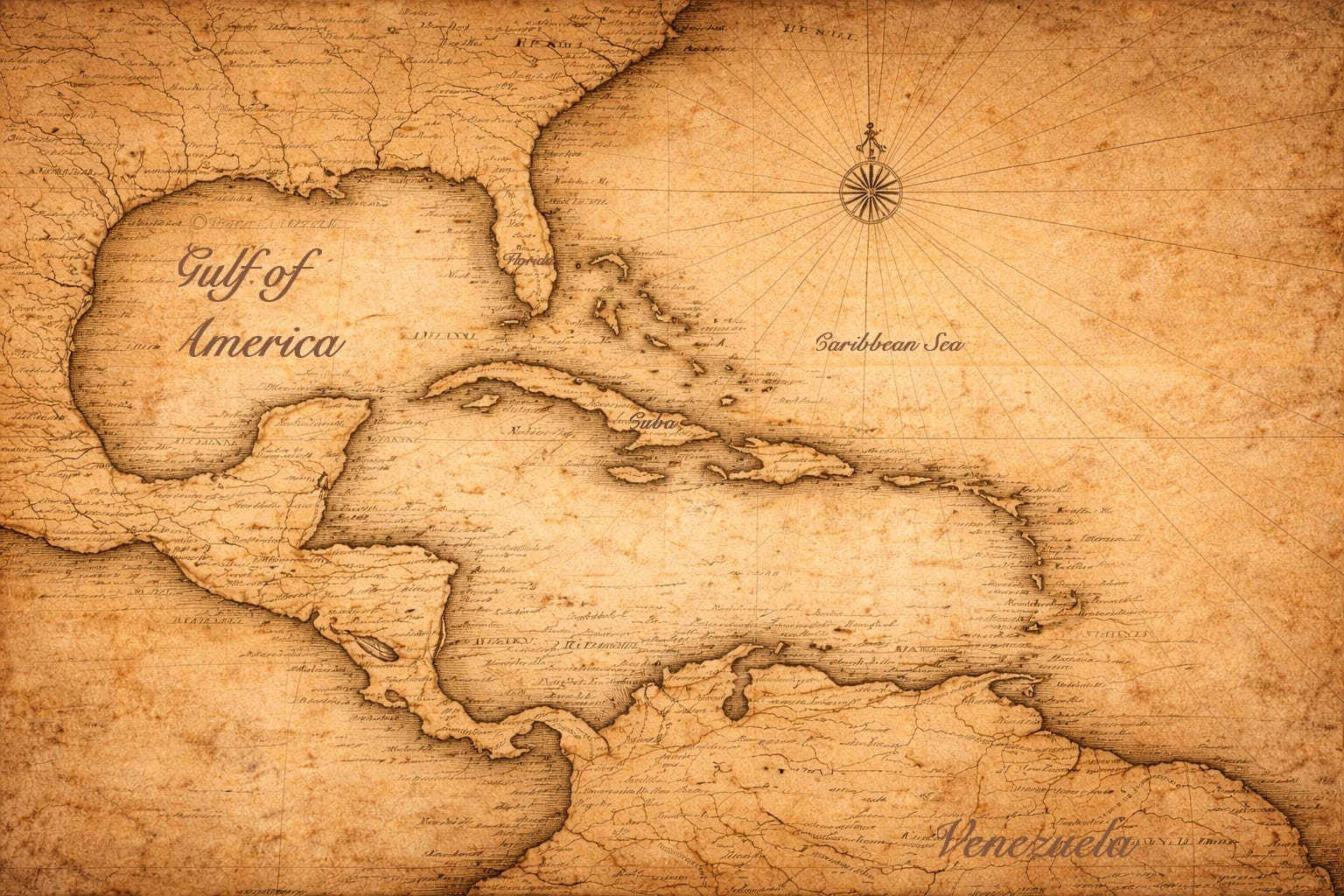
New Map of Venezuela and Gulf of America
The United States’ seizure and removal of Venezuelan President Nicolás Maduro on January 3 has already produced a flood of contradictory claims and counterclaims. The Trump administration says it is now “running” Venezuela. But President Donald Trump has also said that Venezuelan Vice President Delcy Rodríguez remains in charge, even as Venezuelan officials insist that no authority has changed hands at all. Are we seeing regime change from what the United States has labeled a “narco-terrorist” state? An occupation? Or something more ambiguous?
At this stage, such labels are not reliable. What matters is not what officials in Washington or Caracas say, but how power is actually exercised in the days and weeks ahead. History suggests that outcomes in situations like this are not determined by the initial act of force, but by a small number of structural questions that resolve themselves through behavior rather than rhetoric.
Here are six such questions. Together, they will determine what this intervention really is—and whether it is sustainable.
Control: Who Actually Exercises Authority?
Removing a head of state is not the same as controlling a country. Real authority consists of giving orders that are obeyed, controlling security forces, moving money and fuel, and keeping institutions functioning. Who controls the Venezuelan security forces in practice? Who controls the operations, exports, and revenue flows of PDVSA, Venezuela’s national oil company? Who directs courts, ports, borders, and payment systems?
The Maduro extraction appears to have been smooth, quick, and remarkably easy. Did any elements of Venezuelan forces choose not to resist the operation, actively assist it, or were they simply paralyzed by confusion or shock? So far, there is no public evidence of Venezuelan cooperation with the United States. Still, the absence of resistance itself requires explanation. If there were undisclosed understandings, they might help explain why President Trump has referred to Rodríguez as being in charge, and why the United States has not pressed for the immediate seating of opposition leaders widely viewed as having won Venezuela’s July 28, 2024 elections.
Legitimacy: Why Should Venezuelans Accept This Authority?
Control without legitimacy is possible, but it is expensive and brittle. Venezuela’s history—and Latin America’s more broadly—makes this especially true when external power is involved.
On what theory does the United States claim the right to direct Venezuelan governance, if it does at all? What constitutional or emergency authorities are asserted on the Venezuelan side? How are these arrangements perceived by the public, elites, and the armed forces?
Particular attention should be paid to the administration’s statements that Delcy Rodríguez is “in charge.” That claim could reflect a conditional bargain, an attempt at indirect rule, or simply a bluff. Rodríguez’s own public rejection of U.S. authority cuts against the idea of a settled arrangement.
The issue is not abstract legitimacy, but whether enough Venezuelans come to treat the situation as tolerable, temporary, or unavoidable.
Economics: Who Controls Oil, Money, and Sanctions?
The Trump administration has been unusually explicit that economic benefit—particularly oil—is a central objective. That clarity removes ambiguity about motive but raises the stakes.
What exactly will the United States demand in oil terms: production rights, revenue priority, compensation for expropriation, restructuring of PDVSA, or some combination? Who will make and enforce those decisions on the Venezuelan side?
Equally important is sanctions coherence. It would make little sense—and create significant legal and compliance confusion—for Venezuela to remain a sanctioned sovereign state if the United States is directing its economic affairs. How this tension is resolved will determine whether third-country firms, banks, and governments engage or stay away.
Economic arrangements will shape elite behavior more reliably than any speech.
Conflict and the Disposal Problem: How Does Violence Re-Enter the System?
The absence of immediate large-scale violence tells us little about the medium term. In many interventions, conflict does not return as a clash of armies, but as fragmentation, criminalization, and low-level insurgency.
On the U.S. side, previous claims of narco-terrorism imply that a large number of Venezuela’s security forces were involved in drug trafficking or terrorist activity threatening the United States. Who was involved? Does the United States intend to remove them, prosecute them, or cut deals with them—trading amnesty for cooperation?
Do Venezuelan security forces remain unified, splinter, or defect? Do non-state armed groups reposition themselves as resistance movements or opportunistic actors? Do external players quietly raise the cost of U.S. influence through deniable means?
The form violence takes, if it returns, will matter as much as its scale.
Humanitarian Conditions: What Happens to Daily Life?
Humanitarian outcomes are not secondary. They directly affect legitimacy, migration, and regional stability.
Do power, water, fuel distribution, hospitals, and food logistics function better or worse? Does technocratic continuity hold, or does political disruption accelerate service collapse?
If daily life deteriorates, any governing arrangement will be blamed, regardless of intent. If conditions stabilize, even unpopular arrangements can persist.
Duration: How Long Will the U.S. Sustain Its Presence in Venezuela?
Initial resolve is easy. Endurance is not.
What is the end state of the U.S. intervention: elections, a transitional authority, or an open-ended “guardianship”? What are the exit ramps if legitimacy collapses, violence rises, or economic objectives prove unattainable? How durable is U.S. political will in the face of casualties, oil-market volatility, legal challenges, or congressional resistance?
History suggests that those who have planned for duration usually prevail over those who have only planned for impact. These questions will not be answered by press conferences.
Jonathan M. Winer is the former Special Envoy for Libya and Deputy Assistant Secretary of State for International Law Enforcement and a Distinguished Diplomatic Fellow at MEI. He is a member of The Steady State.
Founded in 2016, The Steady State is a nonprofit 501(c)(4) organization of more than 360 former senior national security professionals. Our membership includes former officials from the CIA, FBI, Department of State, Department of Defense, and Department of Homeland Security. Drawing on deep expertise across national security disciplines, including intelligence, diplomacy, military affairs, and law, we advocate for constitutional democracy, the rule of law, and the preservation of America’s national security institutions.