
Voting Out the Autocrat
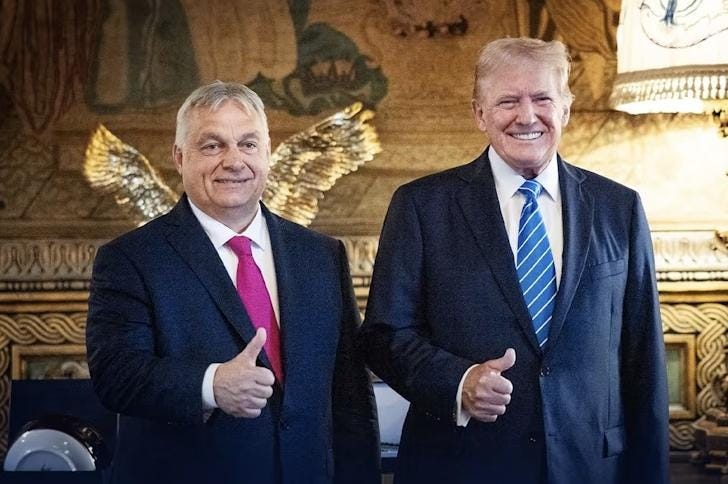
“We have got to get Viktor Orbán reelected… what the United States and Hungary together represent… is the defense of Western civilization.” — JD Vance
Exporting Illiberalism
When a sitting American vice president flies to Hungary not to conduct diplomacy, but to campaign for a foreign strongman, it is not subtle. It is a signal. The endorsement of Viktor Orbán by Donald Trump’s political movement is not about Hungary. It is about importing a model.
And that model is clear: hollow out democratic institutions, consolidate power, weaponize grievance, and call it “Western civilization.” In recent days, Vance didn’t just praise Orbán, he echoed his worldview, attacking the European Union, defending nationalist policies, and urging Hungarian voters to keep Orbán in power. The message wasn’t coded. It was an explicit alignment.
The Orbán Model
Orbán has spent over a decade building what he calls an “illiberal state.” In practice, that has meant consolidating power at every level. Independent media outlets have been bought up, shuttered, or brought under government-friendly control. Election laws have been rewritten to favor the ruling party. Courts have been weakened. Civil society organizations have been stigmatized and constrained. And universities, especially those seen as ideologically inconvenient, have been pushed out or brought to heel. I had the pleasure of speaking and participating in a variety of events at the Central European University before Orban ran it out of town. That was a warning shot to every institution that independence would not be tolerated.
Orbán’s rhetoric has sadly matched his actions. His government has trafficked in anti-immigrant fear, openly racialized narratives about preserving Hungarian identity, and messaging that critics across Europe have repeatedly described as flirting with antisemitic tropes. This is politics rooted in division, defining “the people” narrowly, and casting everyone else as a threat.
Meanwhile, corruption has flourished. Orbán’s inner circle has grown extraordinarily wealthy, even as many Hungarians face stagnant wages, strained public services, and declining economic mobility. This is the system Vance is calling “successful.”
A Glimpse of Intent
The Trump parallels are not subtle. They are the point.
Like Orbán, Donald Trump has attacked independent media as illegitimate. Like Orbán, he has sought to undermine courts, politicize law enforcement, and purge institutions of those seen as insufficiently loyal. His worldview, like Orbán’s, frames politics as an existential struggle in which normal democratic constraints are obstacles to be overcome.
What Orbán represents is the end-state of that approach. Not chaos, but control. Not the collapse of democracy, but its transformation into something managed, where elections still occur, but the playing field is so tilted that outcomes are rarely in doubt. That’s why admiration matters. It’s not rhetorical. It’s aspirational.
Loyalty Over Liberty
At its core, the Orbán model replaces pluralism with loyalty. Institutions are no longer valued for their independence or expertise, but for their alignment with the ruling ideology. Universities must conform. The media must reinforce. Courts must validate.
Sound familiar?
This is the same instinct driving efforts in the United States to purge the civil service, intimidate journalists, and reshape education around political priorities. It is governance by loyalty over competence because loyalty is easier to control.
The result in Hungary has not been renewal. It has been stagnation. Despite the rhetoric of strength and sovereignty, the average Hungarian is no better. Public services have eroded. Economic gains have been uneven. And the country’s international standing has suffered as it drifts away from democratic allies and toward more authoritarian partners.
Transactional Power, No Memory
Trump’s foreign policy reflects the same instinct: transactionalism without continuity, pressure without strategy, and engagement without institutional memory.
In Iran, U.S. attacks have failed to alter the underlying structure of power. The regime remains intact, with the Islamic Revolutionary Guard Corps even more central to its survival architecture than before. Repression continues, dissent is crushed, and long-standing strategic behaviors (regional proxy activity and nuclear ambition) remain embedded in state policy.
In Venezuela, similarly, sanctions and pressure have not produced democratic restoration. Instead, the same governing coalition remains dominant, elections will remain constrained, opposition figures harassed or imprisoned, and political competition tightly managed.
In both cases, the pattern is the same: attack, declare progress, move on, while the underlying systems adapt and endure. That is not a strategy. It is drift, with the predictable result that problems are not resolved, only deferred. In both countries, the leadership survives. The system persists. And ordinary citizens bear the consequences.
A Test of Limits—And a Verdict
Sunday, Hungarian voters delivered a result that many observers had considered increasingly uncertain: Viktor Orbán conceded defeat after an unexpectedly decisive electoral loss.
That fact matters for two reasons. First, it demonstrates that even systems designed for durability have limits. Even heavily managed political environments can produce outcomes that their architects cannot control. And even long-entrenched leaders can be forced, by the electorate, to accept defeat.
Second, Orbán conceded, in contrast to a more troubling pattern in contemporary politics: the normalization of refusal to accept electoral outcomes when they are unfavorable. In the United States, that norm has already been tested in ways that continue to shape political behavior and institutional trust. That divergence should not be ignored.
For years, Orbán has been treated in certain American political circles as a kind of proof of concept: that a leader can reshape institutions, consolidate authority, and maintain electoral legitimacy simultaneously. His defeat complicates that narrative. It suggests that even after sustained institutional capture, electoral accountability can reassert itself when public tolerance for stagnation, corruption, and democratic constraint reaches its limit.
That is not a Hungarian lesson. It is a democratic one. And it is a reminder that political systems are not static, that control and permanence are not the same thing, and that legitimacy, once eroded, is difficult to indefinitely sustain through institutional engineering alone.
The United States will face its own tests soon enough, this November and again in 2028. The question is not whether illiberal models can be admired or studied. The question is whether they can be replicated or resisted when pressure is applied at home. Hungary has now offered its answer. The United States must answer similarly.
Bruce Berton served as a U.S. diplomat for over three decades, ultimately rising to the senior ranks of the Foreign Service, including two years as Ambassador and Head of Mission at the Organization for Security and Cooperation in Europe’s (OSCE) Mission to Bosnia and Herzegovina. He is a Pacific Northwest native and a graduate of Pacific Lutheran University. He is a member of The Steady State.
Founded in 2016, The Steady State is a nonprofit 501(c)(4) organization of over 390 former senior national security professionals. Our membership includes former officials from the CIA, FBI, Department of State, Department of Defense, and Department of Homeland Security. Drawing on deep expertise across national security disciplines, including intelligence, diplomacy, military affairs, and law, we advocate for constitutional democracy, the rule of law, and the preservation of America’s national security institutions.
Powered by WPeMatico