
A Purge Problem?
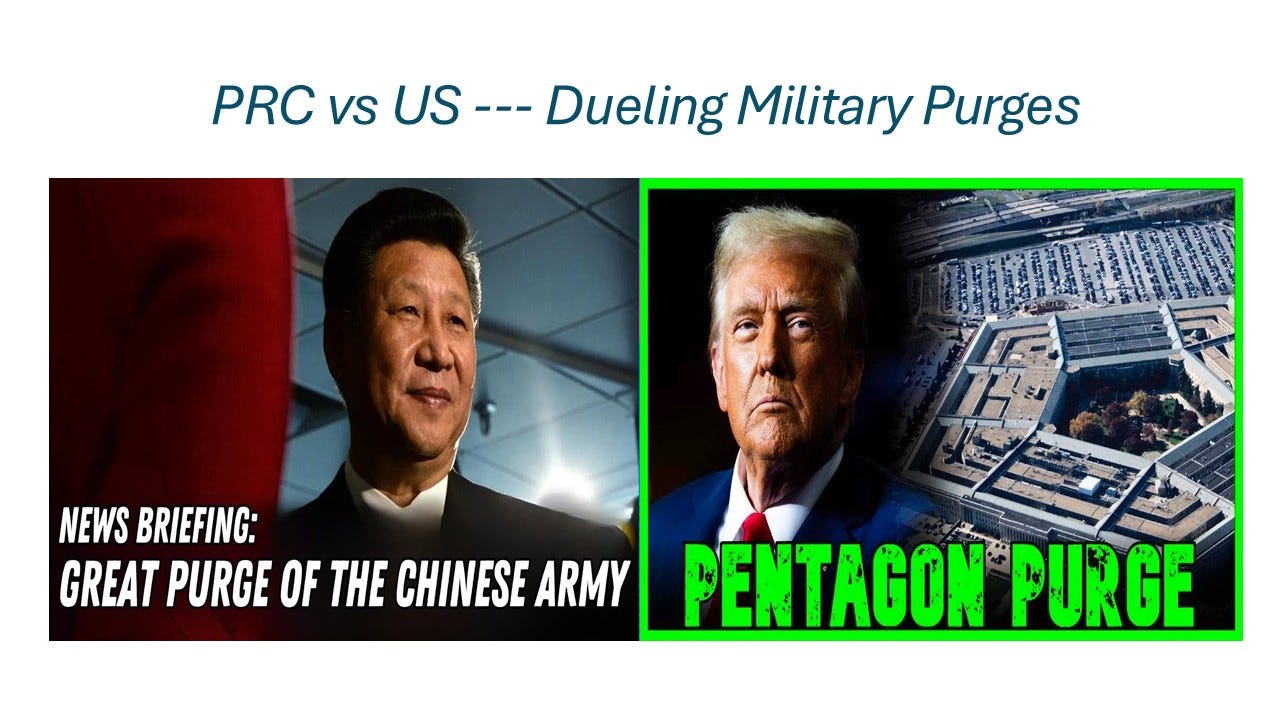
While China’s military purge reflects its authoritarian system, the United States is choosing a similar path—trading competence for loyalty and risking long-term strategic consequences.
Secretary of Defense Hegseth has ironically expanded US military competition with China’s People’s Liberation Army (PLA) – not to improve our position vis-a-vis China, but through a politically driven purge of the US military. China’s purge is larger and somewhat differently motivated, but the negative impact on military readiness is likely similar in both cases. More troubling, both purges reflect the same authoritarian impulse: prioritizing loyalty and ideology over professionalism and performance. If China wants to hollow out its military for political reasons, we should welcome it. The question is why the United States would follow suit.
China’s Military Purge
Over the past two years, President Xi has undertaken an unprecedented purge of the PLA’s senior ranks. According to US think tank analysis, more than half of roughly 100 top flag officers have been removed, including five of seven members of the Central Military Commission – the PLA’s apex command body.
US analysts cite several drivers: rooting out endemic corruption, Xi’s frustration with the pace of military modernization, and above all, demands for loyalty to Xi and his personal agenda. The consensus among US and international analysts is that PLA capabilities will be negatively affected, at least in the near term. Such purges are not unprecedented in China’s history – they are a hallmark of Leninist authoritarian governance, where ideological conformity and regime loyalty take precedence over military effectiveness.
The US Military Purge
So, if Communist China is doing what it does, why is the US copying this pattern and what does it say about American national political leadership, especially at the Department of Defense (DoD)?
Secretary Hegseth has removed at least 21 flag officers on the basis of race, gender, or suspected political leanings. He refused to promote four flag officers reportedly due to their race and gender – a move that contributed to the removal of the Army Chief of Staff when he pushed back. Under Hegseth, the DoD has aggressively dismantled policies designed to prevent racial and gender discrimination, gutted the senior ranks of the military’s legal offices, and eliminated the organization established to minimize civilian casualties – all framed as ending “woke” restrictions.
The purge has extended to the “Stars and Stripes,” the military’s long-standing internal newspaper, overhauled for being too “woke.” Its ombudsman was fired recently, reportedly for raising editorial independence concerns. Former senior officers have described a Pentagon consumed by vindictiveness, politicization, and what one called the Secretary’s obsession with installing a “virile, anti-woke warrior ethos” – one that stretches into disdain for international law. The department is in “a full-blown meltdown,” says John Ullyot, a Hegseth loyalist who served as chief spokesman until April.
Loyalty and Ideology: The Common Thread
Corruption remains the most significant difference between the two purges – a difference that reflects well on the professionalism of the US military. But the underlying logic is disturbingly similar. Both purges subordinate military effectiveness to political loyalty. In China, this is a feature of authoritarian rule: the military must be personally loyal to Xi and aligned with his agenda. In the United States, personal loyalty and ideology should not be factors, but have become so under Hegseth and Trump.
Hegseth’s conduct in the US-Iran conflict illustrates the consequences. Hegseth is clearly out of his depth as Secretary. As one former military official put it to the Economist magazine, he is “a 12-year-old boy with a set of army action figures who likes to play war.” When loyalty displaces honest professional judgment, superb military execution fails to translate into strategic success – precisely the domain where a Secretary of Defense (and President) must perform.
Equally damaging is Hegseth’s effort to rewrite the ethos of the American military. Since President Truman integrated the armed forces in 1948, the military has served as a unifying national institution – one that draws on the country’s full range of talent and signals to adversaries that America stands together. The so-called anti-woke campaign undermines that foundation. As a recently retired senior Army lawyer observed, “The Hegseth mindset is victory at all costs…You’re seeing a real conflict with everything that we thought we stood for as a military.”
That conflict extends beyond the military. A leadership more focused on political conformity than professional excellence – and promoting a worldview antithetical to core American principles – is not a model to emulate. It is a warning from history that we are choosing to ignore.
Harry Hannah retired after four decades of experience in the Intelligence Community. He retired from the CIA in 2018. About half that time was focused on analyzing the capability of multiple foreign militaries in direct support of US military planning and operations and national-level decision-making. He is a member of The Steady State.
All statements of fact, opinion, or analysis expressed are those of the author and do not reflect the official positions or views of the US Government. Nothing in the contents should be construed as asserting or implying US Government authentication of information or endorsement of the author’s views.
Founded in 2016, The Steady State is a nonprofit 501(c)(4) organization of more than 390 former senior national security professionals. Our membership includes former officials from the CIA, FBI, Department of State, Department of Defense, and Department of Homeland Security. Drawing on deep expertise across national security disciplines, including intelligence, diplomacy, military affairs, and law, we advocate for constitutional democracy, the rule of law, and the preservation of America’s national security institutions.
Powered by WPeMatico