BARRELS, BALLOTS, AND NOW BULLETS
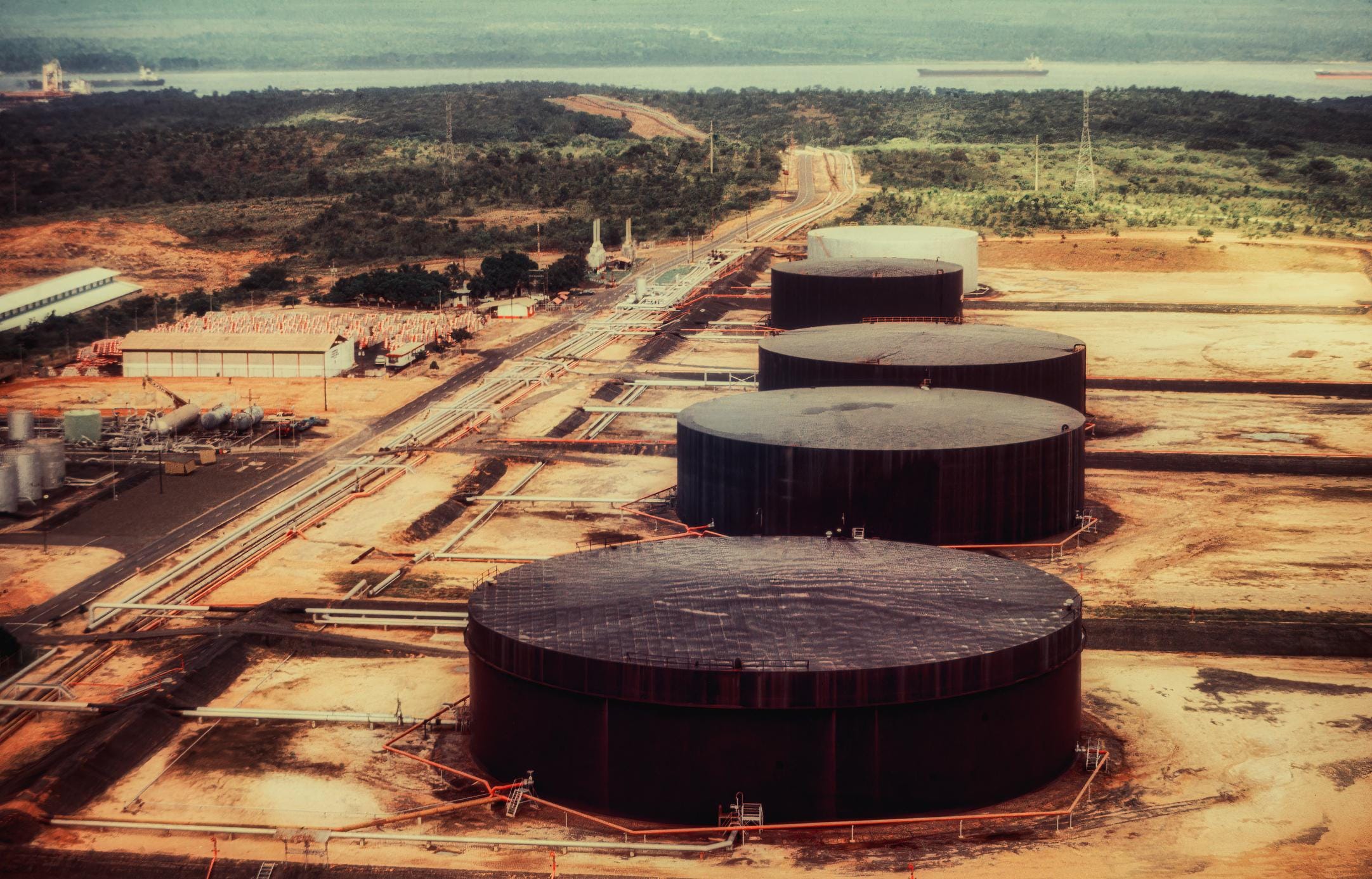
Venezuelan Oil Extraction Industrial Center
The barrels are flowing. The bankers are arriving. The guns are firing. The only thing not moving in Venezuela is democracy.
On June 12, the Organization of American States offered María Corina Machado its help in organizing an election. That same evening, President Trump announced on Truth Social that the United States had killed the leader of the Tren de Aragua gang in a “swift and lethal kinetic strike” on Venezuelan soil — carried out, his defense secretary says, in “full collaboration” with the very government Machado is trying to replace. Within hours, she thanked him for it. Two images, one night: a Nobel laureate accepting an offer of elections that have no date, and an American president advertising a killing done hand-in-hand with Venezuelan Interim President Delcy Rodríguez, the woman she would unseat. That is Venezuela in June 2026. Here is what the United States is doing there, and what it should mean for all of us.
The fast clock raced. For five months, I have tracked two clocks in Venezuela: a commercial one moving fast, and a political one that barely moves. This month, the fast clock produced signatures. On June 11, acting President Delcy Rodríguez presided over five agreements with Shell to develop the offshore Loran gas field; the day before, the oilfield-services giant SLB signed with the state-owned oil and gas company of Venezuela, PDVSA, returning after ninety-seven years. OPEC puts output up some 28 percent since January’s capture of Maduro, and exports at a seven-year high. Treasury smoothed the path on June 10 with its broadest Venezuela rules yet, easing contract terms the drillers had resisted and opening the door to Venezuelan gold. JPMorgan and Jefferies are booking investor trips to Caracas; Lazard and Centerview are fighting over the debt restructuring. The barrels are flowing, and the bankers are flying.
Recovery now runs through Washington — by design. This is no open market; it is a structure built for leverage. Foreign buyers of Venezuelan fuel must wire payment into a U.S. Treasury account, not to Caracas. State contracts must be governed by U.S., British, French, or Singaporean law. The rules wall off Russia, China, Iran, and Cuba. Venezuela’s most important revenue stream is deposited into a U.S. account, spent only with U.S. approval, and shielded from creditors by U.S. executive order. When Secretary Rubio told the Senate that oil money “is not being stolen,” he described exactly that; it is not stolen because Washington now controls where it goes. The relief is surgical and, as sanctions lawyers warn, fully reversible at Washington’s discretion.
And now, a partner inside the country. The newest instrument is the one that should worry us most. The June 12 strike that killed Tren de Aragua’s “Niño Guerrero” was no solo American operation: Caracas confirmed a joint action, the CIA reportedly supplied the targeting intelligence, and Hegseth said the Rodríguez government invited us in. Days earlier, he had said the quiet part aloud: that Washington now has “a partner willing to cooperate” inside Venezuela. Set that against the army’s simultaneous sweep of the Las Claritas gold belt, with U.S. investors touring the nearby mines the week before, and a fourth instrument joins oil, money, and licenses: security cooperation. Each one is another reason for Washington to prefer the partner it has over the democrat it once championed.
The slow clock did not move. For all this motion, the political track gave no ground. There is still no election date and no new electoral council, the very step U.S. officials call the precondition for a vote. Interior Minister Diosdado Cabello dismissed the opposition’s call for election talks in unprintable terms. The opposition’s May 28th Panama Manifesto set out the obvious conditions: a new electoral authority, prisoner releases, an end to repression, and the government has granted none. Laboratorio de Paz captured the consensus in a title: “Reconfiguration Without Transition.” The metric that matters to this administration is what it was on day one: barrels, not ballots, and now bullets, too.
The human cost keeps failing the test. On June 10, the Inter-American Court ordered Venezuela to close El Helicoide, its intelligence-police headquarters, as a torture center, even as some ninety political prisoners were quietly moved out of it to jails where families fear there is less oversight, not freedom. Foro Penal, the Venezuelan human rights organization, counts 389 political prisoners; at least 87 are held past Venezuela’s own legal limits. Releases come one conditional case at a time while the machinery that detains stays intact. The same week the oil deals were signed, teachers struck nationwide: the minimum wage has been frozen since 2022 at about twenty-two U.S. cents a month. A Wall Street bidding war over Venezuela’s debt and a teacher earning pennies are unfolding in the same country, in the same week.
Other crises hog the headlines, Iran above all, but Americans should attend to what is being done in our name in Venezuela. For thirty-two years in the Foreign Service, including three tours in Venezuela until I was declared persona non grata and expelled on forty-eight hours’ notice, I watched U.S. policy in this Hemisphere rest on a simple premise: that we are strongest when we stay engaged, build coalitions, and make democratic standards a condition of partnership, not an aspiration for later. The operation that captured Maduro promised to topple a narco-dictatorship. Five months on, we have built its successor a new oil architecture, a new revenue system, and now a security partnership, and told thirty million Venezuelans their election can wait. We have seen this movie before. It does not end well. The barrels are flowing, the contracts are being signed, and now the guns are firing alongside ours. The one clock that has not moved is the only one that mattered.
Brian R. Naranjo is an independent strategic consultant and former Senior Foreign Service Officer with over thirty-two years of experience serving primarily in the Western Hemisphere. His service included three Venezuela tours (including Deputy Chief of Mission until he was declared persona non grata and expelled), and tours as a senior political officer in Panama, Canada, and Mexico. He is a member of The Steady State.
Founded in 2016, The Steady State is a nonprofit 501(c)(4) organization of more than 390 former senior national security professionals, including former officials from the CIA, FBI, Department of State, Department of Defense, and Department of Homeland Security. We advocate for constitutional democracy, the rule of law, and the preservation of America’s national security institutions.
Powered by WPeMatico