
Facism Is as Fascism Does
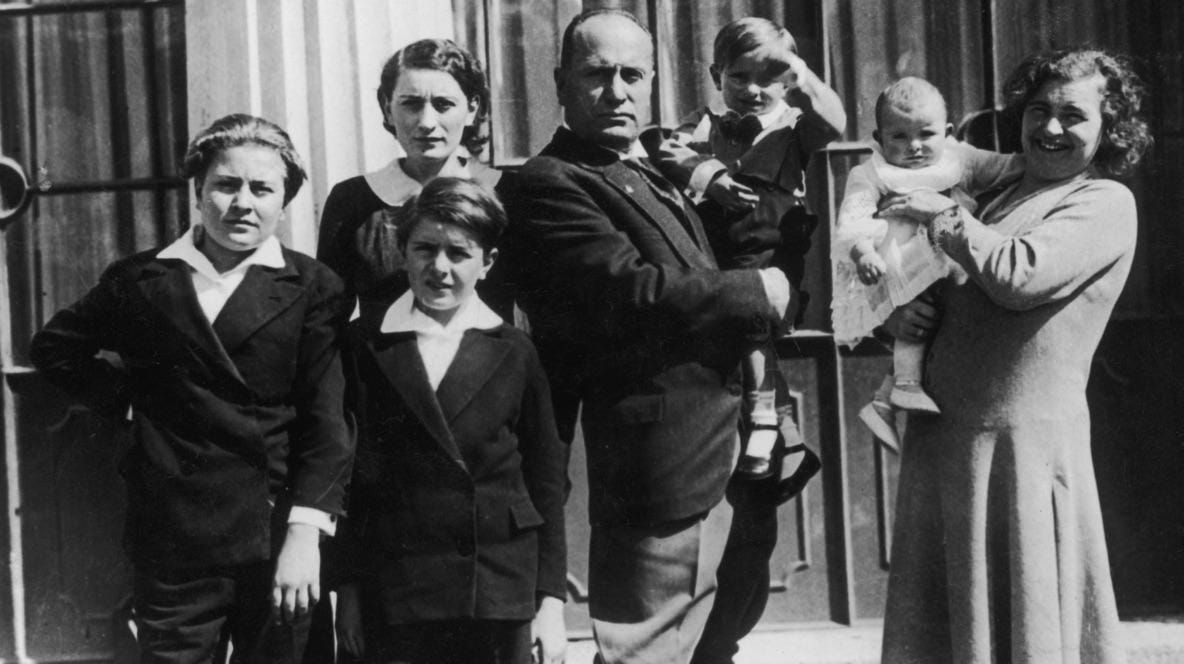
Benito Mussolini and Family
Fascism rarely arrives announcing itself. It appears first as contempt for expertise, hostility toward institutions, and demands for personal loyalty over professional competence. Bill Pulte’s appointment embodies all three.
The announcement of President Trump’s appointment of Bill Pulte to the position of Acting Director of National Intelligence (DNI) was met with bipartisan disapproval. Mr. Pulte is supremely unqualified to hold such a sensitive post. But while every American should be concerned, no one should be surprised. His appointment, which became effective on 19 June, is quite consistent with this Administration’s pattern of appointing incompetents and sycophants to key jobs. It is very much in keeping with the authoritarian orientation of the President and some of his key advisors.
Steve Bannon, one of President Trump’s early and key advisors, has called himself a Leninist in his desire to see the so-called “administrative state” smashed. This is provocative, but it is balderdash. In Leninism, the ultimate goal is the abolition of the state entirely, replacing it with a worker’s state. What Bannon and other advisors have in mind is replacement of the pesky impediments of career civil servants in favor of concentrating power in a unitary executive. This is closer to fascism than to Leninism.
Fascism holds that the bureaucratic “elites” of government, the administrative state, constitute an enemy class that must be defeated. It regards the institutions of governance, the courts, civil service, legislature, press, as corrupt and unpatriotic. Russell Vought, Director of the Office of Management and Budget, has said of career civil servants, “We want the bureaucrats to be traumatically affected. We want, when they wake up in the morning, we want them not to want to go to work. Because they are increasingly viewed as the villains.” The career civil servant is recast as an enemy of the people. Neutral expertise is to be replaced by political loyalty as the organizing principle of government. This is distinctly fascist in character.
The fascist ideal of governance is loyalty to a single leader, not adherence to impersonal rules administered by “faceless bureaucrats.” Deliberately creating institutional chaos (see: DOGE) leads to concentration of real power in a single leader. Fascism rejects pluralism. Elections are seen as exercises in validation, not an expression of popular will. This means that opposition, whether candidates or voters, must be marginalized and purged. Other aspects of fascism that evoke more than faint echoes are ultranationalism, racism, and glorification of violence.
Which brings us back to Bill Pulte. In an organization which prizes objective expertise, who better to accomplish a fascist agenda than someone who is neither objective nor expert, but who is fiercely loyal to the President? Whether his appointment survives for long or not, the message of contempt for established, functioning institutions of government and the public servants who staff them is clear.
That is not to say the Office of the DNI should be exempt from reform. Since its inception in 2004, ODNI has grown from a staff of hundreds responsible for coordinating the work of the many existing intelligence organizations in the government to a complement of thousands comprising a separate intelligence agency in its own right. Certainly, streamlining and rationalization of the ODNI are in order. A fresh eye can be useful in this regard, but not a jaundiced eye. And how is reform to be accomplished, and by whom? A team of serious and experienced intelligence and policy professionals? Or a mortgage broker with carte blanche from the President? If one takes the fascist view that the organization is an enemy to be annihilated, then the latter is the choice.
The clearest example of this class warfare is the operation of DOGE, where inexperienced, zealous, but loyal, raiders decimated entire agencies without serious mission analysis or regard for the human consequences of their arbitrary actions. As with ODNI, any government agency could use scrutiny of its operations with an eye to streamlining and increased efficiency. But operational effectiveness was not the point of DOGE. Punishment of an enemy class was.
This mindset is a far cry from Ronald Reagan’s “government is the problem” (which turned out to be mostly a campaign slogan, the size of government actually increased a bit). Reagan made grand bargains with Democrats on immigration and fiscal issues. The pace of new regulations issued by agencies such as HUD and OSHA did slow down, but as the result of cost-benefit analysis mandated by the Reagan administration for each one. That is quite a contrast to the slash-and-burn approach of the current administration.
This is not to say that any single individual in the current administration is self-consciously a fascist (there are a couple that might be exceptions). Most would recoil at the thought. However, the concepts of governance, the place of established institutions, and the valuation of public service add up to a fascist, non-democratic program unprecedented in our country.
Fascism is as fascism does.
Michael Eiland retired with 46 years of government service, both military and civilian. He holds a PhD in International Relations from George Washington University. He is a member of The Steady State.
Founded in 2016, The Steady State is a nonprofit 501(c)(4) organization of more than 400 former senior national security professionals. Our membership includes former officials from the CIA, FBI, Department of State, Department of Defense, and Department of Homeland Security. Drawing on deep expertise across national security disciplines, including intelligence, diplomacy, military affairs, and law, we advocate for constitutional democracy, the rule of law, and the preservation of America’s national security institutions.
Powered by WPeMatico