
Birthright Is America’s Strategic Advantage

Compliments of Scientific American
Trump’s effort to end birthright citizenship now before the Supreme Court isn’t merely unconstitutional—it rests on false premises. Across the Western Hemisphere, birthright citizenship is the democratic norm, and abandoning it would weaken America’s credibility, strain vital regional relationships, and undermine U.S. national security.
Birthright citizenship is the simple and democratic rule enacted through the 14th Amendment of 1868, providing that any child born in the territory of the United States is automatically a citizen, such that children of former slaves and children of immigrants enjoy the fundamental rights of citizenship on par with children of other parents. Changing U.S. demographics, as well as Trump’s statements and targeting of immigrants of color, show that his campaign against birthright citizenship is discriminatory. And, given the language of the 14th Amendment and relevant Supreme Court cases, the EO is clearly unconstitutional.
As I wrote in 2012 in Harvard Human Rights Law Journal and in 2025 as an expert in the related case before the federal court in Massachusetts, retraction or retrogression of birthright citizenship in the U.S. would violate customary international law in the Americas. It would also disturb diplomacy and security in the Americas. For example, as I stated in my declaration to the Massachusetts federal court: “Foreign policy and economic implications include that Latin American nations may no longer reciprocate by providing citizenship documents for the children of American citizens living abroad, such as the 1.6 million U.S. citizens living in Mexico, disrupting their access to education, health care, ability to work, and property rights.”
False Premises
The Supreme Court is likely to strike down the EO as an unconstitutional overreach of the President’s authority. However, it is crucial and incumbent upon us to also overturn the myth that the U.S. is one of the “relatively few developed countries” that generously offer birthright citizenship. This is one of the arguments that the Trump Administration’s Solicitor General raised in oral argument in April. Justice Gorsuch replied that only U.S. law applies, but it is still concerning that this out-and-out fallacy has been raised constantly by Trump and others who have wanted to retract birthright citizenship. To counter this false allegation, I wrote in 2012 that the U.S. is not exceptional in this case, as the great majority of Latin American nations provide birthright citizenship, and that, further, birthright citizenship is a fundamental promise of democracy and equality in the Americas.
Before the U.S. enacted the 14th Amendment providing for birthright citizenship, the emerging democracies in Latin America had already made it part of their constitutions, which guaranteed that Black and Indigenous people and children of immigrants, every child born in their nations, were automatically and equally citizens. Birthright citizenship was established as a fundamental right by the Haitian Revolution in 1791 and by Simón Bolívar in 1819, when six nations were liberated from Spain and became part of a new democracy in the current territories of Bolivia, Colombia, Ecuador, Panamá, Perú, and Venezuela. When other Latin American and Caribbean nations freed themselves from European imperialism, this is the path they followed.
Here is CNN’s summary and map of countries that provide birthright citizenship today:
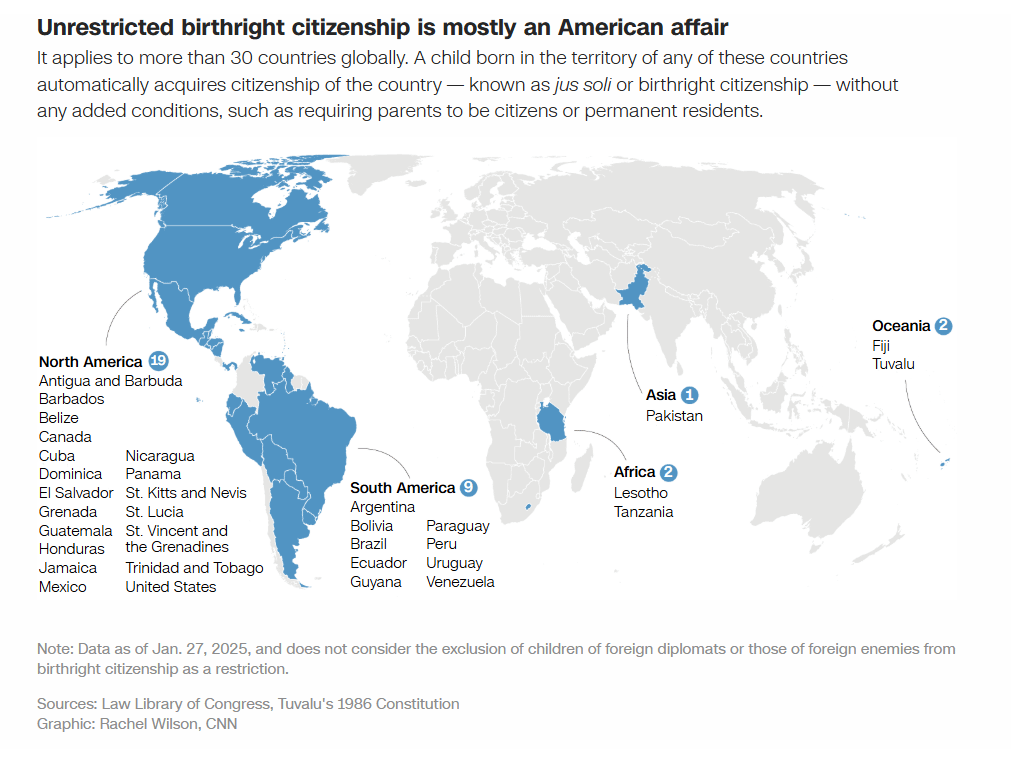
This map clearly belies the argument that the U.S. is an outlier in providing birthright citizenship. That is simply not true in the Americas, where 30 out of 35 countries have adopted birthright citizenship. Moreover, while there are a few and growing number of countries adopting birthright citizenship elsewhere, particularly in Africa, the facts clearly show that most countries that provide it are in the Americas.
Second, retracting birthright citizenship would violate fundamental regional human rights law that is “nonderogable” and is applicable in the Americas, including the United States. This type of human rights norm falls into the category of inalienable rights and applies whether or not a country has signed a treaty agreeing to abide by its rules.
Third, some believe that Latin American nations adopted birthright citizenship mainly to populate their countries by encouraging European immigration. My research shows that it is true that some of the historical impetus in some South American nations, such as Argentina, included birthright citizenship as part of an effort to increase European immigration. But that was not the main reason for Latin American democracies to embrace birthright citizenship; the main reason was to create new nations based on equality, where race or ethnicity was not a bar to citizenship. Further, Argentina retracted birthright citizenship during its dictatorship for autocratic reasons, and when the Dirty War ended, democracy was re-established, birthright citizenship was re-established based on fundamental human rights law, and not to encourage immigration.
Finally, Latin American nations are not all “developing countries” in comparison to the U.S. today. The United States is slipping in indices of democracy vs. authoritarianism, and countries that are now ranked higher include several Latin American nations with birthright citizenship, as well as Canada, which also provides this right and ranks higher in democratic indices compared to the United States.
It is up to the American public to realize that the true history of birthright citizenship includes liberating the Americas from imperialistic English and Spanish ideals in order to establish democracy. And now, birthright citizenship must be protected as part of the fight to preserve American democracy and our credibility in the region.
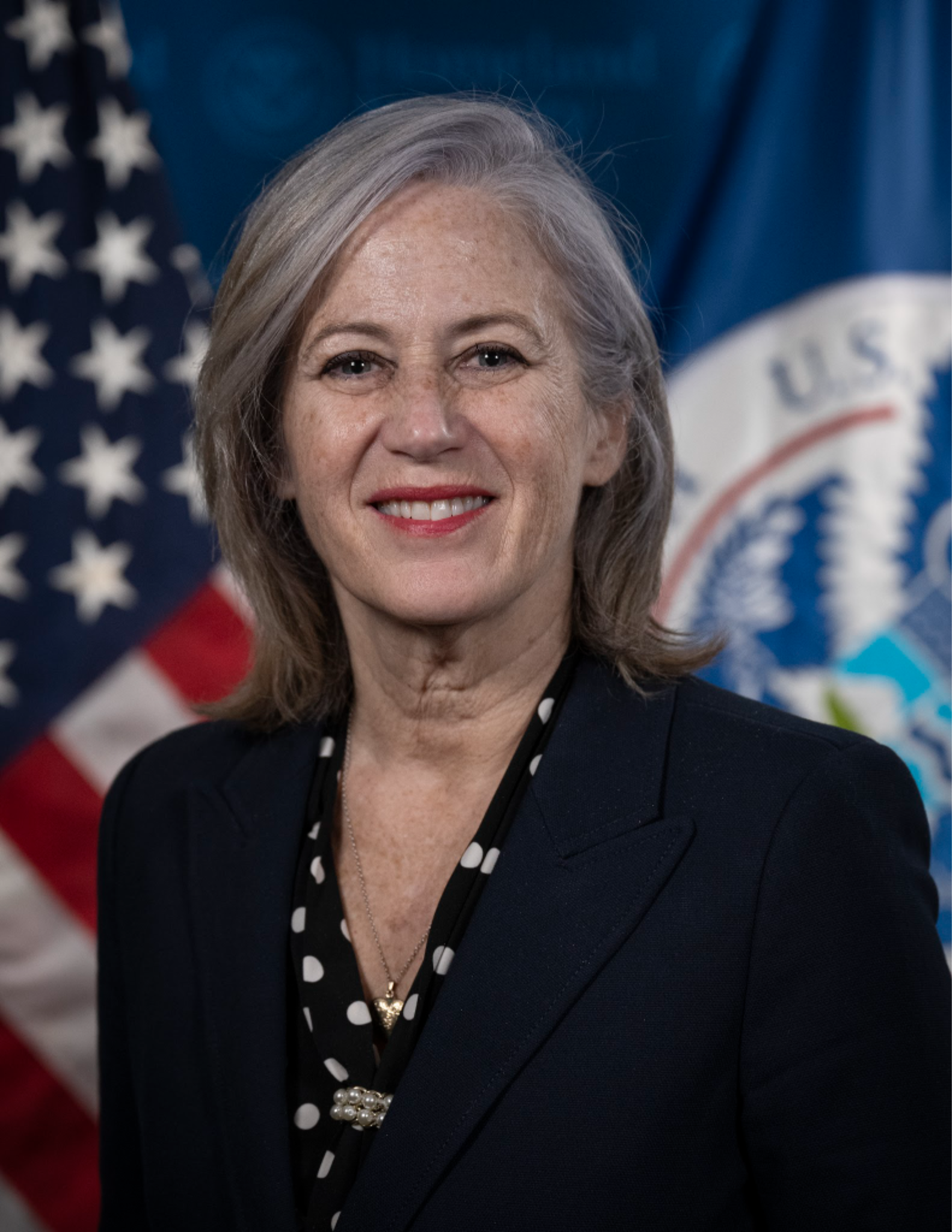
Katherine Culliton-González is a veteran civil and human rights lawyer, a widely published expert on inclusive democracy in the Americas, and chair of the Hispanic National Bar Association’s Committee on American Democracy. A former Fulbright Scholar who contributed to the transition to democracy in Chile, she also served as lead attorney for immigrants’ rights and access to justice at the Mexican American Legal Defense and Educational Fund during the post-9/11 era. She also served as Director of the Office of Civil Rights Evaluation in the U.S. Commission on Civil Rights, as a Senior Attorney in the Civil Rights Division of the Department of Justice, and as a Presidential Appointee in the Biden-Harris Administration, where she led the Office for Civil Rights and Civil Liberties for the Department of Homeland Security. She is a member of The Steady State.
Founded in 2016, The Steady State is a nonprofit 501(c)(4) organization of more than 400 former senior national security professionals. Our membership includes former officials from the CIA, FBI, Department of State, Department of Defense, and Department of Homeland Security. Drawing on deep expertise across national security disciplines, including intelligence, diplomacy, military affairs, and law, we advocate for constitutional democracy, the rule of law, and the preservation of America’s national security institutions.
Powered by WPeMatico