
Has the U.S. Been Set up for a Reichstag Moment?
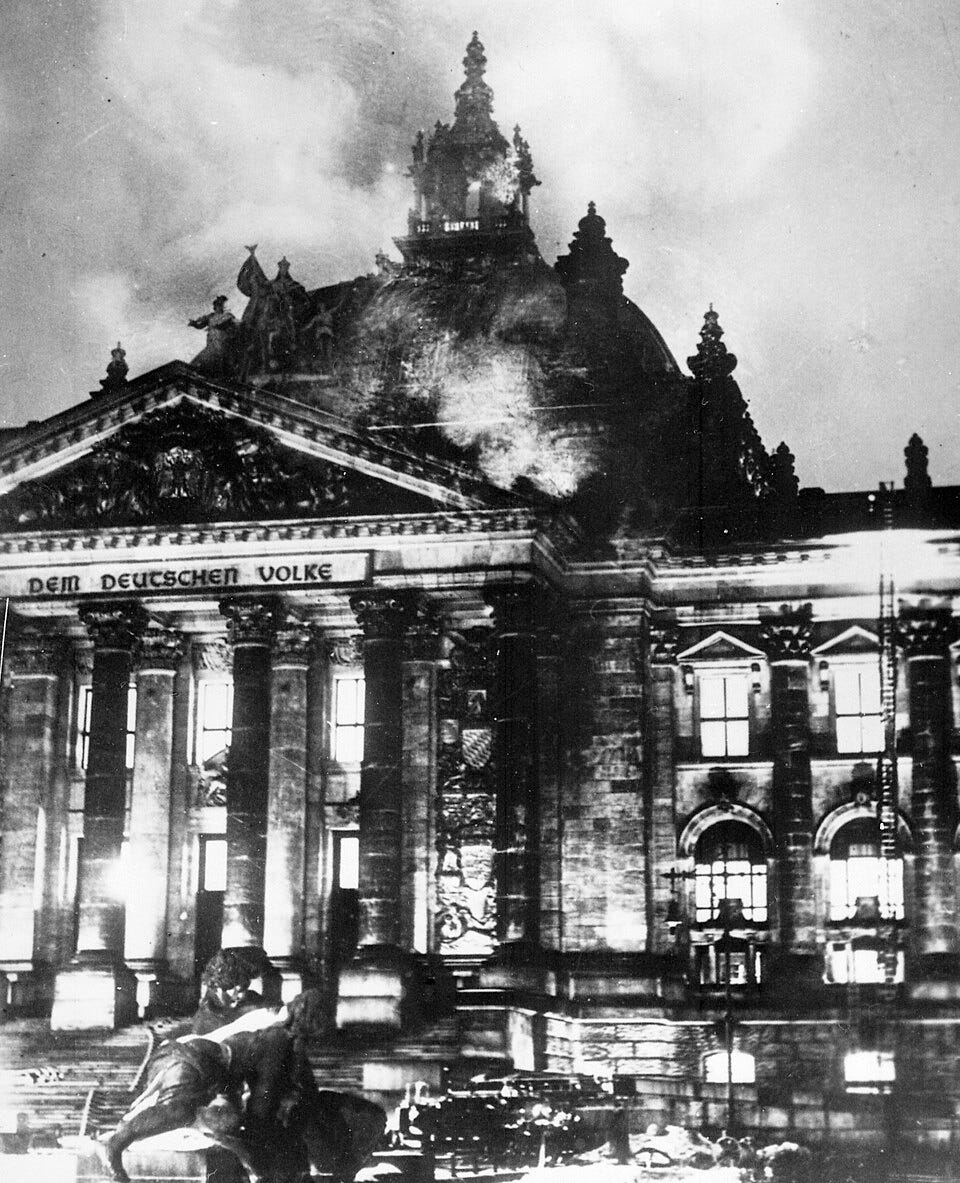
On February 27, 1933, the Reichstag, home of the German parliament in Berlin, burned to the ground following an arson attack. Using the fire as a pretext, Hitler, then the German Chancellor, induced the German president to issue the Reichstag Fire Decree, suspending civil liberties. The suspensions led to mass arrests of political opponents and allowed Hitler to consolidate power and dismantle democratic institutions. They remained in effect during the entirety of the Nazi reign. How susceptible is the United States to its own Reichstag moment?
What is certain is that the current administration of President Trump has increasingly shown a willingness to threaten the civil liberties of American citizens and non-citizens alike. At the same time, not since September 10, 2001, has the U.S. been as susceptible and vulnerable as it is today to an international terrorist attack on domestic soil following the deliberate choice of the President to disregard Constitutional constraints and ignite a war in the Middle East.
The same institutions which were created and/or enhanced post-9/11 to protect America and its citizens from international terrorism, notably the Departments of Defense (DoD) and Homeland Security (DHS) as well as the Federal Bureau of Investigations (FBI), have either been decimated and demoralized by staff firings or redirected to domestic initiatives, to include mass arrests of non-criminal undocumented immigrants, resulting in overall reduced operational capacity. The current administration has codified this reprioritization and redirection of resources intended to counter international terrorism, to include DHS and FBI assets (such as Joint Terrorism Task Forces, or JTTFs), through the issuance of National Security Presidential Memorandum/NSPM-7, Countering Domestic Terrorism and Organized Political Violence.
Because both the risk of an international terrorist attack has increased and our ability to prevent such attacks has diminished, the likelihood of the U.S. being targeted is now at its greatest since 9/11. Should such an attack occur, it can create a pretext for a president seeking to expand his authority, just as the Reichstag fire in 1933 Germany was used as a pretext for authoritarian measures.
It takes a strong commitment to democratic principles and civil liberties for all on the part of national leadership to resist taking advantage of such a pretext. Do we have such leadership in our nation today, or has the U.S. been set up for our own Reichstag moment – and if so, has it been deliberate?
J. William Leonard is the Former Deputy Assistant Secretary of Defense (Security & Information Operations), Former Director, Information Security Oversight Office and Former Chief Operating Officer, National Endowment for Democracy. He is a member of The Steady State.
Founded in 2016, The Steady State is a nonprofit 501(c)(4) organization of more than 390 former senior national security professionals. Our membership includes former officials from the CIA, FBI, Department of State, Department of Defense, and Department of Homeland Security. Drawing on deep expertise across national security disciplines, including intelligence, diplomacy, military affairs, and law, we advocate for constitutional democracy, the rule of law, and the preservation of America’s national security institutions.
Powered by WPeMatico