
Important Stuff to Know About: The Laws of War Still Apply

War does not suspend the law—the principles of distinction, necessity, proportionality, and humanity are not optional, and abandoning them carries real strategic and moral consequences.
In the several weeks since the United States and Israel attacked Iran, the President and Secretary of Defense have announced on a number of occasions that we are winning the war even as the air campaign continues. The President and the Secretary of Defense have identified bombing Iran “back to the Stone Age” as a strategic goal. The Secretary has talked about “giving no quarter” to the enemy and denigrated the need for Rules of Engagement and the requirements of International Humanitarian Law (IHL). It is in this context that a brief discussion of IHL, also referred to as the Law of Armed Conflict (LOAC), might help frame the conversation.
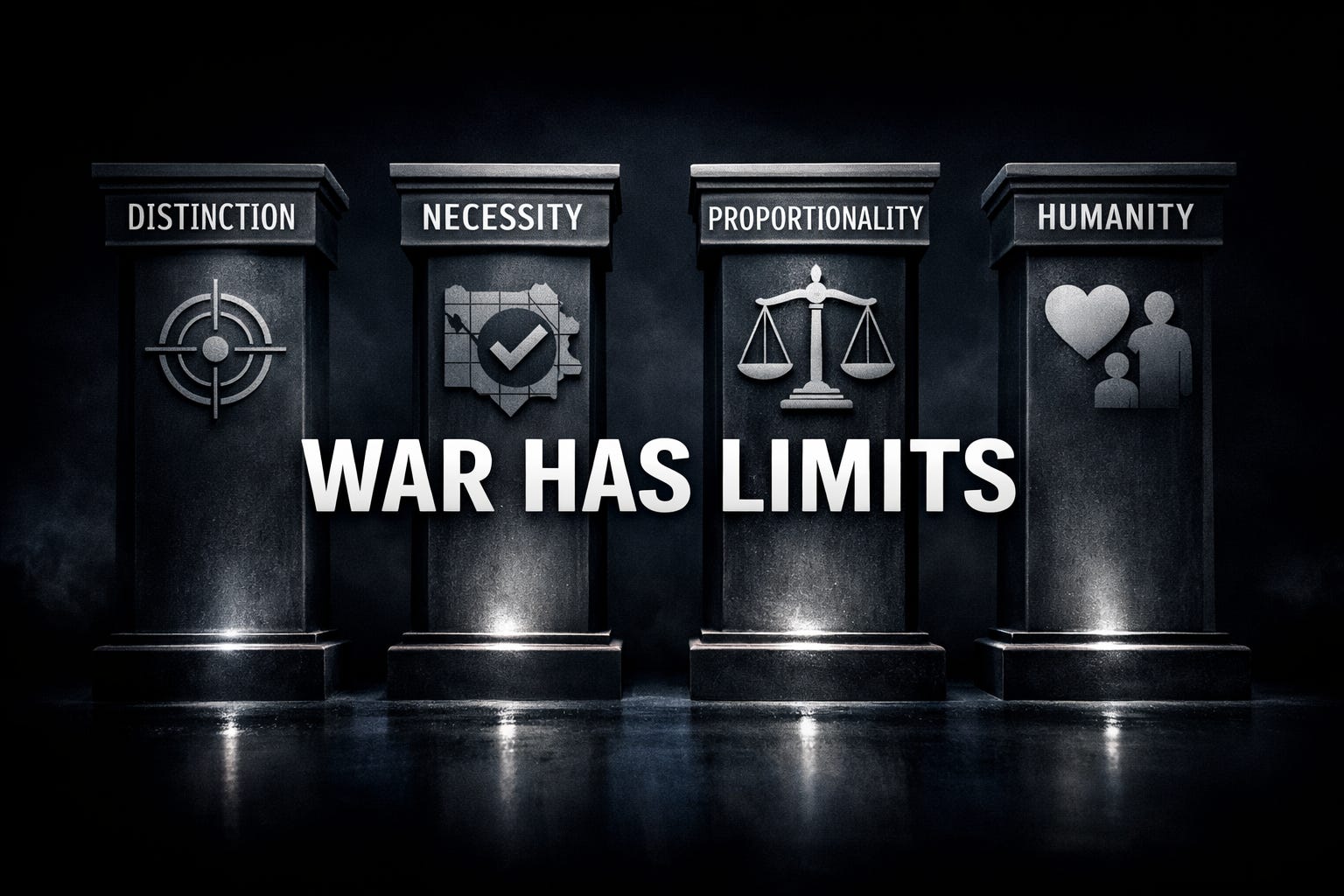
AI Generated Graphic
The core principles of IHL clearly apply to the war in Iran, as all three parties to the conflict are legally bound to follow IHL. The four basic principles of IHL (distinction, military necessity, proportionality and humanity) are established in the Geneva Conventions of 1949 and the Additional Protocols of 1977. These principles seek to provide a legal framework under which armed forces will strive to focus on military targets and limit collateral damage to both people and property to the greatest extent possible.
The implementation of IHL in practice involves difficult and controversial judgments that weigh military necessity against likely collateral damage, to include civilian deaths. Unlike much of our war experience since 9/11 against terrorist and insurgent groups in places like Iraq and Afghanistan, our war with Iran is much more of a traditional conflict against a state actor. Iran is likewise bound by IHL, and any violation of IHL by either side is a potential war crime.
Distinction.
The principle of distinction, added to the Geneva Conventions by the 1977 Additional Protocols, requires parties to a conflict to always distinguish between civilians and combatants, and direct operations only against military targets. Distinction is the most humanitarian of the basic principles, in that it requires military forces at all times to distinguish between military and non-military personnel and military and non-military targets
The principle of distinction covers not only people, but also places. Certain areas, including hospitals and schools, are presumed to be protected from military attack. Protected sites may lose their protected status if they are used for military purposes. Other sites, such as bridges, are of both civilian and military use. In such cases, the burden is on the side making the attack to make the military case for the strike.
Military Necessity
Military Necessity allows all measures necessary to accomplish a legitimate military purpose so long as these measures are not otherwise prohibited by IHL. It is a legitimate military purpose to defeat the enemy as quickly and efficiently as possible, but military necessity does not allow disproportionate or indiscriminate targeting, nor does it allow activities whose purpose is to spread terror among a civilian population. As stated in Rule 54 of the Additional Protocols, an attacking force is not permitted to destroy “objects indispensable to the survival of the civilian population.” Heated rhetoric directed at making Iran uninhabitable calls into question the underlying purpose of continuing air attacks and only invites similar retaliation from Iran.
Proportionality
Proportionality recognizes that incidental harm will occur to civilians during military operations. As with the principle of distinction, proportionality as a concept asks the question of whether anticipated harm to the civilian population is “excessive” relative to the military advantage that is anticipated from the military action. In general, proportionality requires judging each attack on its own merits. In a campaign as massive as the current US and Israel bombing campaign, proportionality judgments must be made countless times each day, highlighting the importance of Rules of Engagement. Because proportionality assumes collateral damage, an objective assessment of whether projected military advantage outweighs anticipated damage to civilian life and infrastructure is a difficult but necessary decision.
Humanity.
The fourth IHL principle is humanity, found at Article 35, which has two major provisions. The first prohibits the use of weapons intended to cause “superfluous injury or unnecessary suffering.” The second prohibits employing methods intended or likely to cause widespread and long-term severe damage to the natural environment. The harsh environment of the Middle East means that populations require desalinization plants to meet water needs and electricity to power air conditioning as a matter of survival for much of the region’s population. In this way, the principle of humanity is related to military necessity.
IHL provides a legal framework under which nations have agreed to conduct military action. The US military has always taken IHL requirements seriously, even as other nations (e.g. Russia) do not. The US military has always prided itself on respecting IHL as a means of effective and honorable warfare. We can only hope that the inappropriate rhetoric emanating from the White House and the Pentagon does not alter the conduct of our uniformed men and women who are fighting this war.
James Petrila spent over thirty years as a lawyer in the Intelligence Community, working at the National Security Agency and, for most of his career, at the Central Intelligence Agency. He has taught courses on counterterrorism law and legal issues at the CIA at the George Washington University School of Law. He is currently a senior advisor to the Institute for the Study of States of Exception and is a member of The Steady State.
Founded in 2016, The Steady State is a nonprofit 501(c)(4) organization of more than 400 former senior national security professionals. Our membership includes former officials from the CIA, FBI, Department of State, Department of Defense, and Department of Homeland Security. Drawing on deep expertise across national security disciplines, including intelligence, diplomacy, military affairs, and law, we advocate for constitutional democracy, the rule of law, and the preservation of America’s national security institutions.
Powered by WPeMatico