
The Art of No Deal
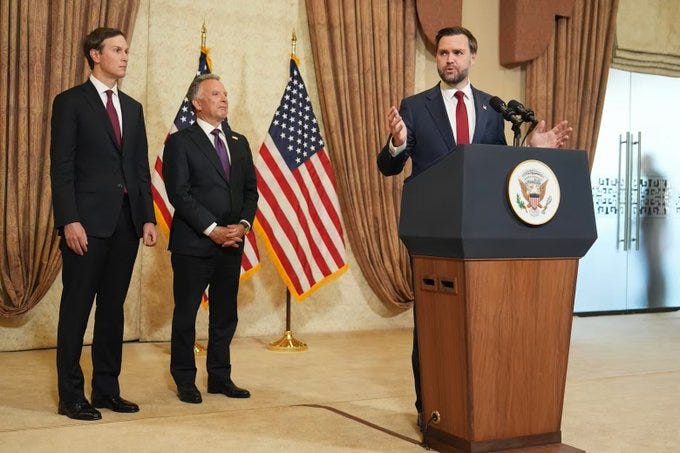
A one-day negotiation, a “final offer,” and no follow-up plan—this wasn’t serious diplomacy; it was a setup for failure with dangerous consequences.
Given the inexperience, inflexibility, and overconfidence the US team brought to Islamabad for talks with Iran on April 11, it was not surprising that nothing was achieved. Heavy-handed attempts at coercion and brinksmanship were bound once again to fail. For Vice President J.D. Vance to say he gave Iran Washington’s “final and best offer” at the outset suggests a serious misreading of how such negotiations work. The Trump Administration, which touts its deal-making skills, was out of its depth. One also cannot help but wonder if it is just going through the motions or setting Vance up to be the fall guy.
Reaching meaningful, lasting agreements is hard and takes time. Every successful negotiation involving foreign adversaries has lasted weeks, months, or years. The 1968-1973 Vietnam Paris Peace process, for example, took nearly five years. The 2015 Iran nuclear deal that Trump tore up during his first term was the culmination of a 20-month negotiation. Ending talks in Islamabad after just one 21-hour session was diplomatic malpractice.
Sending Vance to Islamabad to lead talks with Iran ostensibly demonstrated gravitas. It certainly was a step up from the real-estate mogul-led team previously deployed. While Vance has no more experience in Middle East affairs or nuclear technology than diplomatic neophytes Steve Witkoff and Jared Kushner, at least he is accountable to the public. In previous talks with Iran, Witkoff and Kushner failed to understand Iran’s offers, the technical realities of its nuclear program, or the status of its weaponization efforts. Their misinforming President Trump that Tehran was not negotiating seriously encouraged him to begin his disastrous war.
Unlike those previous engagements, Vance brought along a “technical team,” which included Vance’s National Security Adviser, Andrew Baker, and Michael Vance (no relation), special adviser to the Vice President for Asian affairs, both political appointees. The White House said “a full suite of experts” was in Islamabad or supporting the team from Washington. One would hope the team included career officials well-versed in Iran matters, nuclear non-proliferation and sanctions. But such expertise has become increasingly rare in the federal government after purges initiated by DOGE and continued under Secretary of State Marco Rubio. Those who remain in place are understandably leery of stepping out of line and offering advice that might contradict the positions of senior officials.
Vance’s short press event after emerging from the failed 21-hour talks indicated he does not have a handle on how diplomacy works. Success requires finding common ground. Experienced negotiators seek to understand the other side’s motivations and concerns and to explore alternatives to skirt roadblocks. For Vance to say that “Iran would not accept our terms” reflects a “my way or the highway” attitude. Framing it that way ensures failure.
Successful negotiations also depend on building trust. Whatever trust the United States had built in negotiating the 2015 nuclear deal was shattered when President Trump abandoned the deal in 2018. He deepened Iran’s distrust last June and again in February when he launched strikes while supposedly negotiating a replacement.
A key US goal is to deny Iran the ability to produce nuclear weapons. This requires durable limits on uranium enrichment and on enriched uranium stockpiles. For decades, Iran’s own red line has been to preserve what it regards as a right to this technology. This need not be a deal breaker. As one of us recently assessed, various technical means could preserve the non-proliferation goal without crossing either side’s red line on enrichment. Alternatively, since Iran is currently not enriching, thanks to last June’s attacks, the status quo could be extended for some years, leaving the future status and the issue of a right to enrichment ambiguous or for future talks.
A top priority could be to verifiably eliminate Iran’s stockpile of near-weapon-grade uranium. This requires Iran’s cooperation and international inspections; there is no plausible military option to seize or destroy the canisters of highly enriched uranium buried underground. And a key to Iran’s continued cooperation is that it remains in the Nuclear Non-Proliferation Treaty, which prohibits it from obtaining nuclear weapons. US attacks could backfire if they spur Iran to withdraw from the treaty and permanently remove its nuclear program from international constraints and inspections, making the problem even more intractable.
Whether there will be future talks is unclear. Normally, when negotiations stall, momentum can still be preserved by the expediency of scheduling another round. Vance made no mention of this. While Iran has hinted at interest in continuing to meet, Trump is doubling down on military tools, announcing a complete blockade of Iranian shipping, with more bullying and bluster aimed at allies and adversaries alike. The optics of his being at an Ultimate Fighting Championship event in Miami rather than monitoring the talks from the White House Situation Room show how little regard he had for the diplomatic effort.
Trump is delusional if he really believes that Iran “will come back and… give us everything we want.” After six weeks of strategic disaster overshadowing tactical successes, he needs to ditch his “Art of the Deal” hard-ball approach and engage in genuine deal-making. Serious diplomacy offers the only off-ramp to his ill-conceived war.
Mark Fitzpatrick is a retired US diplomat who served as Deputy Assistant Secretary for Non-Proliferation. As an Associate Fellow at the London-based International Institute for Strategic Studies, he has engaged in many track II meetings with Iranian counterparts. He is a member of The Steady State
Mark Goodman is a senior scientist who retired from the State Department in 2025 after a thirty-year civil service career, working extensively on international nuclear policy. Dr. Goodman is a non-resident fellow at the Center for Nonproliferation Studies and a Fellow of the American Physical Society. He is a member of The Steady State
Founded in 2016, The Steady State is a nonprofit 501(c)(4) organization of more than 400 former senior national security professionals. Our membership includes former officials from the CIA, FBI, Department of State, Department of Defense, and Department of Homeland Security. Drawing on deep expertise across national security disciplines, including intelligence, diplomacy, military affairs, and law, we advocate for constitutional democracy, the rule of law, and the preservation of America’s national security institutions.
Powered by WPeMatico