
We Ultimately Lose When We Ignore The Rules
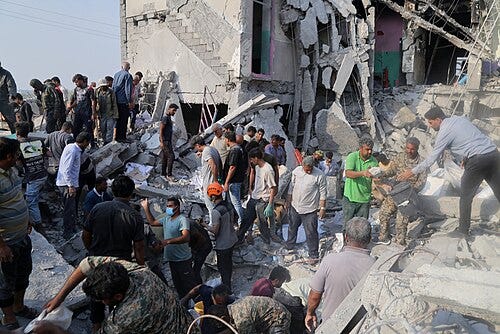
Bombing of School, Minab, Iran 2026 (Wikipedia)
When the current Secretary of Defense was a Fox News commentator, he regularly advocated for pardons of three service members who were charged with war crimes: two charged with murder, and one charged with multiple serious crimes. Hegseth’s television lobbying paid off when President Trump intervened in all three cases.
Once confirmed as Secretary of Defense, one of Hegseth’s first actions was to fire the senior corps of Judge Advocates General (JAG), lawyers who are responsible for ensuring adherence to the Law of Armed Conflict (LOAC). In March, he hired his personal lawyer as a Navy Commander and assigned him as a senior JAG. Throughout his tenure as Secretary of Defense, Hegseth has made no secret of his contempt for JAG lawyers, referring to them dismissively as “jagoffs,” international law and the law of armed conflict in carrying out extrajudicial killings in the Caribbean and Eastern Pacific, and promising no “stupid Rules of Engagement” in Trump’s special military operation against Iran.
Now, it appears that one of his first actions as Secretary of Defense was to scrap a significant Department of Defense program that was intended to reduce civilian harm during military operations and force out those who were assigned to the project.
In light of these comments and actions, the likelihood that the US military was responsible for the strike on an Iranian girls school in Minab that killed over one hundred individuals takes on added significance.
Accidents and misfires occur during armed conflict. Collateral damage and collateral deaths are impossible to avoid. The purpose of the Law of Armed Conflict, which is based on the Geneva Conventions, is to limit civilian death and destruction to the maximum extent possible. Rules of Engagement (RoE) are a critical component of these efforts. Instead, the current war on Iran, with its ever shifting justifications, undefined strategic ends, and embarrassing memes from motion pictures and video games, raises the question of how serious the civilian leadership of our nation is at following norms embedded in US law that been accepted since the end of World War II.
In Afghanistan, when U.S. consistently tried to sweep reports of civilian casualties under the rug in Afghanistan as ‘fog of war’ mistakes or ‘exaggerated’ numbers, it made one of the more consequential errors of that conflict. The Taliban capitalized on these very real tragedies, while the Afghan political leadership was put in an untenable position: agree with the Taliban or reject the validity of suffering by its citizens. The wedge driven by this issue between the U.S. and the Afghan people assisted the Taliban as it sought to rebuild its insurgency after NATO’s initial success.
It appears that neither Hegseth nor the president has learned the lesson from Afghanistan. The president incredibly has called into question whether the tomahawk missile that appears to have killed school girls in Minab was launched by the United States, by raising the possibility that the Iranians somehow had launched their own tomahawk – that they do not possess. The Secretary of Defense continues to equivocate, stating that the incident continues to be “under investigation.” The New York Times reports that a preliminary military investigation has concluded that a US missile struck the school.
Shared commitments to follow the Law of Armed Conflict are military assets – not dreams; the only stupidity is not learning from mistakes that were made less than one generation ago. The Rules of Engagement dismissed by Hegseth are ones our nation helped craft, with honor, and serve as the basis for compliance with US and international law. These commitments also provide the legal basis for robust information sharing among allies. It is very difficult for NATO allies, who are bound by the same Geneva Conventions and human rights laws, to share information that could potentially lead to unnecessary civilian deaths. The U.S. needs allies – will we only go to war with other pariahs?
The “no lawyers, no RoE, no worries” approach of the Secretary of Defense creates a public messaging nightmare for the United States armed forces, allowing the otherwise-unpopular Iranian regime to craft a single narrative as victims of unwarranted US aggression – yet another self-inflicted wound in this disastrous war of choice.
James Petrila spent over thirty years as a lawyer in the Intelligence Community, working at the National Security Agency and, for most of his career, at the Central Intelligence Agency. He has taught courses on counterterrorism law and legal issues at the CIA at the George Washington University School of Law. He is currently a Senior Advisor to the Institute for the Study of States of Exception and is a member of The Steady State.
A retired U.S. Department of State senior career diplomat with 30 years’ experience in security, human rights, and international organizations policy, Annie Pforzheimer was Deputy Chief of Mission at the US Embassy in Kabul and is currently an adjunct professor of international relations. She is a member of The Steady State.
Founded in 2016, The Steady State is a nonprofit 501(c)(4) organization of more than 390 former senior national security professionals. Our membership includes former officials from the CIA, FBI, Department of State, Department of Defense, and Department of Homeland Security. Drawing on deep expertise across national security disciplines, including intelligence, diplomacy, military affairs, and law, we advocate for constitutional democracy, the rule of law, and the preservation of America’s national security institutions.
Powered by WPeMatico