
The Only Thing We Have to Fear Is Fear Itself
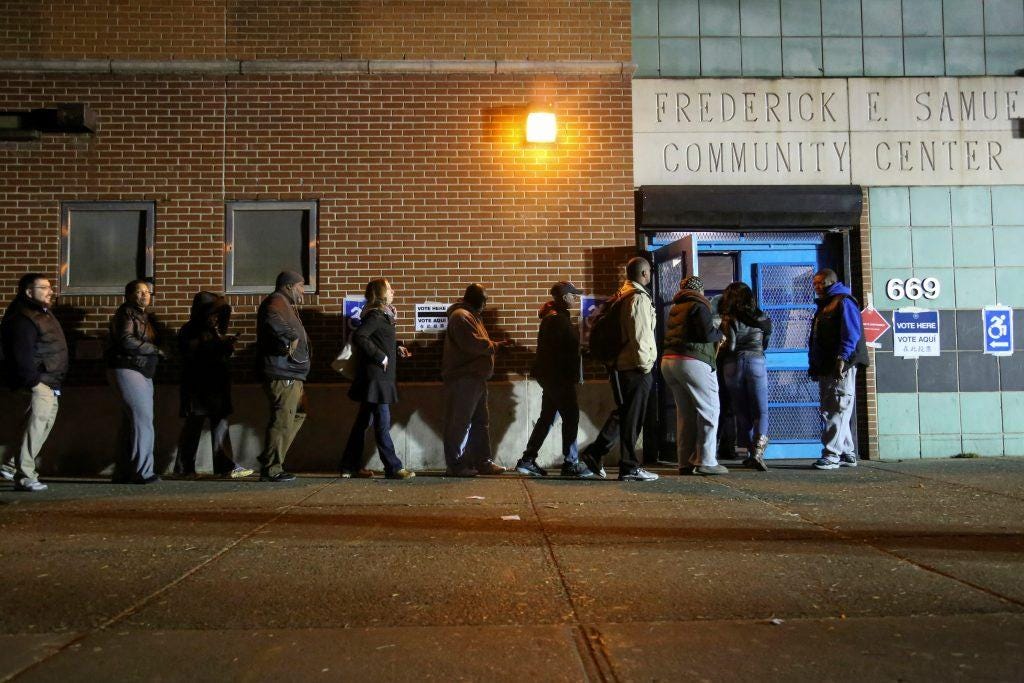
“Those in line can vote” photo with thanks to PBS
The threat of armed federal personnel near polling places is meant to intimidate, not protect democracy. Americans must reject fear, defend the rule of law, and vote.
The prospect of armed federal personnel appearing at or near polling places should alarm every American, regardless of party. In recent months, the President of the United States and several of his allies have repeatedly suggested, sometimes explicitly and sometimes by implication, that Immigration and Customs Enforcement personnel, federal agents, or even military forces could be deployed in connection with elections and voting sites. The message is unmistakable. It is intended to convey surveillance, force, and intimidation.
There are serious legal questions surrounding any such effort. Federal law sharply restricts military involvement in domestic law enforcement, and Congress has never authorized the use of armed federal deployments to supervise ordinary American voting. Longstanding constitutional protections, federal civil rights statutes, and voting rights laws exist precisely because intimidation at the polls has such a dark and shameful history in the United States. These legal protections matter, and should be advanced in litigation, in Congress, and in public to deter, and maybe even prevent the Administration’s threats from being implemented. Civil society organizations, election officials, state governments, and the courts all have important roles to play.
But there is another issue emerging beneath these debates, and it deserves equal attention.
Too many Americans, including many who oppose authoritarianism, appear to be unconsciously accepting the underlying premise driving these threats: that citizens who support constitutional democracy will simply stay home if confronted by armed personnel near a polling place. The Trump administration has been working hard to elicit this behavior through its use of ICE agents, masked, armed, and uniformed, attacking, physically threatening and even killing U.S. Citizens who are peacefully protesting against the President’s actions. The point of that visible force has not been operational necessity. America does not require soldiers or armed immigration agents to conduct immigration arrests, and most certainly not to conduct elections. The primary purpose is psychological. It is to create hesitation. To encourage fear. To persuade ordinary people that participation in democracy carries personal risk.
History teaches us that pro-democracy movements survive only when citizens refuse to internalize that fear. The history of voting in the United States includes many examples of voters confronting threats of force at polling places and voting in the face of threats.
The members of The Steady State include former diplomats, intelligence officers, military officers, and homeland security officials who spent careers watching democratic backsliding overseas. We have seen governments attempt to use intimidation to hollow out democratic participation while preserving the outward appearance of elections. The mechanism is familiar. The objective is not always mass arrests or overt violence. Often, it is far simpler: convince enough people that participation is dangerous, futile, or personally costly.
And history repeatedly shows the same thing in response. Democracies endure when ordinary citizens decide that fear will not govern them.
Young people in Serbia stood against Slobodan Milošević despite intimidation and state force. Citizens in Poland resisted authoritarian pressure for years before democratic institutions re-emerged stronger. Hungarians, Georgians, Ukrainians, and countless others have faced armed police, internal security services, and state-backed intimidation while insisting on their right to political participation.
Americans sometimes speak as though this is foreign history, detached from our own national experience. It is not.
The United States has a long tradition of citizens risking violence and repression to secure and exercise the right to vote. During the Civil Rights Movement, Americans, particularly Black Americans across the South, routinely faced threats, beatings, economic retaliation, arrests, and murder simply for attempting to register or cast a ballot. They faced armed deputies, attack dogs, mobs, and state-sanctioned intimidation.
And they voted anyway.
Not because they believed the risks were imaginary, but because they understood that surrendering participation to fear would permanently destroy constitutional democracy itself.
That history matters now.
If armed federal personnel appear near polling places in future elections, Americans should challenge the legality of those deployments vigorously. Governors, attorneys general, and courts should act. Congress should assert its constitutional role. Civil society organizations should monitor and document every abuse.
But ordinary citizens must also make something unmistakably clear: intimidation will fail.
Americans will vote.
They will vote calmly, lawfully, peacefully, and in large numbers. They will not be provoked into violence. But neither will they accept the proposition that constitutional participation depends upon the approval or comfort of armed political power.
Democracy ultimately survives not because institutions alone defend it, but because citizens do.
That is the lesson of democratic movements abroad. It is the lesson of the American Civil Rights Movement. And it is the lesson Americans may now need to remember again.

Steven A. Cash served as a prosecutor in the Manhattan District Attorney’s office before joining the CIA in 1994 as Assistant General counsel and subsequently serving as an intelligence officer in the Directorate of Operations. In 2001 he joined the Senate Select committee on Intelligence as Counsel and designee-staffer to Senator Diane Feinstein). He later served as a senior staffer in the House Select Committee on Homeland Security, the Department of Energy, the Senate Judiciary Subcommittee on Terrorism, Technology and Homeland Security and the Department of Energy. In the private sector he has advised on national security, counterintelligence, and technology policy and served on the Biological Sciences Experts Group under the Director of National Intelligence. Mr. Cash is currently the Executive Director of The Steady State.
Founded in 2016, The Steady State is a nonprofit 501(c)(4) organization of more than 400 former senior national security professionals. Our membership includes former officials from the CIA, FBI, Department of State, Department of Defense, and Department of Homeland Security. Drawing on deep expertise across national security disciplines, including intelligence, diplomacy, military affairs, and law, we advocate for constitutional democracy, the rule of law, and the preservation of America’s national security institutions.
Powered by WPeMatico