
Executive Order 12333: The Most Important Guardrail You Never Heard Of
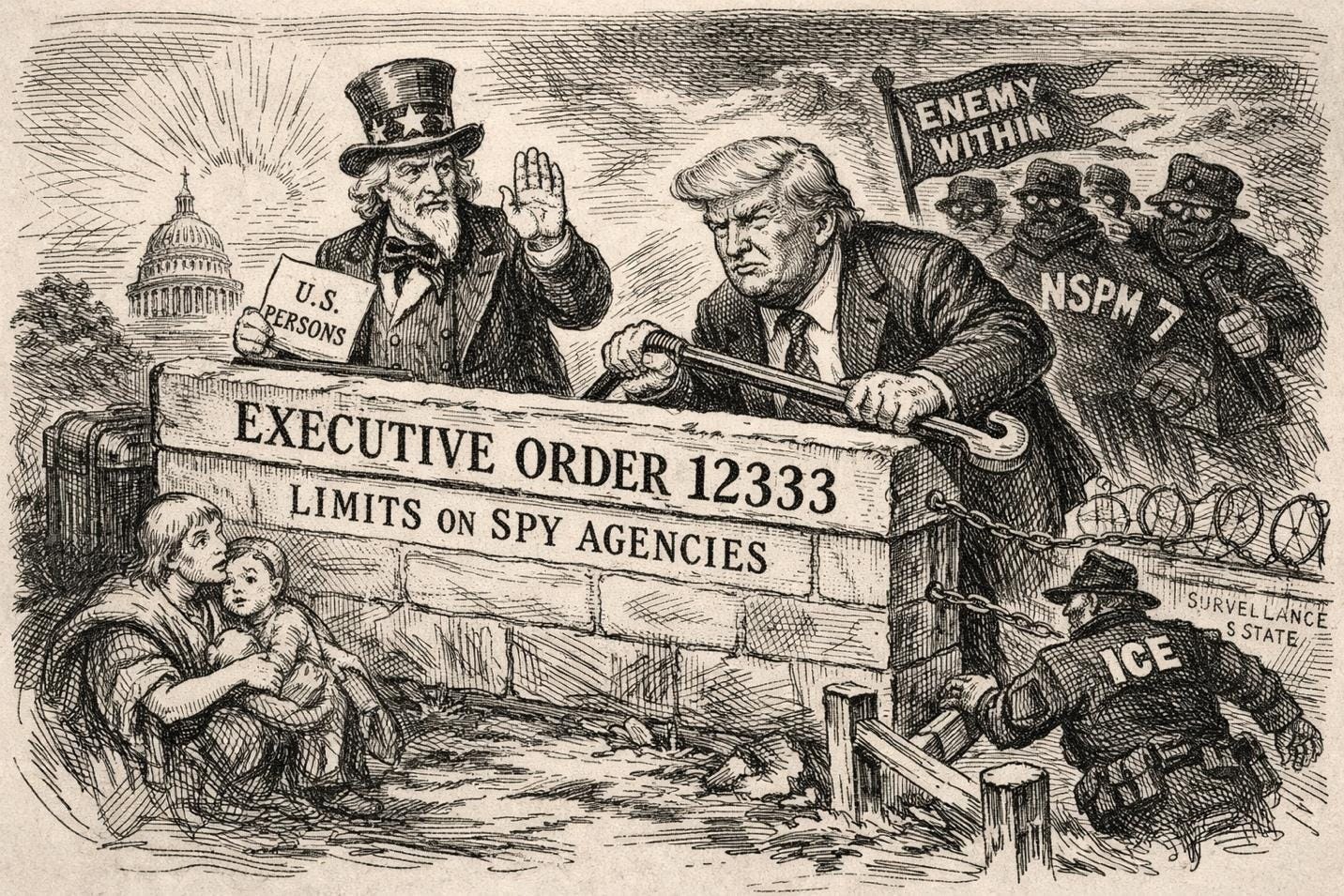
Executive Order 12333 is one of the publicly least well known, and most important, documents in American national security. First issued by President Ronald Reagan in 1981 and last substantively updated by President Barack Obama, it is the foundational directive that governs what the United States Intelligence Community may, and may not, do. It defines intelligence authorities, assigns responsibilities, and, critically, imposes binding limits. It is also a textbook example of what an executive order is actually supposed to be: a presidential directive that organizes executive branch activity within the boundaries set by law and the Constitution.
Unlike campaign rhetoric or policy memoranda, Executive Order 12333 is operational. It is relied upon daily by intelligence officers, lawyers, inspectors general, and courts. It tells intelligence agencies how they may collect, retain, analyze, and disseminate information, including detailed rules for information concerning U.S. persons. It also tells them what they cannot do.
At the center of the order is a simple but profound principle: intelligence agencies exist to collect intelligence on foreign powers and foreign threats, not to monitor Americans.
Executive Order 12333 therefore draws a sharp line around “United States persons,” a category that includes U.S. citizens, lawful permanent residents, and most U.S.-based associations and corporations. With narrow and carefully defined exceptions, the order prohibits intelligence agencies from intentionally collecting information about U.S. persons. Where incidental collection may occur, the order imposes strict rules governing minimization, retention, and use. Intelligence agencies are required to delete or destroy information about U.S. persons that does not meet specific legal criteria for retention, and even then, use is tightly constrained.
These protections did not arise by accident. They are the product of painful history. The intelligence abuses uncovered in the 1970s by the Church Committee revealed extensive domestic surveillance of civil rights leaders, political opponents, journalists, and protest movements. Executive Order 12333, along with statutes such as the Foreign Intelligence Surveillance Act, was designed to ensure that those abuses would not recur and to impose lasting legal and procedural limits on intelligence activities.
President Obama’s updates to the order reinforced those guardrails. They clarified limits on bulk collection, strengthened privacy protections, and reaffirmed that intelligence authorities exist to protect national security, not to serve partisan or ideological ends. The order was treated not as a political instrument, but as a constitutional restraint.
That is why Executive Order 12333 deserves renewed attention now.
If recent patterns hold, this order is likely to become a central battleground. President Trump has already demonstrated a willingness to disregard institutional norms, to blur distinctions between political opposition and national security threats, and to frame dissent as disloyalty. National Security Presidential Memorandum 7 (NSPM-7) is an early warning sign. In its text, it relies on established legal categories such as ‘domestic terrorism.’ But in public remarks, explaining and justifying these authorities, President Trump has repeatedly described the same targets as the ‘enemy within,’ including in meetings with senior U.S. military officials in late September 2025. His rhetoric does not merely echo the memorandum; NSPM-7 itself treats “hostility towards those who hold traditional American views” as an indicator of whether a person or group may fall within the scope of these investigative tools. The rhetorical and legal conflation of lawful counterterrorism authorities with an ideologically-defined internal enemy–a category so elastic that it effectively encompasses anyone who does not share what Donald Trump asserts are “American values”–collapses critical distinctions on which constitutional limits depend.
This is where authority meets danger.
Executive Order 12333 is the document that stands between that worldview and the machinery of the Intelligence Community. If a president wishes to turn foreign intelligence tools inward, to repurpose intelligence collection capabilities toward domestic political ends, this is the guardrail that must be weakened, reinterpreted, or removed. The order’s restrictions on collection concerning U.S. persons are not a technical detail. They are the point.
History shows how this pressure unfolds. Authoritarian systems rarely announce that they are dismantling legal limits. Instead, they redefine threats, expand exceptions, and demand loyalty from institutions designed to be neutral. Intelligence services are particularly vulnerable to this process because they operate largely in secret and, as executive agencies, are required to follow presidential direction within the bounds of the law. That is precisely why Executive Order 12333 exists, to make clear that presidential direction itself has limits.
Americans tend to focus on dramatic acts: mass arrests, overt censorship, visible repression. But democratic erosion more often begins in documents, definitions, and legal interpretations. It begins with quiet changes to authorities that most people have never heard of, but that govern immense power.
Executive Order 12333 is one of those documents. It is not glamorous. It does not trend on social media. But it is a cornerstone of the legal framework that seeks to balance security and liberty in a manner consistent with constitutional limits . If it is altered to accommodate an expansive definition of internal enemies, or if its protections for U.S. persons are weakened in the name of ideological conformity, the consequences will be profound.
That is why this order matters, and why it deserves public scrutiny now. The most important guardrails are often the ones you never hear about, until they are gone.
Steven A. Cash served as a prosecutor in the Manhattan District Attorney’s office before joining the CIA in 1994 as Assistant General counsel and subsequently serving as an intelligence officer in the Directorate of Operations. In 2001 he joined the Senate Select committee on Intelligence as Counsel and designee-staffer to Senator Diane Feinstein). He later served as a senior staffer in the House Select Committee on Homeland Security, the Department of Energy, the Senate Judiciary Subcommittee on Terrorism, Technology and Homeland Security and the Department of Energy. In the private sector he has advised on national security, counterintelligence, and technology policy and served on the Biological Sciences Experts Group under the Director of National Intelligence. Mr. Cash is currently the Executive Director of The Steady State.
Founded in 2016, The Steady State is a nonprofit 501(c)(4) organization of more than 360 former senior national security professionals. Our membership includes former officials from the CIA, FBI, Department of State, Department of Defense, and Department of Homeland Security. Drawing on deep expertise across national security disciplines, including intelligence, diplomacy, military affairs, and law, we advocate for constitutional democracy, the rule of law, and the preservation of America’s national security institutions.
Powered by WPeMatico