
Putin’s Window in Ukraine, Courtesy of Donald Trump
There is good reason to think that, before the Iran war, Russia was close to the breaking point. Sanctions and low global oil prices were squeezing Russian revenues. Russian forces were making at best incremental gains on the Ukraine battlefield, at tremendous cost: well over 1000 casualties a day in 2025, according to the Center for Strategic and International Studies. The loss of Russian access to Starlink in February helped shift the initiative to Ukraine, which began to recapture territory.
According to Russian journalist Mikhail Zygar, Putin was planning a shake-up inside the Kremlin, to include dismissing his chief Ukraine negotiator. A new team would be needed if Putin wanted to change course on Ukraine.
But the Iran war has handed Putin a lifeline. Oil prices are way up, with oil routinely selling at over $100/barrel. To keep prices down the US has waived sanctions on Russian exports. Air defense missiles that could have gone to Ukraine are being used up to defend against Iranian attacks. The cost of the war—the Pentagon has reportedly proposed a defense supplemental of $200 billion—will make the US even more reluctant to support NATO.
Relations between the US and its allies, already strained, have been shredded by a war undertaken with no American consultation with key partners in Europe and Asia. These regions are being badly hurt by oil and gas shortages. These same allies are being publicly attacked by President Trump for refusing to help; Trump and Secretary of State Rubio are now openly talking about leaving NATO altogether.
Russia is ecstatic at seeing the US once again drawn into a Middle East adventure that squanders American resources and distracts it from countering Russia. America’s lengthy wars in Iraq and Afghanistan helped Putin immensely as he consolidated power and re-built Russia’s repressive systems in the first decades of the 21st century.
Putin’s long-game strategy in Ukraine has always been to count on the West’s internal divisions. He has calculated that the US and NATO will struggle to sustain a common front, and that the US will be paralyzed by disagreements between America-firsters and those wanting to counter Russia. Russia has done all it could to widen these fissures, from massive social media campaigns to hosting Tucker Carlson in Moscow. It has manipulated Victor Orban’s Hungary into being a constant obstacle to European support for Ukraine; Hungary is now blocking a $100 million loan to Ukraine on the pretext that Ukraine is not allowing Russian oil to flow through the Druzhba pipeline. Russia is reportedly providing Iran with targeting information to use against the US.
Curious things are happening inside Russia. Major cities, including Moscow and Petersburg, have recently been experiencing prolonged interruptions in basic internet services as the state tries to force users onto MAX, a single centralized service. Russia’s complacent middle class, which up to now has been carefully insulated from the impact of the war in Ukraine, is now feeling some discomfort. Muscovites are complaining they can’t get Uber rides or order take-out. Putin seems to judge that now is a critical moment to tighten his control and further restrict access to outside information.
Is this, as Zygar suggests, in preparation for changing course and abandoning Russia’s maximalist demands? In this case Putin may fear a backlash from the militant nationalists he has whipped into a frenzy over the past four years. Recently one of his fervent supporters, Ilya Remeslo, issued a public attack on Putin that went out to his 90,000 Telegram followers, one of the services now being disrupted: “Vladimir Putin is not a legitimate president. Vladimir Putin must resign and be brought to trial as a war criminal and a thief!” Two days later Remeslo found himself in Petersburg’s Psychiatric Hospital #3.
Or, could Putin, seeing NATO divided and distracted, instead be preparing for escalation? This would require a level of mobilization that Putin has so far tried to avoid: higher taxes, rationing, conscription—sacrifices that would not spare the urban middle class. Russia and the US have been negotiating fruitlessly about Ukraine for months. Russian commentators are now warning that negotiating with America is a dangerous waste of time, pointing to how the US used its negotiations with Iran to disguise its attack.
Putin has been preparing Russia for something like this. The movie “Mr. Nobody Against Putin,” which recently won an Oscar for best documentary, shows how since the beginning of the ‘special military operation’ in 2022, Russian school-children have been bombarded with ultra-nationalist propaganda. Mandatory programs teach Russians to fear the West and hate Ukrainians. They incessantly put before young people the example of World War II, the Great Patriotic War, a time of sacrifice to the Motherland. They prepare them for military service with practice marching, weapons training, and exposure to Ukraine veterans.
Putin is consumed by visions of his historical importance that depend on winning the Ukraine war and permanently returning Ukraine to its ‘rightful place’ in the Russian empire. Thanks to Donald Trump he may now see this as within reach.
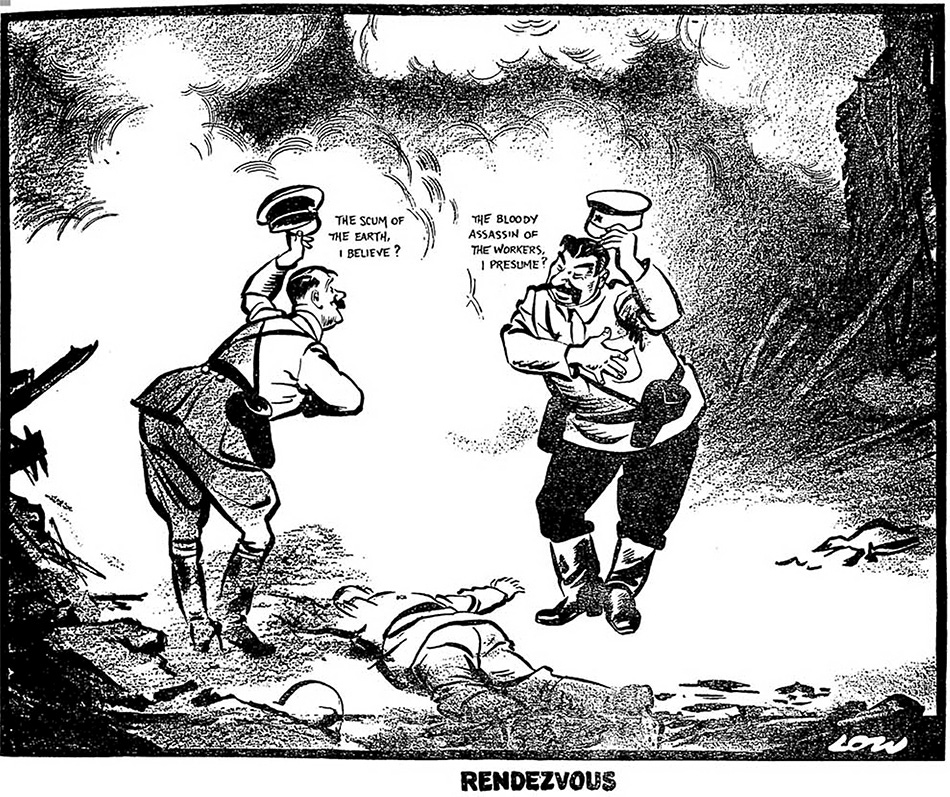
Trump and his close supporters, who have long despised Ukraine and looked up to Putin, may not be unhappy with this turn of events. Military adventurism, propaganda in schools, clamping down on dissent, and intimidating online critics are all in the Trump playbook. Putin is intent on controlling the outcome of parliamentary elections this fall, just as Trump is hoping to shape the midterms. The meeting of minds between two old enemies may not be as jarring as the infamous Hitler-Stalin rapprochement in 1939 that led to the Second World War. But it is equally shortsighted and morally bankrupt.
Adam Wasserman is a retired CIA analyst with experience on failing democracies in the former Soviet Union, the Middle East, and Southeast Asia. He served on the State Department Policy Planning Staff, the CIA Red Cell, and the National Security Council staff. He is a member of The Steady State.
Founded in 2016, The Steady State is a nonprofit 501(c)(4) organization of more than 400 former senior national security professionals. Our membership includes former officials from the CIA, FBI, Department of State, Department of Defense, and Department of Homeland Security. Drawing on deep expertise across national security disciplines, including intelligence, diplomacy, military affairs, and law, we advocate for constitutional democracy, the rule of law, and the preservation of America’s national security institutions.
Powered by WPeMatico